


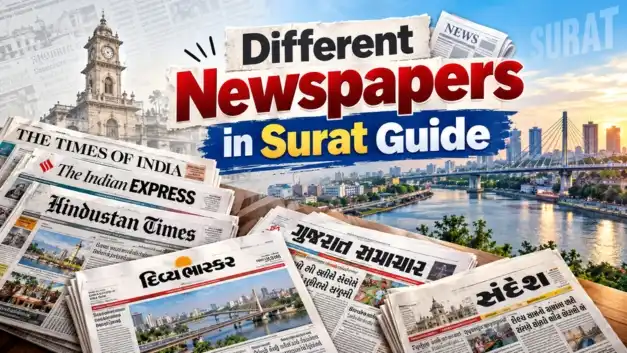
For generations, the sound of a newspaper landing outside the house has been part of the morning routine in Surat.
And Newspapers in Surat before smartphones, WhatsApp and breaking-news notifications, the newspaper was one of the first things people looked at after waking up. A cup of tea, breakfast and the morning newspaper became a familiar combination for millions of families.
But Surat’s newspaper culture has changed dramatically. Today, readers can choose between a printed newspaper, an e-paper, a news website, a mobile app, social media updates and instant breaking-news notifications.
So, what are the major newspapers available in Surat? How did newspaper culture develop? And what will happen to printed newspapers in the future?
Let’s take a look at the journey.
The History of Newspapers in India
The history of newspapers in India goes back more than two centuries. India’s first newspaper, Hicky’s Bengal Gazette, was published by James Augustus Hicky in Calcutta on January 29, 1780. The newspaper became known for its independent and sometimes critical reporting before being suppressed by the colonial authorities.
The development of newspapers gradually expanded into different Indian languages. One of the most important milestones for Gujarati journalism came in 1822, when Mumbai Samachar was founded by Fardunjee Marzban. It is regarded as the oldest continuously published newspaper in Asia.
This development eventually helped create a strong Gujarati newspaper culture across Gujarat, including Surat.
Surat’s Long Newspaper Tradition
Surat has a particularly interesting place in the history of Gujarati journalism. According to the Surat Municipal Corporation’s historical record, Surat-Mitra was started in Surat in 1863 by Dinshah Ardeshar Taliyarkhan. On September 11, 1864, it was renamed Gujarat-Mitra.
Today, Gujarat Mitra is considered one of India’s oldest newspapers and continues to be associated closely with Surat. The Gujarati Vishwakosh records its establishment on September 15, 1863, initially as Surat-Mitra, before the name changed to Gujarat-Mitra the following year.
This is one reason Surat’s newspaper culture is more than just a modern business. It is connected with the city’s social and cultural history.
Major Types of Newspapers Read in Surat
Readers in Surat have access to newspapers covering local, Gujarat, national and international news.
Some of the important categories include:
1. Gujarati Newspapers
Gujarati newspapers remain extremely important in Surat because they provide local news in the language most comfortable for a large section of the city’s population.
Major Gujarati newspaper brands available in Surat include:
- Gujarat Mitra – One of Surat’s oldest newspaper institutions.
- Gujarat Samachar – A major Gujarati daily with a Surat edition.
- Sandesh – One of Gujarat’s established Gujarati newspapers with Surat coverage.
- Divya Bhaskar – A major Gujarati daily with a Surat edition.
- NavGujarat Samay – A Gujarati news publication covering Gujarat and wider developments.
- Other regional and local publications – Surat also has smaller newspapers and local publications focused on specific communities, areas and subjects.
Government and institutional records also show Surat editions of newspapers such as Gujarat Samachar, Sandesh and Divya Bhaskar, along with Gujarat Mitra and other regional publications.
2. English Newspapers
Surat also has readers who prefer English newspapers, particularly students, professionals, business owners and readers interested in national and international developments.
The Times of India and Hindustan Times maintain dedicated Surat city coverage, with stories covering Surat’s civic issues, business, crime, education, weather and other local developments.
English newspapers generally offer a combination of city, national, business, sports, technology and international coverage.
3. Local and Community Newspapers
Another part of Surat’s newspaper ecosystem is the smaller local newspaper.
These publications may focus more heavily on:
- Municipal issues
- Local politics
- Community activities
- Crime
- Education
- Business
- Local events
- Public notices
- Neighbourhood-level developments
For many readers, hyperlocal information can be more relevant than national headlines.
What Makes a Surat Newspaper Different?
A newspaper is not simply a collection of headlines. For a city like Surat, local newspapers often act as a daily record of the city’s development.
A reader may open the paper and find news about:
- Surat Municipal Corporation
- Traffic and roads
- Textile markets
- Diamond industry
- Surat airport
- Surat railway station
- Schools and universities
- Local businesses
- Crime and police cases
- Weather and rainfall
- Government announcements
- Cultural and religious events
- Property and public notices
This local connection is one reason newspapers continue to have a place in Surat even in the smartphone era.
The Traditional Surat Morning Routine
There was a time when the newspaper was almost a household ritual.
The newspaper boy delivered several papers early in the morning. Someone at home would pick up the newspaper, make a cup of tea and begin reading. One family member might read the front page. Another might immediately turn to business news. Students could look at education and career information. Older readers might spend more time with politics, editorials or local news. And the sports pages often had their own loyal readers.
The newspaper was not just information. It was part of the morning rhythm of the household.
What Has Changed in Today’s Newspaper?
The biggest change is speed.
A printed newspaper is prepared hours before it reaches the reader. Digital news can be updated within minutes. For example, if heavy rain starts in Surat at 7 a.m., people do not necessarily wait until the next morning to know what happened.
They may receive:
Breaking News – Mobile Notification – WhatsApp Update – Website Story – Video – Social Media Post
The same news can now reach the reader through several formats. This has changed the role of newspapers from being the only source of information to becoming one part of a much larger news ecosystem.
From Newspaper to E-Paper
One of the biggest bridges between traditional journalism and digital media is the e-paper. An e-paper is essentially a digital version of the printed newspaper. Readers can open the newspaper on a smartphone, tablet or computer and read the pages electronically.
Major Gujarati newspapers now provide digital editions alongside their websites and apps. For example, the Gujarat Samachar app offers breaking news, local coverage, e-paper editions, videos and other digital features, including a dedicated Surat edition. This gives traditional newspaper readers a familiar newspaper-style experience without needing a physical copy.
Newspaper Apps: News in Your Pocket
Mobile apps have changed news consumption even further. Instead of waiting for tomorrow’s newspaper, readers can receive notifications throughout the day.
A typical news app can provide:
- Breaking-news alerts
- Surat city news
- Gujarat news
- India news
- International news
- Videos
- Photo stories
- E-paper
- Live updates
- Weather information
- Business and market news
The smartphone has effectively turned the newspaper into something people can carry everywhere.
News Websites and the Rise of 24-Hour Journalism
News websites have created another major change. A printed newspaper generally has a fixed daily cycle. A website does not. A story can be published in the morning, updated in the afternoon and followed by another development in the evening.
This is particularly important for a fast-growing city like Surat, where developments in infrastructure, business, weather, traffic and civic administration can change quickly.
Digital-first news platforms have therefore created a new habit: people no longer consume news only once a day. They check it repeatedly.
Social Media Has Changed How People Discover News
Today, many people do not directly open a newspaper website.
They discover news through:
- YouTube
- Google Discover
- Search engines
- News notifications
A newspaper story can therefore begin as a printed article but eventually appear as a short video, social media post, infographic or mobile notification.
The format has changed, but the basic purpose remains the same: informing people about what is happening around them.
Print vs Digital Newspaper
| Feature | Printed Newspaper | Digital Newspaper |
|---|---|---|
| Delivery | Once a day | 24/7 |
| Updates | Next edition | Immediate |
| Reading device | Physical paper | Mobile, tablet or computer |
| Videos | No | Yes |
| Notifications | No | Yes |
| Search | Manual | Instant |
| Archive | Physical copies | Digital archives |
| Local coverage | Strong | Strong and continuously updated |
| Convenience | Familiar reading experience | Available anywhere |
Neither format completely replaces the other. Some readers still love the feeling of holding a newspaper, while others prefer receiving news directly on their phone.
Why Newspapers Still Matter in 2026
In 2026, newspapers are no longer competing only with other newspapers. They are competing with an entire digital information ecosystem. Yet trusted journalism remains important.
The internet has made information faster, but it has also made misinformation easier to spread. A forwarded WhatsApp message can reach thousands of people before anyone verifies it. This makes professional reporting, fact-checking and responsible journalism even more important.
For local news, this is especially significant because a verified report about a Surat civic issue can be much more useful than an unverified social-media claim.
The Future of Newspapers in Surat
The future of newspapers is unlikely to be simply “print versus digital.” Instead, the two formats are likely to work together.
The newspaper of the future may combine:
Print + Website + E-Paper + Mobile App + Video + Social Media + AI + Personalised News
Artificial intelligence may also influence how newsrooms work. AI can help journalists analyse large amounts of information, translate content, identify trends, generate summaries and personalise news delivery. But human journalism will remain important for reporting from the ground, verifying information, understanding context and making ethical decisions.
For Surat readers, this could mean a more personalised news experience. Instead of receiving the same newspaper as everyone else, a reader may receive a morning briefing focused on Surat traffic, weather, business, education and local developments that matter most to them.
The Newspaper May Change, But the Need for News Will Not
The newspaper has travelled a remarkable distance, from printed sheets and hand-set type to smartphones, e-papers and instant notifications.
Surat’s own newspaper history reflects this transformation. From the historic Gujarat Mitra tradition to today’s Gujarati and English newspapers, websites and apps, the city has continuously adapted to changing ways of consuming information.
Perhaps the biggest change is not that people have stopped reading newspapers.
Also read, Surat Fake Edible Oil Factory Busted: ₹20.30 Lakh Stock Seized
Watch Latest News Videos on KRH News: Click Here