


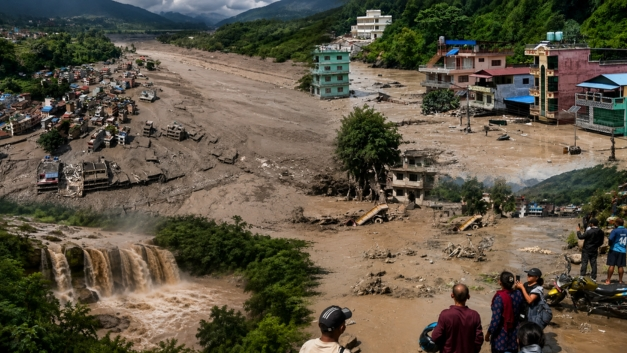
Nepal floods 2026: A devastating flash flood struck northern Nepal on Wednesday, August 26, 2026, causing widespread destruction in the Himalayan region near the Nepal-Tibet border. At least nine people have been reported dead, while hundreds of people, including foreign travellers, remain missing as rescue teams continue their operations.
The disaster has affected villages, roads, bridges, vehicles and hydropower infrastructure, with the Rasuwa district among the worst-hit areas. Authorities have warned people living near rivers to move to safer locations as rescue and damage-assessment operations continue.
Flash Flood Hits Nepal’s Bhote Koshi River Region
The flash flood affected areas around the Bhote Koshi River, which flows from Tibet into Nepal.
According to preliminary assessments cited by disaster experts, an ice-rock avalanche or rock-ice avalanche may have blocked the Lhende Khola River before a sudden release of water triggered the devastating flood. A possible 4.4-magnitude earthquake has also been mentioned in early assessments, although investigations into the exact chain of events are continuing. Videos and images from the affected areas showed torrents of muddy water and debris moving through mountain settlements, sweeping away buildings, vehicles and infrastructure.
Hundreds of People Reported Missing
The scale of the disaster became clearer as authorities began receiving reports of missing people.
Reuters reported that at least 384 travellers were unaccounted for, including nationals from India, the United States, the United Kingdom and South Korea. Many of those affected were travelling through the Himalayan region.
Indian media reports have also highlighted the disappearance of Indian travellers, adding concern among families waiting for information about relatives who were in Nepal or travelling towards the Tibet region. The number of missing people could change as authorities continue to verify reports and establish communication with isolated areas.
Roads and Bridges Washed Away
The flash flood has caused significant damage to transportation infrastructure. Several roads and bridges were damaged or completely washed away, making it difficult for rescue teams to reach some affected locations. The destruction of road links has also disrupted movement along important routes connecting Nepal with the Tibet border. Authorities have issued warnings for several districts, including Rasuwa, Nuwakot, Dhading, Chitwan and Gorkha, because of the continuing flood threat around river systems.
Nepal Army and Security Forces Begin Rescue Operations
The Nepal Army, Armed Police Force and Nepal Police have been deployed for rescue and relief operations.
Helicopters have been used to reach areas that became difficult to access by road. Authorities are prioritising the search for missing people, evacuation of residents from vulnerable areas and assessment of damage to infrastructure. Rescue efforts remain challenging because of damaged roads, unstable terrain and the possibility of further landslides and flooding.
Hydropower Infrastructure Also Damaged
The disaster has also affected Nepal’s electricity infrastructure. The Nepal Electricity Authority said around 430 MW of production capacity, including hydropower and solar facilities, had been damaged, along with transmission and distribution infrastructure. The damage has resulted in disruptions to electricity supplies in affected areas. The impact on hydropower is significant because Nepal relies heavily on hydropower for electricity generation and the affected region contains important energy infrastructure.
Heavy Rainfall Adds to Flood Risk
The flash flood comes during Nepal’s annual monsoon season, when heavy rainfall regularly increases the risk of floods, landslides and other disasters.
Nepal’s Meteorological Forecasting Division had reported continued monsoon activity across the country, with moderate rainfall and thunderstorms expected in several areas, including parts of Koshi, Bagmati and Gandaki provinces.
Earlier in August, Nepal had already recorded significant losses from monsoon-related disasters. According to the Kathmandu Post, at least 85 people had died in floods, landslides, lightning and other monsoon-related incidents between April 14 and August 14, 2026.
China Also Reports Major Impact Near Border
The disaster has also affected areas on the Chinese side of the Nepal-Tibet border. Chinese state media reported major casualties and disruption around Gyirong Port, an important border trade point. China has deployed hundreds of rescue personnel, while authorities have warned of mudslide risks and unsafe roads in affected areas.
Officials are also concerned about the possibility of another flood if an upstream blockage remains unstable.
What Happens Next?
Rescue teams are continuing to search for missing people while authorities assess the full extent of the damage.
With several roads blocked and communication disrupted in some areas, the final death toll and number of missing people could change as teams reach more affected locations. The disaster has once again highlighted the vulnerability of Himalayan communities to flash floods, landslides and other extreme weather events.
For now, authorities are urging people living near rivers and vulnerable slopes to remain alert, follow evacuation instructions and avoid travelling through dangerous areas.
Nepal Flood 2026: Key Facts
| Detail | Information |
|---|---|
| Date | August 26, 2026 |
| Country | Nepal |
| Worst-Affected Area | Rasuwa and northern Himalayan region |
| River | Bhote Koshi / Lhende Khola system |
| Deaths | At least 9 reported |
| Missing | Hundreds; Reuters reported 384 travellers unaccounted for |
| Cause Under Investigation | Possible ice-rock avalanche and river blockage |
| Major Damage | Roads, bridges, homes, vehicles and hydropower infrastructure |
| Rescue Agencies | Nepal Army, Nepal Police and Armed Police Force |
| Weather Factor | Active monsoon and heavy rainfall |
Figures are developing and may change as rescue teams verify information.
Also read, Vadodara Plans Four New Flyovers to Ease Traffic at Key Junctions
Watch Latest News Videos on KRH News: Click Here