


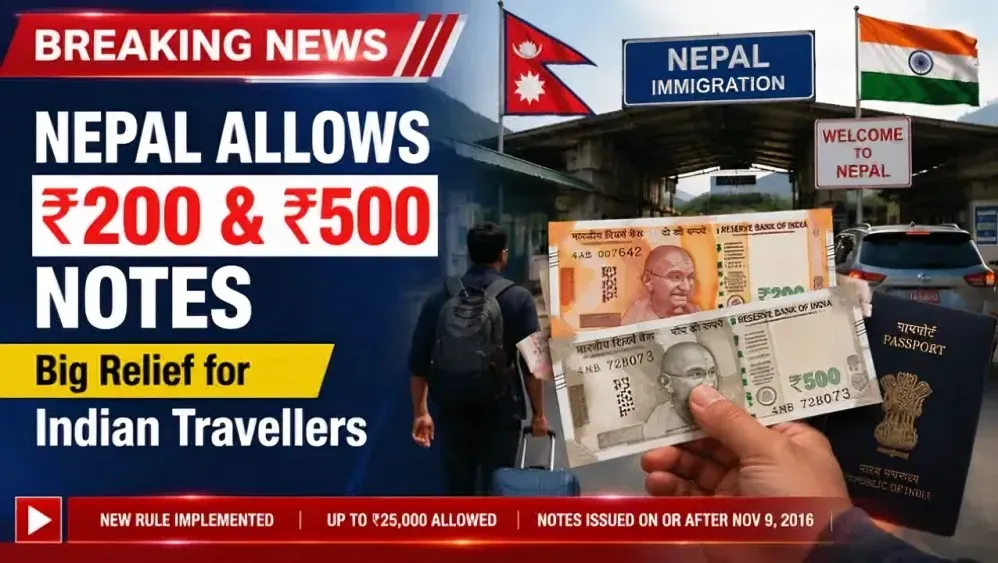
KATHMANDU, July 2026 – In a major relief for Indian travellers, pilgrims, and cross-border traders, Nepal has officially allowed the use and movement of Indian ₹200 and ₹500 Indian notes, ending a restriction that had effectively remained in place since India’s 2016 demonetisation. The new rule is expected to make travel and trade between the two neighbouring countries much smoother.
The decision has been implemented by the Nepal Rastra Bank (NRB) and permits both Indian and Nepali citizens to carry specified Indian currency notes subject to prescribed limits.
What Has Changed?
Under the revised rules:
- Indian and Nepali citizens can now carry ₹200 and ₹500 Indian currency notes.
- Only notes issued on or after November 9, 2016 are permitted.
- The total value of these notes must not exceed ₹25,000 per person.
- The rule applies while entering or leaving Nepal in accordance with existing regulations.
Why Were ₹200 and ₹500 Notes Restricted?
Following India’s demonetisation in November 2016, Nepal had stopped permitting higher-denomination Indian currency notes because new rules governing their circulation had not yet been formalised. For years, Indian visitors were effectively limited to carrying Indian notes of ₹100 denomination or lower, creating inconvenience for tourists, business travellers, and pilgrims.
Major Relief for Indian Tourists after the Ban on ₹ 200 and ₹ 500 Indian Notes
The latest decision is expected to significantly benefit:
- Indian tourists visiting Nepal
- Pilgrims travelling to Pashupatinath and Muktinath
- Cross-border traders
- Nepali citizens engaged in business with India
- Border residents who frequently travel between the two countries
Using ₹200 and ₹500 notes will reduce dependence on currency exchange for routine expenses and simplify cash transactions during travel.
₹25,000 Limit Still Applies
While the restrictions have been relaxed, Nepal has retained the maximum permissible limit.
Travellers can carry:
- ₹200 and ₹500 notes
- Maximum combined value of ₹25,000
- Only post-November 2016 series notes
Authorities have advised travellers to comply with all customs and banking regulations while carrying Indian currency.
What About Other Foreign Currency?
Apart from Indian currency, Nepal continues to allow visitors to carry other foreign currencies under its existing customs regulations. The revised notification specifically addresses the movement of Indian ₹200 and ₹500 banknotes.
Strong India–Nepal Economic Ties
India and Nepal share an open border, extensive trade relations, and deep people-to-people connections. Every year, millions of travellers cross the border for tourism, religious visits, education, employment, and commerce.
Financial experts believe the latest move will:
- Improve tourism flows
- Support border trade
- Simplify cash transactions
- Strengthen bilateral economic cooperation
Nepal’s decision to permit ₹200 and ₹500 Indian currency notes after nearly a decade marks a significant easing of cross-border travel rules. While the ₹25,000 carrying limit remains unchanged, the revised regulation is expected to benefit millions of Indian tourists, pilgrims, traders, and Nepali citizens who regularly travel between the two countries.
Also read, Indian Organ Donation Day 2026: Gujarat Sees Remarkable Rise in Organ Donation, Yet Ranks 7th Nationwide
Watch Latest News Videos on KRH News: Click Here