


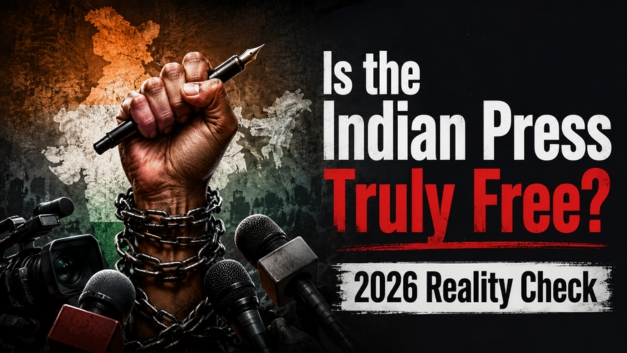
Is the Indian Press Truly Free? We will find out in this blog article. The fundamental question regarding the operational freedom of the fourth pillar of democracy in India has once again taken center stage globally. For years, the domestic media landscape has oscillated between hyper-partisan cheerleading and independent investigative journalism. However, the release of the 2026 World Press Freedom Index alongside highly publicized diplomatic stand-offs has converted structural concerns into an unignorable democratic crisis.
As citizens increasingly question the objectivity of the news hitting their screens, international watchdogs have explicitly sounded the alarm. The dynamic has shifted from a subtle domestic transformation into a matter of global scrutiny.
The 2026 World Press Freedom Index: India’s Alarming Decline
According to the annual comprehensive report published by the global journalism watchdog Reporters Sans Frontières (RSF), India’s ranking has experienced another significant decline.
The Statistical Reality of Media Freedom
| Evaluation Year | India’s Global Ranking (Out of 180 Countries) | Primary Structural Drivers |
| 2024 | 159th | Concentration of corporate media ownership |
| 2025 | 151st | Intermittent use of anti-terror laws against reporters |
| 2026 | 157th | Severe legal actions, tax raids, and global unscripted media blocks |
The 2026 Index positions India at a lowly 157th rank, slipping six places down from the previous year. To place this data point in an even more sobering context, India currently ranks below several of its neighboring South Asian nations, including Pakistan (153rd), Bhutan (150th), and Nepal (87th). The metrics clearly indicate that the operational ecosystem for unscripted journalism in India is severely shrinking.
The Norway Incident: A Microcosm of Unscripted Press Avoidance
The underlying systemic friction exploded into an international embarrassment during Prime Minister Narendra Modi’s official state visit to Europe in mid-May 2026.
The Face-off with Helle Lyng Svendsen
While attending a joint diplomatic briefing alongside Norwegian Prime Minister Jonas Gahr Støre in Oslo, PM Modi delivered his scheduled bilateral statement and prepared to leave the room without opening the floor to journalist interactions.
“Prime Minister Modi, why don’t you take some questions from the freest press in the world? Do you deserve the trust of our government?”
Instead of answering, PM Modi walked out of the conference hall without offering a response, leaving his diplomatic delegation to manage the fallout. Later that same day, when Svendsen questioned Sibi George, India’s Ministry of External Affairs Secretary (West), regarding minority human rights and democratic erosion, the Indian official defensively dismissed her research, stating that foreign reporters rely on “one or two reports published by some god-forsaken, ignorant NGOs.”
The “Regrettable Fact”: 12 Years Without an Open Press Conference
The face-off in Oslo prompted a swift and severe condemnation from the Editors Guild of India (EGI). In an official public release, the EGI characterized the interactions as “embarrassing” and criticized the Indian government’s rising intolerance toward institutional questioning.
The press body noted a “regrettable fact”: throughout his 12-year tenure in the Prime Minister’s Office, Narendra Modi has never hosted a single open, unscripted press conference on domestic soil. Media interactions have been strictly confined to highly curated, pre-screened television interviews conducted by friendly channels or popular YouTubers who avoid pressing topics.
Mechanisms of Control: How Press Freedom is Restrained
The RSF analysis highlights that the decline of independent journalism in India is driven by three distinct pillars of institutional and financial pressure:
1. Weaponization of National Security Laws
Independent local news outlets and regional journalists are increasingly subjected to judicial harassment. Anti-terror laws like the Unlawful Activities Prevention Act (UAPA) and severe provisions of the Telecommunications Act are routinely invoked to place investigative reporters into prolonged “provisional” detentions without immediate bail.
2. Corporate Media Consolidation
The economic backbone of mainstream Indian journalism has fallen into an “unofficial state of emergency.” Massive corporate conglomerates close to the ruling party have acquired formerly independent television networks- exemplified by the high-profile acquisition of NDTV by the Adani Group. This economic centralization forces newsrooms to prioritize corporate interests over raw accountability.
3. Coordinated Online Harassment
Journalists who write critical reports are immediately targeted by highly organized, politically backed digital troll networks. These campaigns frequently involve leaking personal contact information, issuing rape threats to female reporters, and filing coordinated criminal defamation cases across multiple states to drain the financial resources of independent writers.
Conclusion: The Path Forward for Independent Journalism
A democracy cannot breathe healthily if its media is systematically treated as an adversary. While the government frequently dismisses international indices as western bias, the ground reality faced by regional reporters in Kashmir, central tribal belts, and independent newsrooms confirms a deep systemic issue.
For platforms like KRH News and other emerging independent digital publications, our primary duty remains clear: upholding uncompromised, unbiased reporting. True democratic power lies not in avoiding questions, but in having the institutional courage to answer them transparently.
Also read, 2026 Mega Highway Projects in India: Tunnels, Roads and Bridges
Watch Latest News Videos on KRH News: Click Here