


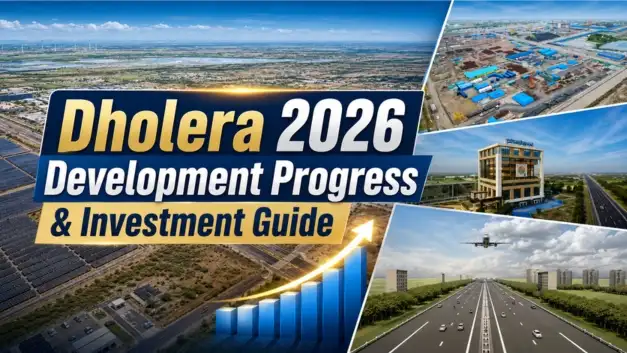
DHOLERA: Rising from the salt flats of the Gulf of Khambhat, the Dholera Special Investment Region (DSIR) has officially transitioned from a visionary blueprint into India’s most technologically advanced industrial metropolis.
Spanning a massive 920 square kilometers, Dholera is structurally engineered to be larger than Singapore and twice the size of Mumbai. As a flagship node of the Delhi-Mumbai Industrial Corridor (DMIC), the year 2026 marks a historic turning point for the smart city, with key anchor industries beginning commercial production and critical connectivity corridors opening up to the public.
For global industrialists, tech firms, and real estate investors, Dholera is no longer a future possibility- it is an active, rapidly scaling reality.
1. The Genesis: Understanding the History and Master Plan
The concept of Dholera was envisioned in 2009 by Narendra Modi during his tenure as the Chief Minister of Gujarat. The goal was simple yet audacious: build a greenfield smart city from scratch that could outpace global manufacturing hubs.
Architecturally designed by the world-renowned firm AECOM, Dholera’s master plan divides the region into six distinct Town Planning (TP) schemes. Unlike traditional Indian cities that grew organically and suffered from infrastructure bottlenecks, Dholera utilizes a “plug-and-play” underground utility model. This means that ICT networks, storm-water drains, potable water lines, sewage systems, and industrial gas pipelines are pre-laid beneath the roads, entirely eliminating the need for future road digging.
2. Dholera 2026: Major Live Infrastructure Updates
The year 2026 has brought monumental progress to Dholera’s core connectivity and industrial ecosystem, firmly establishing it as a global manufacturing powerhouse.
The Ahmedabad-Dholera Expressway (NH-751)
The highly anticipated 109-km, 4-lane (expandable to 8-lane) access-controlled expressway linking Ahmedabad to Dholera is now fully operational. This infrastructure milestone has slashed travel times between the two manufacturing cities from over two and a half hours to just under 60 minutes. The expressway features dedicated corridors for heavy freight, instantly unlocking logistical efficiency for the region’s industries.
Dholera International Airport (Navagam)
Construction at the Navagam international cargo and passenger airport is moving at an aggressive pace. The 3.2-kilometer primary runway is structurally complete, and construction on the main passenger and cargo terminal buildings is entering its final stages. Slated to manage the spillover cargo traffic from Ahmedabad and Mumbai, the airport is on track to handle its first commercial cargo flights by early 2027.
3. The Semiconductor Capital: Anchor Industries Take Shape
Dholera’s biggest claim to fame in 2026 is its emergence as the undisputed crown jewel of India’s semiconductor mission.
Tata-PSMC Semiconductor Fabrication Plant
Spanning a massive manufacturing zone within the Activation Area, Tata Electronics, in partnership with Taiwan’s Powerchip Semiconductor Manufacturing Corporation (PSMC), is aggressively advancing its ₹91,000-crore semiconductor fab facility. The main cleanroom structures are complete, and advanced lithography and wafer manufacturing equipment installations are underway. The plant is firmly on target to roll out India’s first domestically produced, commercial-grade microchips by the end of 2026, creating over 20,000 high-tech jobs.
Clean Energy and Renewables Hub
To power these massive, power-hungry chip manufacturing plants, Dholera is integrating a 5,000 MW Ultra Mega Solar Park. Massive arrays of solar modules are already feed-in operational, ensuring that multinational manufacturing entities operating within the DSIR can claim 100% green energy compliance for their global supply chains.
4. Smart City Infrastructure and the Future Expansion
Dholera is governed by a central digital brain – the ABCD Building (Administration and Business Centre for Dholera). This structure houses the central command and control center, which uses real-time IoT sensors to manage city traffic, optimize automated water distribution, and run smart waste management operations across the completed Activation Zone.
The 2030 Expansion Horizon
With the 22.5 sq. km Activation Zone (TP 2A) fully occupied by heavy industries, electronic manufacturers, and logistics firms, urban planning bodies are now opening up Town Planning Schemes 3 and 4. These future expansion zones are meticulously designated for high-density residential layouts, international universities, multi-speciality medical zones, and commercial financial districts designed to house the incoming white-collar workforce.
5. Dholera Investment Guide: How to Invest Wisely
The convergence of operational connectivity and global industrial anchors has triggered an unprecedented real estate boom. However, investing in Dholera requires a calculated, strategic approach.
Top Micro-Markets to Watch
- The Activation Zone Boundary: Lands immediately bordering the industrial zones are highly prized for commercial developments, worker housing complexes, and logistical warehouses.
- Expressway Corridors: Commercial plots along the NH-751 expressway are seeing heavy capital appreciation due to their high visibility and direct regional connectivity.
- Inside vs. Outside SIR: Investors must carefully verify whether a property sits inside the officially demarcated boundary managed by the Dholera Industrial City Development Limited (DICDL) or outside in the surrounding agricultural buffer zones under SUDA regulations.
Key Advisory for Genuine Investors
Because Dholera is a heavily regulated smart city, investors must meticulously check for RERA approvals, clear land titles, and NA (Non-Agricultural) use permissions before executing any land purchase. Focus on institutional-grade developers offering clear boundary demarcations and internal road connectivity to avoid long-term litigation or zoning bottlenecks.
Also read, Surat 2030 Master Plan: Top Upcoming Mega Projects Transforming the City
Watch Latest News Videos on KRH News: Click Here