


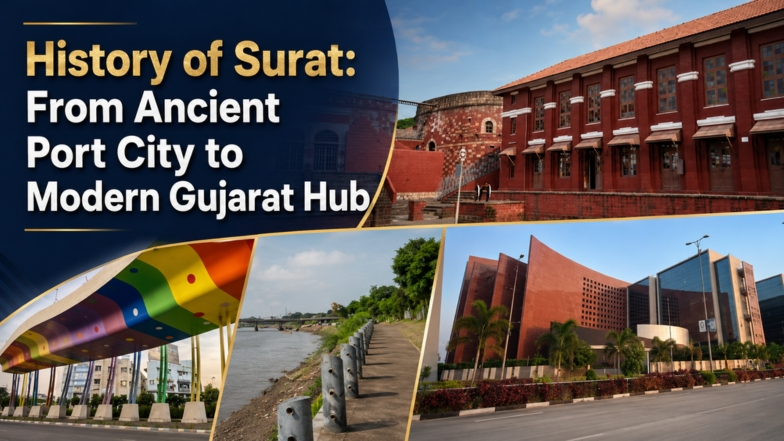
History of Surat: Surat is today known for diamonds, textiles, business and rapid urban development, but the city’s story began long before its modern industrial identity. Situated on the banks of the Tapi River and close to the Arabian Sea, Surat developed into one of western India’s most important trading centres and ports.
Over centuries, Surat witnessed the rise of the Gujarat Sultanate, Mughal rule, European trading companies, Maratha attacks and British administration. Its importance later declined as Bombay emerged as a dominant western Indian port, but Surat reinvented itself through textiles, diamond processing, manufacturing and trade.
Today, Surat stands as one of Gujarat’s major economic centres—but its modern success is deeply connected to the city’s centuries-old trading culture.
Updated: August 25, 2026
Location: Surat, Gujarat, India
Topic: Surat History, Heritage & Development
Surat at a Glance
| Fact | Details |
|---|---|
| State | Gujarat |
| River | Tapi (Tapti) |
| Region | Western India |
| Coast | Arabian Sea |
| Historical Name | Suryapur / Surat |
| Municipality Established | 1852 |
| Municipal Corporation | 1966 |
| Major Modern Industries | Textiles, diamonds, trade, manufacturing |
| Historic Importance | International maritime trade |
| Major Heritage Landmark | Surat Castle/Fort |
The Surat Municipal Corporation describes the city as one of India’s dynamic urban centres and identifies textiles, diamonds and trade among the sectors that have shaped its economy.
How Old Is Surat?
The history of Surat is complex because references to the wider region and the present-day city do not always point to exactly the same period.
The Surat Municipal Corporation states that the city’s history dates back to around 300 BC, while the Government of India’s tourism portal describes Surat as a city with more than 600 years of recorded urban history and identifies its development as a major city from the 15th century onward.
The District Surat administration notes that Surat was previously known as Suryapur and records historical references connected with the region extending much further back. This distinction is important: ancient references to the broader area should not automatically be treated as proof that the modern city existed in exactly its present form at that time.
Surat’s Early History and the Name Suryapur
One of the historical names associated with Surat is Suryapur.
According to the Gujarat government’s history of Surat, the name Suryapur appears in historical and Jain literary references, while the name Surat became established in historical records from around the middle of the 15th century.
The city’s location played a major role in its development.
The Tapi River provided access to the interior while the nearby Arabian Sea connected Surat with maritime trade routes.
That geographical advantage would eventually transform Surat into an international trading centre.
Surat Under the Gujarat Sultanate
During the medieval period, Surat came under the influence of different rulers and administrations in the Gujarat region.
The Gujarat government’s historical account records the involvement of the Gujarat Sultanate in the development and administration of Surat and nearby Rander. Malik Gopi, a prominent figure associated with the city’s history, is credited with expanding parts of the settlement and developing areas including Gopipura.
The city gradually became more important as trade expanded along Gujarat’s western coastline. Its strategic location made it valuable not only for commerce but also for rulers seeking control over maritime routes.
Surat Becomes an Important Port City
The 16th century marked a major turning point in Surat’s history. European traders were increasingly interested in India’s western coast, and Surat’s port became an important gateway for international commerce.
A Portuguese traveller, Duarte Barbosa, described Surat in 1514 as a major trading city and important seaport visited by ships from Malabar and other ports, according to the Surat Municipal Corporation’s historical documentation. This period was not peaceful.
Portuguese attacks reportedly damaged the city in the early 16th century. Following repeated attacks, the Gujarat authorities strengthened Surat’s defences. This eventually led to the construction of the Surat Castle, one of the city’s most important surviving historical landmarks.
Surat Fort: The Fortress That Protected a Trading City
The Surat Fort was built as a defensive structure to protect the city against attacks.
The fort’s history reflects Surat’s changing political landscape. Its architecture contains influences associated with different periods, including the Tughlaq, Gujarat Sultanate, Mughal, Dutch and British eras.
The fort was not simply a military structure. It was closely connected to the protection of Surat’s citizens, merchants and trading activities. Today, the restored fort provides a physical connection to the period when Surat was one of the most important ports on India’s western coast.
Surat Under the Mughals
The Mughal period was arguably one of the most prosperous chapters in Surat’s history.
After the Mughal conquest of Gujarat, Surat became increasingly important within the empire’s international trading network.
The Gujarat government’s historical account says that Surat experienced significant growth in population, area, trade relations and prosperity during the Mughal era. The city became a major port for ships travelling towards the Red Sea and the pilgrimage routes to Mecca. This gave Surat importance not only as a commercial centre but also as a major point of departure for pilgrims.
Surat: A Gateway to the World
During its golden period, Surat attracted merchants and traders from different parts of the world.
European trading communities established commercial operations in the city, while merchants from other parts of Asia and the Middle East also participated in its trade. The Government of India’s tourism portal describes medieval Surat as a major centre of global trade that attracted merchants from Europe, Africa, Arabia and Southeast Asia. This international character helped make Surat one of the most cosmopolitan commercial cities in western India.
The British Arrive in Surat
Surat occupies an important place in the history of European involvement in India. The English East India Company established a trading presence in Surat in the early 17th century.
The Surat Municipal Corporation records 1612 as the year when the British established a kothi, or trading centre, and states that Thomas Roe obtained trading rights for the East India Company after meeting Mughal Emperor Jahangir in 1614.
The English were not the only European traders interested in Surat. The Portuguese, Dutch and French also had commercial interests in the city.
Why Was Surat So Important to European Traders?
Surat offered European companies access to India’s western trade networks.
Goods moving through the region included textiles and other valuable commodities, while the port connected Indian merchants with overseas markets. The English East India Company initially made Surat one of its most important bases in India.
Historical accounts record the English-P portuguese naval confrontation near Surat in 1612, after which English commercial prospects in the city improved significantly. This was a crucial moment in the early history of the English East India Company’s expansion in India.
Surat and Chhatrapati Shivaji Maharaj
Surat’s wealth also made it a target during periods of political conflict. Chhatrapati Shivaji Maharaj attacked Surat in the 17th century.
The Gujarat government’s history records two major attacks, in 1664 and 1678, and notes that the city’s prosperity suffered during the Maratha period. The attacks demonstrated both the wealth of Surat and the vulnerability of a major trading city during periods of political instability.
The Decline of Surat’s Port
Surat’s decline did not happen overnight. vSeveral factors gradually weakened its position. Political instability, attacks, changing trade patterns and competition from other ports all affected the city’s importance. The rise of Bombay (Mumbai) was particularly significant.
As Bombay developed into a major British-controlled port, commercial activity increasingly shifted there. Surat’s traditional maritime importance declined, and its shipbuilding industry also suffered. This was one of the biggest turning points in Surat’s history.
Surat Under British Rule
British control expanded over Surat during the late 18th and early 19th centuries.
The Surat Municipal Corporation’s historical record identifies 1759 as an important year in the transfer of control from the Mughals to the British, while its timeline records further British consolidation by 1800. British administration brought new institutions and infrastructure.
Some of the major developments included:
- Municipal administration
- Schools
- Printing
- Telegraph communication
- Railway connectivity
- Roads
- Public institutions
The first meeting of Surat’s municipality took place in 1852.
Surat Railway and the Beginning of a New Era
Rail connectivity changed Surat’s economic possibilities. The city’s official historical timeline records the erection of Surat Railway Station in 1860, while the Gujarat government’s historical account notes Surat’s railway connection in the 1860s.
Railways helped connect Surat more efficiently with inland markets. This was particularly important because Surat’s economic future would gradually become less dependent on its traditional port and more connected to land-based trade and industry.
Surat’s Role in Social Reform and Education
Surat’s history is not only about trade. The city also played a role in Gujarat’s social, educational and literary development. The Gujarat government’s historical account highlights the contributions of figures such as Durgaram Mehta and Narmad, along with other writers and reformers connected with Surat.
The city also saw the establishment of educational institutions and libraries during the 19th century. For example, the Andrews Library opened in 1850, and Surat’s municipal administration was formally established in 1852.
Surat and India’s Independence Movement
Surat also has an important place in India’s freedom movement. The city hosted the famous Indian National Congress session of 1907, remembered for the split between the Moderates and Extremists within the Congress.
Surat’s history also includes the activities of national leaders and local organisations connected with India’s independence movement. The Gujarat government’s account notes the contributions of Patidar Ashram and Dayalji Ashram to the movement and highlights visits by Mahatma Gandhi and Sardar Vallabhbhai Patel.
Surat After Independence
India’s independence brought another major transformation. Surat gradually moved away from its historical identity as primarily a port and trading centre and developed into an important industrial and commercial city.
The textile sector became a major part of the city’s economy. The city’s diamond industry also grew dramatically, eventually making Surat internationally known as one of the world’s leading centres for diamond cutting and polishing. The Gujarat government specifically highlights the development of art, silk, zari and diamond industries, along with industrial projects in the Hajira area.
How Surat Became the Diamond City
The modern identity of Surat is closely linked to diamond processing.
Over time, diamond cutting and polishing developed into a major economic activity, supported by a large workforce and an established trading network. Today, the nickname “Diamond City” is strongly associated with Surat. This is a remarkable transformation because the city’s historic economy was originally built around maritime commerce and textiles.
The modern diamond industry demonstrates how Surat repeatedly adapted its economic model to changing circumstances.
Surat’s Textile Industry
Textiles remain another defining part of Surat’s economy.
The city has developed a large ecosystem involving:
- Synthetic fabrics
- Textile manufacturing
- Weaving
- Dyeing
- Printing
- Embroidery
- Wholesale trading
- Garment-related businesses
The Surat Municipal Corporation identifies textile manufacturing, trade and related industries as major contributors to the city’s economy. This industrial ecosystem has also helped Surat attract workers and entrepreneurs from across Gujarat and other Indian states.
Hajira and Surat’s Industrial Expansion
Surat’s transformation did not stop with textiles and diamonds. The Hajira region became an important industrial zone, with major industrial projects contributing to the broader Surat metropolitan economy.
This helped diversify the city’s economic base beyond traditional textile and diamond activities. The Gujarat government’s history of Surat specifically points to international companies establishing projects in the Hajira area.
Surat Municipal Corporation and Urban Growth
Surat’s municipal history is another important part of its transformation. The municipality was established in 1852, while the Surat Municipal Corporation was established in 1966. As industrialisation accelerated, the city expanded beyond its historical core.
The growth of residential areas, commercial districts and industrial zones dramatically changed Surat’s physical landscape. The city that once depended heavily on its historic port had become a large modern urban and industrial centre.
Surat’s Heritage Still Visible Today
Despite rapid development, Surat’s history can still be seen in several parts of the city.
Surat Fort
One of the most important reminders of Surat’s medieval trading era.
Gopi Talav
Associated with Malik Gopi and the development of historic Surat.
Mughal-era Heritage
Several areas and structures retain connections with Surat’s Mughal history.
European Heritage
Portuguese, Dutch and British commercial activity left traces in the city’s historical landscape.
Historic Old City
Areas such as Gopipura, Nanavat and other traditional neighbourhoods preserve aspects of Surat’s older urban character.
Surat Today: A Modern Gujarat Hub
Modern Surat is very different from the Surat visited by European merchants centuries ago.
Today, it is known for:
- Diamond cutting and polishing
- Textile manufacturing
- Textile trading
- Zari and embroidery
- Manufacturing
- Chemical industries
- Infrastructure
- Education
- Healthcare
- Real estate
- Retail and commerce
The city’s transformation from a historic maritime trading centre into a diversified industrial and commercial hub is one of the most significant urban stories in Gujarat.
Surat’s History Timeline
| Period / Year | Major Development |
|---|---|
| Ancient period | Historical traditions and references associated with the Surat region |
| 15th century | Surat emerges as an important urban settlement |
| 1514 | Portuguese traveller Barbosa describes Surat as an important trading city |
| 16th century | Surat develops as a major western Indian port |
| 1540 | Strong Surat fortification constructed following Portuguese attacks |
| 1573 | Mughal Emperor Akbar takes control of Surat |
| 17th century | Surat reaches major international trading importance |
| 1612 | English establish an important trading presence |
| 1614 | English East India Company receives important trading rights |
| 1664 | Shivaji attacks Surat |
| 1678 | Another major Maratha attack is recorded |
| 18th century | Surat’s maritime importance gradually declines |
| 1759 | British control expands over Surat |
| 1850 | Andrews Library established |
| 1852 | Surat Municipality established |
| 1860s | Railway connectivity develops |
| 1907 | Historic Indian National Congress session held in Surat |
| 1947 | India becomes independent |
| Post-1947 | Textile and diamond industries expand |
| 1966 | Surat Municipal Corporation established |
| Modern era | Surat develops into a major industrial and commercial hub |
Historical dates are based primarily on official Surat Municipal Corporation and Gujarat government historical records; some dates and descriptions vary among historical sources.
Interesting Facts About Surat’s History
1. Surat Was Once a Global Port
During its peak, Surat connected Indian merchants with international markets across Asia, Africa, Arabia and Europe.
2. Surat Attracted European Trading Companies
Portuguese, Dutch, English and French interests were all connected with the city during different periods.
3. The City Had a Strong Shipbuilding Tradition
Surat’s river and coastal location supported shipbuilding activities, particularly along parts of the Tapi coast.
4. Surat Was Connected to the Hajj Trade
Ships carrying pilgrims to Mecca departed from Surat, giving the port major religious as well as commercial significance.
5. Surat’s Economy Survived a Major Port Decline
When Bombay became the dominant western Indian port, Surat’s economy adapted rather than disappearing.
6. Surat Became a Textile Powerhouse
The post-independence growth of textile manufacturing helped establish the foundation for modern Surat.
7. Surat Became a Global Diamond Centre
Diamond processing became one of the defining industries of modern Surat.
What Makes Surat’s History Unique?
Many cities are shaped by one dominant historical period. Surat is different. Its history has gone through several distinct economic phases:
Ancient settlement → Medieval port → Mughal trading centre → European commercial hub → British-era city → Textile centre → Diamond centre → Modern industrial metropolis
That continuous process of adaptation explains why Surat remains one of Gujarat’s most important cities today.
Final Takeaway
The history of Surat is ultimately the story of a city that repeatedly reinvented itself.
Its location beside the Tapi River and close to the Arabian Sea helped it become an international port. Mughal rule brought prosperity, European traders established commercial bases, and Surat became an important gateway for international commerce and pilgrimage.
Later, political instability and the rise of Bombay reduced its maritime importance. But Surat did not remain trapped in its past. Railways, municipal development, textiles, diamonds and modern industries gave the city a new economic identity. Today, when people call Surat the Diamond City or Silk City, they are describing only the latest chapter of a much longer story.
From a historic port visited by merchants from around the world to one of modern Gujarat’s major industrial and commercial hubs, Surat’s greatest strength has always been its ability to adapt.
Must read, Best Homemade Business Ideas in Surat: Low-Investment Options to Start From Home in 2026
Watch Latest News Videos on KRH News: Click Here