


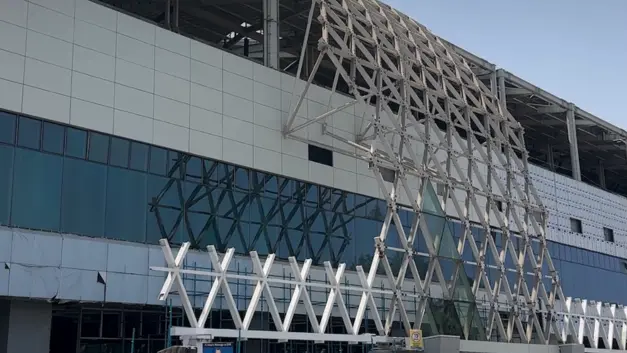
Within a few years, India’s fastest bullet trains will streak through this location at operational speeds of up to 320 km/h.
The visual landscape of Antroli in Surat Bullet Train Station is rapidly transforming. What currently resembles a massive, fast-paced construction site is slated to become one of the most historically significant landmarks in Indian transit. Within a few years, India’s fastest bullet trains will streak through this location at operational speeds of up to 320 km/h.
The Surat Bullet Train Station is evolving from a blueprint into a state-of-the-art reality. It is positioned as a critical anchor on the Mumbai-Ahmedabad High-Speed Rail (MAHSR) corridor.
The Architectural Crown Jewel of South Gujarat
The National High Speed Rail Corporation Limited (NHSRCL) has conceptualised the station’s architecture as a direct tribute to Surat’s global identity. Famously recognized as the “Diamond City of India” where nearly 90% of the world’s diamonds are cut and polished, the station features a facade and interior built around a Diamond Facet Theme.
The structural woodwork, glass panels, and external glass formations mimic the precise, clean cuts of a finished diamond. This design choice ensures that the facility functions as a visually iconic gateway for South Gujarat alongside its role as a transit hub.
Technical Specifications and Progress
The MAHSR corridor spans a total length of 508 kilometers and includes 12 strategically designated stations across Maharashtra, Gujarat, and the Union Territory of Dadra and Nagar Haveli. Among these, the Surat structural footprint stands out for its scale and strategic readiness.
Key Infrastructure Milestones:
- Structural Footprint: The station features a massive 450-meter structural layout.
- Track Configuration: It is designed with four high-speed tracks and two elevated island platforms to manage high-frequency Shinkansen-style trainsets efficiently.
- Operational Progress: Foundation and pier works for the station are fully complete. Track bed construction and overhead equipment (OHE) mast installations are moving forward rapidly.
- Trial Timeline: The first localized 50 km high-speed trial stretch between Surat and Bilimora is scheduled to begin operations by August 2026.
Seamless Multimodal Connectivity at the Core
A defining feature of the Surat High-Speed Station is its emphasis on multimodal transport integration. Instead of existing as an isolated terminal, the station acts as an interconnected web linking various public and private transit systems to minimize commuter transfer times.
| Transit Mode | Proximity / Connection Type |
| Proposed Metro Station | Approx. 280 meters away |
| BRTS Bus Stop | Approx. 330 meters away |
| National Highway 48 (NH-48) | Direct approach road link |
| Surat Main Railway Station | Integrated regional connectivity |
This setup ensures that a passenger arriving via the high-speed corridor can transition smoothly to municipal metro lines, rapid bus systems, or interstate highways without exiting the transit ecosystem.
Inside the Station: Airport-Style Passenger Amenities
The interiors are split across three distinct functional levels: the entrance/service floor, the concourse level, and the elevated platform level. The concourse is designed to handle heavy passenger traffic while offering a premium, comfortable experience.
Premium Passenger Infrastructure:
- Business-Class Waiting Lounges: Ergonomic seating zones equipped with digital information kiosks and charging stations.
- Universal Accessibility: Comprehensive, differently-abled-friendly infrastructure, including tactile flooring, specialized ramps, dedicated lifts, and wide-access escalators.
- Retail and Commercial Spaces: Spaces reserved for high-end retail outlets, cafes, and business utility centers.
- Family Care Amenities: Dedicated nurseries and safe care rooms for passengers traveling with infants.
- Eco-Conscious Architecture: The roof is integrated with specialized skylights to maximize natural lighting, significantly lowering the building’s daily energy footprint.
The Economic Impact on South Gujarat
The introduction of the high-speed corridor will profoundly alter the economic dynamics of the region. Currently, a standard rail journey between Mumbai and Ahmedabad takes roughly seven hours. The bullet train’s limited-stop service, which prioritizes halts at Surat and Vadodara, will reduce that travel time to just under two hours.
By linking Surat’s diamond and textile markets directly to the financial capital of Mumbai and the industrial centers of Ahmedabad, the station will serve as a major catalyst for regional commerce, real estate development, and employment. While construction continues daily, the foundational elements are firmly in place to elevate South Gujarat’s connectivity and economic pace.
Also read, Western Railway Summer Special Trains 2026: Run Unreserved Trains Between Udhna and Madhubani
Watch Latest News Videos on KRH News: Click Here