


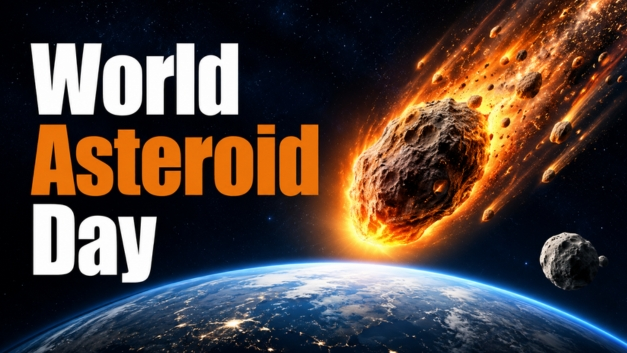
Every day, our planet cruises through a cosmic shooting gallery, bombarding our upper atmosphere with over 100 tons of dust and sand-sized space debris. While most of these cosmic remnants burn up harmlessly as shooting stars, much larger bodies loom in the dark. On Tuesday, June 30, 2026, the global scientific community, space agencies, and stargazers come together to mark World Asteroid Day 2026 (also known as International Asteroid Day).
Far from a mere celebration of astronomy, this United Nations-sanctioned day serves as a critical call to action for planetary defense, global scientific collaboration, and public awareness.
The Core Concept: What is an Asteroid?
Before diving into the historical and scientific importance of this day, it is helpful to conceptualize where these objects come from. Asteroids are rocky, airless remnants left over from the early formation of our solar system approximately 4.6 billion years ago. The vast majority reside in the Main Asteroid Belt between Mars and Jupiter.
While most remain in stable orbits, gravitational interactions can nudge them into paths that cross Earth’s orbit, classifying them as Near-Earth Objects (NEOs).
The History of World Asteroid Day: Remembering Tunguska
The selection of June 30th for World Asteroid Day is no coincidence. It commemorates the anniversary of the Tunguska Event of 1908, the most destructive asteroid impact in recorded human history.
On June 30, 1908, a stony meteoroid measuring roughly 50 to 60 meters across entered the atmosphere over Siberia, Russia. It detonated in the air with a force roughly 1,000 times more powerful than the atomic bomb dropped on Hiroshima. The atmospheric airburst flattened more than 80 million trees across 2,000 square kilometres of pristine Siberian forest. Because the region was so remote, human casualties were averted, but the event proved that Earth remains profoundly vulnerable to space rock impacts.
Fast forward to December 2014: legendary Queen guitarist and astrophysicist Dr. Brian May, filmmaker Grig Richters, Apollo 9 astronaut Rusty Schweickart, and B612 Foundation President Danica Remy co-founded Asteroid Day. Their goal was to educate the public on cosmic threats and advocate for better tracking technology. In December 2016, the United Nations General Assembly officially adopted Resolution A/RES/71/90, declaring June 30th as International Asteroid Day to institutionalise global awareness.
World Asteroid Day 2026 Theme
The official theme for World Asteroid Day 2026 is “Planetary Defence and Asteroid Impact Hazards.” This year’s theme emphasizes the immediate need for international cooperation regarding asteroid detection, data transparency, crisis communication, and proactive mitigation technologies. The 2026 theme serves as a strategic checkpoint as space agencies prepare for a highly anticipated cosmic event: the exceptionally close flyby of the massive asteroid 99942 Apophis on April 13, 2029. Apophis will pass within 32,000 kilometres of Earth – closer than our own geostationary communication satellites and will be visible to the naked eye. The 2026 milestone acts as a critical dress rehearsal for the public communication systems required for such events.
Why World Asteroid Day Matters: The Importance of Planetary Defense
Unlike earthquakes, hurricanes, or volcanic eruptions, an asteroid impact is the only natural disaster that humanity has the technological capability to completely predict and prevent. However, prevention requires early detection. Astronomers estimate that while we have mapped nearly 99% of the massive, planet-killing asteroids (1 kilometer or larger), we have discovered only a small fraction of smaller, city-killing objects (100 to 140 meters across) that could cause catastrophic regional devastation.
Key Objectives of the Movement:
- Accelerating Discovery Rates: The founders established the 100X Asteroid Declaration, pushing for a hundred-fold increase in the detection and tracking of Near-Earth Objects.
- Developing Deflection Technologies: The day highlights experimental milestones like NASA’s DART (Double Asteroid Redirection Test) mission, which successfully crashed a spacecraft into the asteroid moonlet Dimorphos in 2022, proving we can manually alter a celestial body’s orbital trajectory.
- Fostering Global Resource Sharing: Planetary defense cannot be handled by a single nation. It requires joint efforts between NASA, the European Space Agency (ESA), Japan’s JAXA, and global automated observatory networks.
Fast Facts for World Asteroid Day 2026
- The 100-Ton Bombardment: Earth is continuously pelted by roughly 100 tons of sand and dust particles daily; space agencies rely on automated tracking systems to ensure no larger rocks slip through.
- The Asteroid Declaration: Signed by hundreds of scientists, astronauts, and Nobel Laureates, this mandate demands that governments implement global early-warning networks.
- The Upcoming Milestone: The UN has already declared 2029 as the International Year of Asteroid Awareness and Planetary Defence due to the historic trajectory of Asteroid Apophis.
How to Get Involved in 2026
You don’t need to be an aerospace engineer to participate in World Asteroid Day. You can get involved by:
- Tuning into Asteroid Day LIVE: Watch the multi-day global broadcast featuring panel discussions with astronauts, astronomers, and planetary defense experts.
- Attending Virtual Observatory Tours: Check local astronomy clubs or major space agency portals (like NASA or ESA) for special digital webinars and telescope live streams.
- Using Social Media for Advocacy: Share educational graphics, infographics, or host mini-quizzes using the official hashtag #InternationalAsteroidDay.
Final Thoughts
World Asteroid Day 2026 is a vivid reminder that our planet exists inside a dynamic cosmic environment. By celebrating space science and funding advanced telescope networks today, humanity is taking control of its collective future- ensuring that the fate of the dinosaurs never becomes our own.
Also read, International Day Against Drug Abuse 2026: Theme, History, Global Crisis, and India’s Stand
Watch Latest News Videos on KRH News: Click Here