

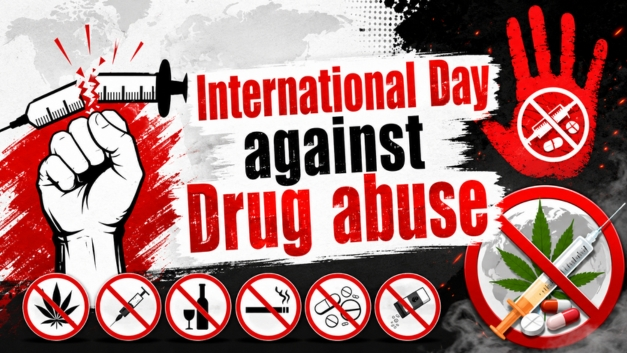
Substance abuse is no longer just an isolated health crisis; it is a global epidemic dismantling families, funding organized crime networks, and threatening the socioeconomic fabric of nations. Every year on June 26, the global community unites to observe the International Day Against Drug Abuse and Illicit Trafficking (also known as World Drug Day).
This day serves as a powerful reminder to strengthen action and cooperation to achieve an international society free of drug abuse. Below is a comprehensive analysis of the day’s significance, shocking global facts, and how India is scaling up its battle on the ground. The observations are driven by strategic frameworks targeting both the global supply chain and local demand reduction.
The UNODC Global Focus
Coordinated by the United Nations Office on Drugs and Crime (UNODC), the overarching global campaign focuses tightly on building evidence-based prevention, countering misinformation, and dismantling the syndicates behind illegal trafficking. The recent global mandate emphasizes moving away from stigmatization, ensuring that substance use disorder is treated as a psycho-social-medical problem rather than a mere law enforcement issue.
India’s Theme: “Nasha Mukt Bharat Abhiyaan – Viksit Bharat Ki Pehchaan”
Aligning with its national development goals, India observes a dedicated week (Nasha Mukt Bharat Saptah) under the focal theme: “Nasha Mukt Bharat Abhiyaan – Viksit Bharat Ki Pehchaan” (A Drug-Free India is the Identity of a Developed India). The initiative reinforces the idea that a truly developed nation requires healthy, aware, and empowered citizens.
History: Why is June 26 Observed?
The origin of World Drug Day dates back to December 7, 1987, when the United Nations General Assembly adopted Resolution 42/112.
The specific date, June 26, holds historical significance as it commemorates the dismantling of the opium trade in Humen, Guangdong, by Lin Zexu just before the First Opium War in China. The UN established this day to catalyze global efforts, leading to landmark declarations like the declaration of 1991–2000 as the “United Nations Decade Against Drug Abuse.”
Alarming Facts and Global Situation
According to recent data from the UNODC World Drug Report, the global illegal substance market is expanding rapidly, fueled by synthetic drug production and digital distribution networks.
Critical Global Statistics
- Surging Consumption: Over 292 million people worldwide use illicit substances, marking a massive 20% increase over the last decade.
- Most Common Substances: Cannabis remains the most widely used substance globally, followed by opioids, amphetamines, cocaine, and ecstasy.
- The Synthetic Shift: The rise of synthetic drugs (like fentanyl and methamphetamine) has drastically increased mortality rates due to their high potency and low cost of production.
The Global Trafficking Geography
The illegal drug trade relies primarily on three highly dangerous transit and production corridors:
- The Golden Crescent: Encompassing Iran, Afghanistan, and Pakistan.
- The Golden Triangle: Encompassing Laos, Myanmar, and Thailand.
- The Triple Frontier: The border zone connecting Argentina, Brazil, and Paraguay.
India’s Situation: Vulnerabilities and Strategy
India’s geographical location makes it exceptionally vulnerable to cross-border drug trafficking. Caught right in the middle of a “sandwich” between the Golden Crescent and the Golden Triangle, Indian borders face a relentless influx of heroin, synthetic party drugs (like Mephedrone), and diverted pharmaceutical formulations.
Key Data on India’s Drug Crisis
The Ministry of Social Justice and Empowerment (MoSJE) estimates that tens of millions of individuals in India require help for substance dependence. The crisis doesn’t just affect health; it directly targets the youth, hampering their education, career prospects, and overall life expectancy.
India’s Multi-Pillar Response Counter-Strategy
To curb this crisis, India has adopted a “Whole-of-Government and Whole-of-Society” approach based on structural, digital, and grassroots reforms.
| Pillar / Initiative | Core Function & Impact |
| Nasha Mukt Bharat Abhiyaan (NMBA) | India’s flagship demand-reduction campaign operating across all districts. It has successfully sensitized over 15.7 crore citizens and mapped out a volunteer network of 20,000+ Master Volunteers. |
| NIDAAN & NCORD Portals | Centralized digital intelligence platforms storing comprehensive databases of drug offenders to map out supply syndicates. |
| Nasha Mukti Mitra Dashboard | A newly launched personalized dashboard enabling citizen-volunteers to track, log, and drive grassroots anti-drug campaigns. |
| Institutional MoUs | Collaboration with massive spiritual and social organizations (like the Art of Living and ISKCON) to turn the anti-drug movement into a mass youth movement (Jan Andolan). |
How You Can Contribute to World Drug Day
Ending the cycle of drug abuse requires micro-level interventions just as much as macro-level policies. Here is how you can take action today:
- Educate with Science, Not Myth: Share authentic data regarding the psychological and physical impacts of drugs with teenagers and peers.
- Support with Empathy: Treat addiction as a disease. Approach individuals struggling with substance use disorder with empathy and help them connect with geo-tagged, government-authorized de-addiction centers.
- Take the Digital Pledge: Visit official portals (like India’s NMBA platform) to take the national e-pledge against drug abuse and encourage your workplace or school to do the same.
Frequently Asked Questions (FAQs)
1. When is the International Day Against Drug Abuse observed?
It is observed globally on June 26 every year, as designated by the United Nations General Assembly in 1987.
2. What is India’s theme for the anti-drug campaign?
India operates under the theme “Nasha Mukt Bharat Abhiyaan – Viksit Bharat Ki Pehchaan,” linking a drug-free society directly to the nation’s vision of development.
3. What are the Golden Crescent and Golden Triangle?
These are the world’s two principal regions of illicit opium production. The Golden Crescent spans across Afghanistan, Iran, and Pakistan, while the Golden Triangle covers Myanmar, Laos, and Thailand. India is highly vulnerable due to its location between these two regions.
Also read, International Olympic Day 2026: Theme, History, and the Global Movement for Physical Fitness
Watch Latest News Videos on KRH News: Click Here