


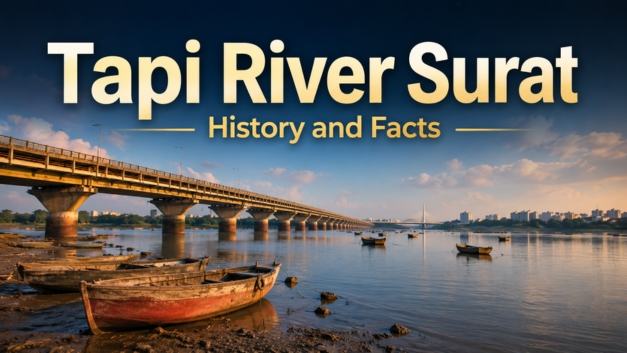
Known as the glorious lifeline of western India, the Tapi River (traditionally called the Tapti) holds an invaluable place in India’s geographical, cultural, and economic landscapes. Flowing across central India into the Arabian Sea, it has nurtured civilizations for centuries – most notably transforming the city of Surat into a global commercial hub.
However, as we look at the river in 2026, the Tapi is standing at a critical evolutionary turning point. Balancing a rich historical legacy with the modern pressures of urbanization, the river is currently undergoing one of the largest mega-infrastructure and ecological facial lifts in Indian history.
This detailed article explores everything you need to know about the Tapi River, ranging from its ancient roots to the grand ₹3,904 Crore government restoration projects currently reshaping its future.
Detailed Overview of the Tapi River
| Parameter | Key Details |
| Source of Origin | Multai, Betul District, Madhya Pradesh (Satpura Range) |
| Total Length | Approximately 724 km (450 miles) |
| Major Basin States | Madhya Pradesh, Maharashtra, and Gujarat |
| Primary Confluence | Gulf of Khambhat (Arabian Sea), near Surat |
| 2026 Mega Project | Tapi Riverfront Development & Rejuvenation Project (TRDRP) |
| Estimated Project Cost | ₹3,904 Crores ($470+ Million USD) |
The Rich History & Mythological Significance
The Tapi River is not merely a body of water; it is a sacred entity deeply rooted in Indian Vedic history.
- The Daughter of the Sun: According to ancient Hindu scriptures, particularly the Tapi Purana, the river is revered as Suryaputri – the daughter of Surya (the Sun God) and Chhaya (the Goddess of Shade). It is believed that the river was created by the Sun God to protect his creation from intense cosmic heat.
- The Twin of Narmada: Geographically and historically, the Tapi and the Narmada rivers run parallel to each other. They are the only two major rivers in peninsular India that flow from East to West into the Arabian Sea, defying the common West-to-East drainage pattern of the subcontinent.
- The Gateway to International Trade: Historically, the mouth of the Tapi River near Surat served as one of India’s most important international maritime trade ports from the 16th to the 18th centuries. Mogul, Dutch, Portuguese, French, and British merchants used the Tapi’s navigable channels to trade Indian textiles and spices with the rest of the world.
Fascinating Facts About the Tapi River
- East-to-West Flow: Unlike 90% of India’s peninsula rivers that flow into the Bay of Bengal, the Tapi flows westward through a massive rift valley.
- Crisscrossing Three States: The river boasts a massive drainage basin covering roughly 65,145 square kilometers, spanning across Madhya Pradesh, Maharashtra, and Gujarat.
- The Lifeline of 6.5 Million People: The river acts as the primary source of industrial, drinking, and agricultural water supply for the entire Surat metropolitan area and the heavy industries located in Hazira.
Why the Tapi River is Domestically Crucial
The modern relevance of the Tapi River operates on three major pillars:
- Agricultural Wealth: The Tapi basin fuels the fertile agricultural belts of Khandesh (Maharashtra) and Southern Gujarat, enabling heavy cultivation of cotton, bananas, sugarcane, and oilseeds.
- Industrial Powerhouse: Massive power plants (like the Ukai Thermal Power Station) and global industrial zones in Hazira (handling steel, petrochemicals, and heavy manufacturing) rely heavily on the constant water supply from the Tapi.
- Groundwater Recharge: Water reservoirs like the Singanpore Weir continuously recharge the local water table, keeping groundwater salinity in check across coastal Gujarat.
Today’s Reality: The Modern Challenges Faced by the Tapi
Despite its importance, rapid industrialization over the late 20th and early 21st centuries left the Tapi vulnerable. Entering the mid-2020s, the river faced heavy ecological threats:
- Tidal Salinity Ingress: Because it meets the ocean seamlessly, severe high tides push salty seawater far back into the riverbed, destroying fresh drinking water quality.
- Severe Urban Flooding Risk: The river’s lower course through Surat is volatile. Silt collection reduces the river’s capacity, causing major flood events during heavy monsoons (similar to the historic floods of 2006).
- Sewage Pollution: Untreated wastewater outfalls historically compromised the cleanliness of the riverbanks.
Future Blueprint: Government Expansion & Rejuvenation Projects
To combat these challenges, the Government of Gujarat, alongside the Surat Municipal Corporation (SMC) and backed by financial considerations from international bodies like the World Bank, is heavily executing the Tapi Riverfront Development and Rejuvenation Project (TRDRP). Managed via a dedicated Special Purpose Vehicle called the Tapi River Front Development Corporation Limited (TRFDCL), the mega-project is structured around key upgrades:
1. The Multi-Purpose Rundh-Bhatha Barrage
The crown jewel of the future expansion is the construction of a massive conventional barrage connecting Rundh and Bhatha. This barrage acts as a physical barrier against the sea, successfully stopping saltwater intrusion and creating an immense fresh-water lake stretching over 10 kilometers right within the city limits.
2. Comprehensive 33-Kilometer Riverfront Master Plan
Similar to the iconic Sabarmati Riverfront in Ahmedabad, the Tapi Riverfront is being built across a 33 km lateral length (creating a massive 66 km continuous urban edge on both sides).
- Phase 1 (Priority Urban Stretch): Spanning 10 km between the Singanpore Weir and the new Rundh-Bhatha barrage, focused on flood protection walls, reinforced green embankments, and walkways.
- Phase 2 (Upstream Nature Extension): Covering 23.6 km up to the Kathore Bridge, focused on environmental preservation and low-impact public zones.
3. Integrated “Room for the River” Flood Management
Instead of using generic concrete walls, the project applies a hybrid model of grey and green infrastructure. It utilizes nature-based solutions, structural riparian banks, and heavy dykes to widen the flood-carrying capacity of the river, ensuring Surat remains safe from extreme monsoon patterns.
4. Eco-Parks, Walkways, and Public Interceptor Sewers
To stop pollution at the source, a web of interceptor lines is catching domestic sewage, diverting it into treatment centers before it ever touches the Tapi. The cleared riverbanks are being converted into massive Eco-Parks, continuous cycling tracks, and open-air cultural zones to promote eco-tourism.
Frequently Asked Questions (FAQs)
Q1. Where does the Tapi River originate and end?
Ans: The Tapi River originates in the Satpura Range in Multai, Madhya Pradesh, and empties into the Arabian Sea through the Gulf of Khambhat near Surat, Gujarat.
Q2. What is the budget of the Tapi Riverfront Development Project?
Ans: The overall comprehensive plan has an approximate budget layout of ₹3,904 Crores, split into prioritized phases.
Q3. How does the Rundh-Bhatha Barrage project help Surat?
Ans: The barrage blocks seawater from entering the fresh river system, creating a permanent sweet-water reservoir for the city while mitigating local flood impacts.
Q4. Why is the Tapi River called Suryaputri?
Ans: In Hindu mythology, the river is honored as the daughter of Surya (the Sun God) and Chhaya (the goddess of shadow).
Also read, How to Start a Textile Business in Surat (2026 Guide)
Watch Latest News Videos on KRH News: Click Here