


Remember when waiting two days for an Amazon delivery felt like magic? In 2026, that feels like ancient history.
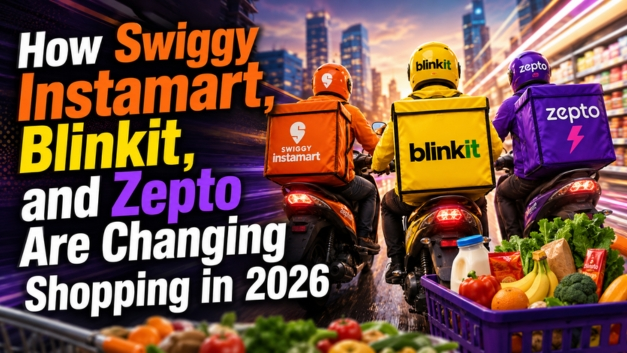
In 2026, Blinkit, Zepto, and Instamart are no longer just apps- they are an integral part of India’s day-to-day lifestyle. According to the June 2026 India Digital Commerce Pulse report by 1DigitalStack, quick commerce (q-commerce) has exploded into a ₹1.08 lakh crore ($13+ billion) segment, accounting for roughly 13.5% of India’s entire digital commerce market. Compounding at a staggering 40% YoY growth rate, dark-store delivery apps are growing nearly four times faster than traditional e-commerce giants.
The industry consensus is clear: “Quick commerce owns the everyday basket; Amazon holds the considered buys.” As Zepto gears up for its blockbuster ₹8,010 crore IPO, Blinkit hits profitability milestones, and legacy tech giants enter the fray, let’s look at the official numbers changing how India shops in 2026.
1. The Scale vs. Profitability Split
- Blinkit (The Titan): Under Eternal Limited, Blinkit has effectively won the first leg of the scale war. It operates nearly double the dark stores of its competitors and achieved an historic Adjusted EBITDA profit of ₹37 crore in Q4 FY26, driven by an inventory-led model and high demand density in tier-1 metros.
- Zepto (The Hyper-Grower): Sitting closely at a 22% market share, Zepto’s order volumes grew by 92.7% YoY in FY26. While its cash burn remains high (reporting an annual loss of ₹5,041 crore due to massive customer acquisition investments), its updated Draft Red Herring Prospectus (DRHP) filed with SEBI shows an encouraging 42% reduction in its loss-per-order ratio.
- Swiggy Instamart (The High-Value Player): Instamart is playing a highly calibrated margin game. Though it lags in overall revenue, it captures the highest basket size, commanding a ₹700 Average Order Value by cross-selling through Swiggy’s premium food delivery ecosystem.
2. Changing Consumer Behavior: Beyond Groceries
What started as an emergency corridor for milk, bread, and onions has successfully cannibalized traditional modern trade. Quick commerce now captures 94% of online food and beverage purchases in major Indian cities.
However, the real growth engine in 2026 lies in high-margin, non-grocery categories:
- Baby Care & Home Care: Purchases skyrocketed, growing by 105% and 101% YoY respectively.
- Seasonal & Direct-to-Consumer (D2C): During peak summer, items like electronics, personal face care, and ice creams posted the sharpest logistical spikes.
- Pharma & Cafés: Features like Zepto Café and Blinkit’s 10-minute medicine deliveries have turned these platforms into decentralized utilities.
3. The 2026 Disrupters: Retail Giants Strike Back
Just as the top three pure-plays established their rules, deep-pocketed conglomerates entered the battlefield, forever shifting the landscape.
JioMart’s Hyperlocal Offensive
At Reliance Industries’ 49th Annual General Meeting (AGM), Isha Ambani Piramal announced that JioMart is bypassing traditional dark stores by leveraging its massive offline network of 3,100 physical stores.
“Quick commerce is coming of age. JioMart has become one of India’s largest quick commerce networks, serving over 1,200 towns across 5,100+ PIN codes. Our repeat orders on quick commerce grew more than sixfold,” she stated.
The E-Commerce Counter-Attack
Simultaneously, Flipkart Minutes and Amazon Now are scaling aggressively. Flipkart Minutes has been adding roughly 100 dark stores every single month, placing immense operational pressure on standalone startups to defend their tier-2 and tier-3 city expansions.
The Verdict: What Lies Ahead?
India’s quick commerce sector has fully transitioned from a gimmicky “10-minute delivery promise” to an infrastructure-led economic powerhouse. Analysts project the market will expand 5x to 7x to hit an astonishing $60 to $83 billion by CY2030.
For consumers, shopping has mutated from a planned weekly chore into an instantaneous, impulse-driven utility. The battle lines for the rest of 2026 are clearly drawn: it is no longer just about who delivers the fastest, but who can expand into tier-2 India while maintaining a profitable bottom line.
Also read, What Is UPI? Everything You Need to Know About India’s Payment System in 2026
Watch Latest News Videos on KRH News: Click Here