


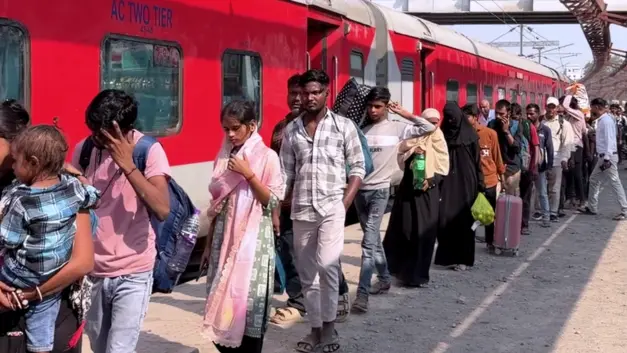
Surat, Gujarat: The movement of migrant workers from Surat towards their hometowns has drawn attention amid reports of queues at Surat Udhna station and concerns about living and working conditions. The trend, described in local media as the “Gaon Chalo” movement, has raised questions about the challenges faced by workers who depend on Surat’s industrial economy.
Udhna Railway Station Sees Attention Amid Workers’ Concerns
Udhna railway station is an important departure point for passengers travelling from Surat to destinations across northern and eastern India. Workers employed in the city’s textile, dyeing, printing and other industrial sectors regularly use the station to travel to their hometowns.
A report published by Sandesh highlights migrant workers queuing at Udhna station as the “Gaon Chalo” movement gains attention. However, the scale of the movement, the number of workers leaving and the precise reasons behind individual journeys could not be independently verified through an official government statement.
LPG Supply Concerns and Migrant Workers
Concerns about cooking gas availability have formed part of the wider discussion around the difficulties faced by migrant workers. In an official release dated April 2, 2026, the Press Information Bureau said state governments had reported that LPG supplies for migrant workers remained stable, while targeted distribution of 5 kg free-trade LPG cylinders could be considered according to local requirements.
In a subsequent release dated June 2, 2026, the Ministry of Petroleum and Natural Gas said the supply of 5 kg LPG cylinders to migrant labourers had increased. The government also said domestic LPG consumers were being prioritised and urged people to rely on authorised communications for updates on fuel availability.
These statements provide the government’s position on LPG distribution, but they do not establish whether gas availability was the main reason for the workers reportedly travelling from Surat.
Why Migrant Workers Matter to Surat
Surat relies on a large workforce across its textile, diamond, manufacturing and other industries. Workers who move to the city for employment also face everyday expenses, including accommodation, food, transport and cooking fuel.
Any sustained departure of workers could create concerns for employers who rely on migrant labour. However, the economic impact of the reported movement cannot be assessed without verified information on the number of workers leaving, how long they intend to stay away and whether industrial units are experiencing labour shortages.
What Happens Next?
The situation requires clear information from railway authorities, local administration and relevant government departments. Official updates on passenger movement, special train arrangements and support for migrant workers would help establish the scale of the situation.
For now, the “Gaon Chalo” label should be understood as a description used in local reporting rather than a formally confirmed government programme or movement.
Also read, Best Garba & Pre-Navratri Locations in Surat 2026
Watch Latest News Videos on KRH News: Click Here