


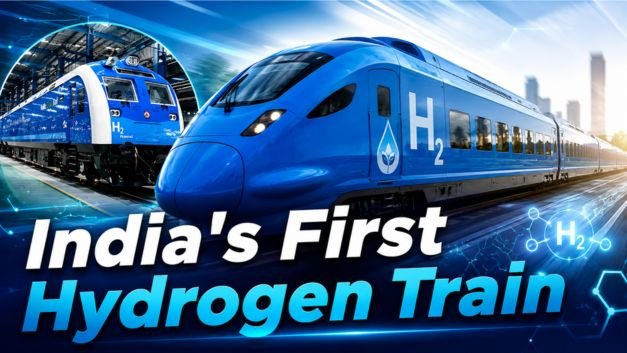
India’s First Hydrogen Train: India is preparing to enter a new era of sustainable rail transportation as Indian Railways’ first hydrogen-powered train is now ready for commercial operations. The country’s first hydrogen train has been developed as part of Indian Railways’ ambitious mission to reduce carbon emissions and adopt clean energy technologies.
The hydrogen-powered train will initially operate on the Jind–Sonipat section in Haryana, making India one of the few countries in the world to introduce hydrogen-powered passenger rail services.
India’s First Hydrogen Train Route as a Expansion
According to Indian Railways, the country’s first hydrogen-powered train will initially operate on the:
Route:
- Jind – Sonipat (Haryana)
The route has been selected for the pilot project before hydrogen train technology is expanded to other railway sections across India. Officials believe the project will help evaluate operational performance, fuel efficiency, and maintenance requirements under Indian conditions.
What Makes Hydrogen Trains Different?
Unlike conventional diesel locomotives, hydrogen trains use hydrogen fuel cells to generate electricity.
How It Works
- Hydrogen stored in onboard fuel tanks
- Fuel cells combine hydrogen with oxygen
- Electricity is generated to power the train
- The only by-product released is water vapour
This makes hydrogen trains one of the cleanest forms of rail transportation available today.
Speed and Performance of Train
The hydrogen train has been designed to deliver performance similar to existing diesel-powered passenger trains.
Expected specifications include:
- Maximum speed of around 110 km/h
- Multiple passenger coaches
- Modern passenger amenities
- Low operational noise
- Zero carbon emissions during operation
The train is expected to provide a smoother and quieter travel experience.
Advanced Safety Features of Train
Indian Railways has incorporated several safety measures into the hydrogen train project.
Key Safety Systems
- High-pressure certified hydrogen storage tanks
- Leak detection sensors
- Automatic emergency shutdown systems
- Fire suppression mechanisms
- Real-time monitoring systems
- Multiple safety redundancies
Officials have stated that hydrogen fuel storage follows international safety standards used across developed countries already operating hydrogen trains.
Why Hydrogen Trains Are Important
The hydrogen train project supports India’s broader clean energy and net-zero emission goals.
Major Benefits
- Zero carbon emissions
- Environment-friendly transportation
- Reduced dependence on diesel fuel
- Lower noise pollution
- Improved energy efficiency
- Supports India’s Green Hydrogen Mission
Experts believe hydrogen-powered rail transport could significantly reduce pollution generated by diesel locomotives in the coming years.
Part of India’s Green Hydrogen Mission
The hydrogen train project complements the Government of India’s National Green Hydrogen Mission, which aims to make India a global hub for green hydrogen production and usage. Hydrogen-powered transport is expected to play a major role in reducing fossil fuel consumption across multiple sectors, including railways, shipping, heavy industries, and commercial transport.
Global Countries Already Using Hydrogen Trains
Several countries have already introduced hydrogen-powered rail services.
These include:
- Germany
- France
- China
- Italy
- Austria
With this launch, India joins the growing list of nations investing in next-generation green railway technology.
Future Expansion Plans
If the pilot project proves successful, Indian Railways plans to introduce hydrogen trains on additional non-electrified railway routes across the country. Future expansion could help replace diesel locomotives on several regional railway lines while reducing environmental impact.
Conclusion
India’s first hydrogen-powered train represents a significant milestone in the country’s railway modernization and green transportation journey. With zero emissions, advanced safety systems, and environmentally friendly technology, the hydrogen train is expected to transform rail travel while supporting India’s long-term sustainability goals.
As commercial operations begin on the Jind–Sonipat route, the project will serve as an important step toward cleaner and smarter rail transportation across India.
Also read, Surat Weather Forecast (July 4 to July 19, 2026)
Watch Latest News Videos on KRH News: Click Here