


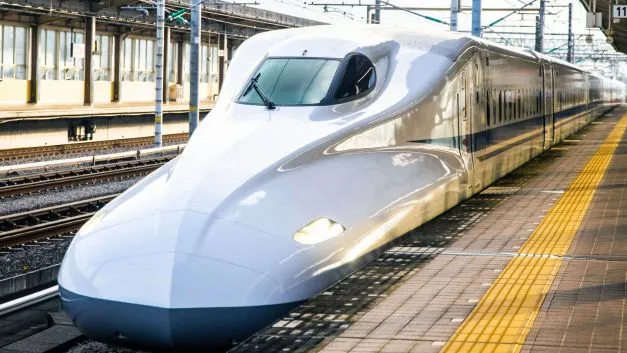
The Mumbai-Ahmedabad Bullet Train Project has reached an important milestone as track installation work on the viaduct is progressing rapidly. The project is adopting Japan’s advanced Shinkansen track technology, bringing the J-Slab Ballastless Track System to India for the very first time.
This modern railway infrastructure is designed to support high-speed train operations at speeds up to 320 km per hour, ensuring safety, durability, and smooth travel. The bullet train project is considered one of India’s most significant transportation developments and is expected to transform connectivity between Mumbai and Ahmedabad.
First-Time Use of Japan’s J-Slab Ballastless Track System in India
The Mumbai-Ahmedabad High-Speed Rail Corridor will use the J-Slab Ballastless Track System based on Japan’s Shinkansen railway technology.
This system consists of four major components:
Key Components of J-Slab Track System
1. RC Track Bed
The reinforced concrete (RC) track bed forms the strong base for the bullet train track and ensures structural stability on the viaduct.
2. Cement Asphalt Mortar (CAM)
CAM is injected beneath the track slab to maintain the final alignment, level, and vibration control of the high-speed rail track.
3. Precast Track Slab
Specially manufactured concrete slabs are installed precisely on the RC bed for long-term performance and smooth train movement.
4. Rails with Fasteners
The rails are fixed with high-precision fasteners to ensure safe and efficient operation at very high speeds.
Surat’s Kim and Anand Become Key Manufacturing Hubs
To support the production of J-Slabs, two modern Track Slab Manufacturing Facilities (TSMF) have been established in Gujarat at Kim near Surat and Anand.
These facilities are specially designed to produce high-quality concrete slabs with precise technical standards required for the bullet train project. Once manufactured, the slabs are stored in stacking zones and later transported by trailers to dedicated Track Construction Bases (TCB).
These TCBs serve as operational centers for handling track slabs, machinery, rails, and construction equipment both on land and on the viaduct.
10 Track Construction Bases Currently Operational
To ensure smooth execution of the track construction process, 10 dedicated Track Construction Bases are currently active.
Their distribution includes:
- 4 TCBs between Surat, Bilimora, and Vapi
- 6 TCBs between Vadodara, Anand, and Ahmedabad
These bases play a crucial role in speeding up construction and maintaining operational efficiency.
Latest Track Construction Progress Report
According to the latest project update, track construction has shown strong progress:
Current Status in Route Kilometers
- RC Track Bed Completed: 185 km
- Track Slab Production Completed: 188 km
- Track Slab Laying and CAM Injection Completed: 70 km
This shows that the project is moving steadily toward its next major construction phase.
Advanced Japanese Machinery Used for Bullet Train Construction
The entire track installation process is highly mechanized using advanced machines specially designed according to Japanese construction standards. Most of these machines have been manufactured in India.
Major Machines Used in Track Installation
Flash Butt Welding Machine (FBWM)
This machine joins 25-meter-long rails into 200-meter-long rail panels. These long welded rails are essential for smooth high-speed train operations.
Strict testing and approval processes are followed before welding begins to ensure safety for trains running at 320 km/h.
Track Slab Laying Car (SLC)
This machine lifts precast slabs and places them accurately on the viaduct. It can carry up to five slabs at one time.
Rail Feeder Car (RFC)
RFC is used to transport and place 200-meter rail panels onto the RC track bed for installation.
CAM Injection Car
After slab placement, the CAM Injection Car mixes and injects Cement Asphalt Mortar beneath the slabs to ensure perfect track alignment and stability.
Bullet Train Project Strengthens India’s Future Rail Network
The Mumbai-Ahmedabad Bullet Train Project is not only introducing world-class technology but also strengthening India’s future transportation infrastructure.
With rapid progress in track installation and strong manufacturing support from Gujarat, the project is moving closer to becoming India’s first high-speed rail corridor.
This development is expected to improve travel time, economic growth, and regional connectivity while setting new standards for railway engineering in the country.
Also read, Surat Metro to Connect Directly With Bullet Train Station Soon
Watch Latest News Videos on KRH News: Click Here