


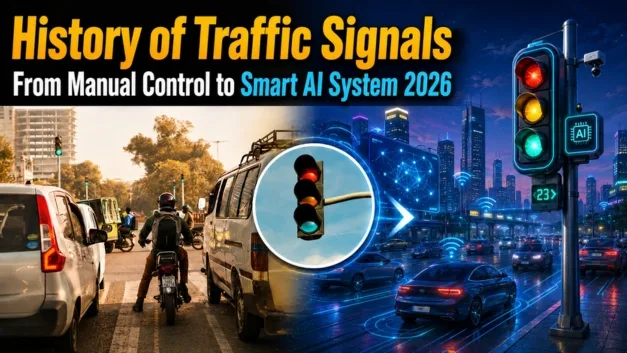
Traffic signals have become an essential part of modern urban life. From crowded city intersections to smart highways, traffic lights help maintain road safety, reduce congestion, and improve transportation efficiency.
Traffic signals have become an essential part of modern urban life. From crowded city intersections to smart highways, traffic lights help maintain road safety, reduce congestion, and improve transportation efficiency.
However, traffic signals were not always automated. The journey from manually controlled traffic systems to today’s AI-powered smart traffic management technology is a fascinating story of innovation, urban growth, and technological advancement.
In 2026, many cities around the world, including Indian smart cities are adopting intelligent traffic systems powered by Artificial Intelligence (AI), sensors, cameras, and real-time data analysis. This article explores the complete history and evolution of traffic signals from their earliest forms to the latest smart AI systems.
Early Days of Traffic Control Before Signals
Before traffic lights existed, roads were managed manually by police officers or traffic wardens.
Manual Traffic Management Era
In the late 19th century, growing numbers of horse carriages, bicycles, and early automobiles created traffic congestion in major cities.
Traffic officers used:
- Hand signals
- Whistles
- Flags
- Semaphore systems
to control movement at busy intersections. As cities expanded rapidly during industrialisation, manual systems became increasingly difficult to manage.
World’s First Traffic Signal System
The world’s first traffic signal was installed in London in 1868 outside the British Parliament.
Gas-Powered Traffic Signal
The early signal system was designed by railway engineer John Peake Knight.
Features included:
- Red and green gas lamps
- Manual operation
- Semaphore-style arms during daytime
Unfortunately, the gas-powered system exploded after a short period due to technical failure, leading to its temporary discontinuation.
Despite this setback, the idea of traffic signaling had already gained attention globally.
Introduction of Electric Traffic Signals
The first electric traffic signal was introduced in Cleveland, Ohio, USA, in 1914.
Features of Early Electric Signals
The early system included:
- Red and green lights
- Electric operation
- Audible warning buzzers
Soon after, yellow warning lights were added to improve safety and reduce accidents at intersections. This three-color system eventually became the global standard still used today.
Meaning Behind Traffic Signal Colors
The red-yellow-green traffic signal system was inspired by railway signaling systems.
Standard Signal Color Meanings
| Color | Meaning |
|---|---|
| Red | Stop |
| Yellow | Prepare / Slow Down |
| Green | Go |
These colors were chosen because they are highly visible and easy to understand universally.
Traffic Signals in India
India introduced traffic signals during the early growth of urban cities like Mumbai, Kolkata, Delhi, and Chennai.
Growth of Traffic Systems in Indian Cities
As vehicle ownership increased after independence, traffic lights became essential for managing growing urban congestion.
Initially, traffic management heavily depended on:
- Traffic police personnel
- Manual signaling booths
- Timed signal systems
Today, Indian cities use advanced digital traffic systems connected with CCTV surveillance and smart city infrastructure.
Evolution of Automated Traffic Signals
By the late 20th century, traffic systems became increasingly automated.
Timer-Based Signal Systems
Cities introduced timer-based traffic lights where signal changes occurred automatically after fixed intervals.
Benefits included:
- Reduced need for manual control
- Better traffic coordination
- Improved road discipline
- Lower accident rates
However, fixed-timing systems often failed during peak traffic hours because they could not adapt to real-time congestion.
Rise of Smart Traffic Systems
With the rise of smart cities and Artificial Intelligence, traffic management entered a completely new era.
What Are Smart Traffic Signals?
Smart traffic signals use:
- AI algorithms
- CCTV cameras
- Vehicle sensors
- Real-time traffic monitoring
- Internet connectivity
- Data analytics
to manage traffic dynamically.
Instead of fixed timers, AI systems adjust signals based on:
- Vehicle density
- Traffic flow
- Emergency vehicle movement
- Peak-hour congestion
AI Traffic Systems in India 2026
Many Indian cities are now implementing AI-powered traffic systems under Smart City projects.
Cities Using Smart Traffic Technology
Several cities have introduced intelligent traffic systems, including:
- Surat
- Ahmedabad
- Mumbai
- Bengaluru
- Delhi
- Hyderabad
- Pune
Features of AI Traffic Signals in 2026
Modern systems now include:
- Adaptive signal timing
- Automatic congestion detection
- Emergency vehicle priority
- Red-light violation cameras
- Number plate recognition (ANPR)
- Smart traffic analytics dashboards
These systems help reduce travel time and improve fuel efficiency.
Traffic Signal Challenges in Modern Cities
Despite technological advancement, traffic management still faces several challenges.
Common Urban Traffic Problems
- Rapid increase in vehicles
- Poor lane discipline
- Signal jumping
- Illegal parking
- Pedestrian safety issues
- Infrastructure limitations
Experts believe AI alone cannot solve traffic problems without public discipline and proper road planning.
Interesting Facts About Traffic Signals
Did You Know?
- The first traffic signal exploded due to gas leakage
- Traffic lights were inspired by railway systems
- Japan sometimes uses blue instead of green signals linguistically
- AI traffic systems can analyze traffic in real-time within seconds
- Some smart signals prioritize public transport automatically
Conclusion
The history of traffic signals reflects the evolution of modern cities and transportation systems. What started as manually operated gas lamps has now transformed into highly advanced AI-powered smart traffic networks.
In 2026, smart traffic signals are helping cities become safer, faster, and more efficient. As urban populations and vehicle numbers continue to grow, intelligent traffic systems will play an even bigger role in shaping the future of transportation.
From manual control to Artificial Intelligence, traffic signals have truly come a long way.
Also read, Top 10 Countries Where Petrol Is Cheaper Than Water in 2026
Watch Latest News Videos on KRH News: Click Here