


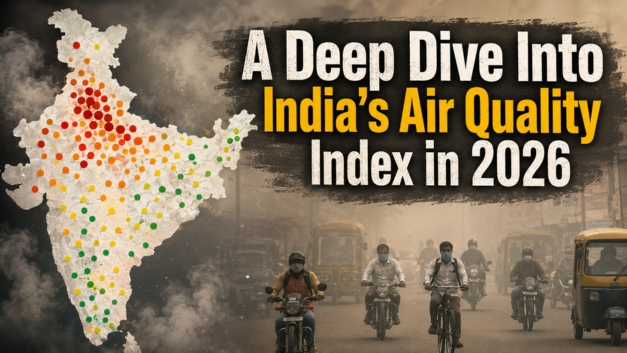
Air pollution has emerged as one of India’s most pressing environmental and public health challenges. From Delhi’s winter smog to rising pollution levels in several industrial cities, the Air Quality Index (AQI) has become a critical indicator of how safe the air is for millions of Indians.
While India has made progress in monitoring and controlling pollution, the country still faces significant challenges compared with many developed nations. Understanding India’s AQI situation requires looking at its causes, global ranking, health impacts, and future plans for cleaner air.
What Is AQI and Why Does It Matter?
The Air Quality Index (AQI) is a system used to measure air pollution levels and communicate health risks to the public.
How AQI Is Measured
India’s AQI is calculated using pollutants such as:
- PM2.5 (fine particulate matter)
- PM10
- Nitrogen dioxide
- Sulphur dioxide
- Carbon monoxide
- Ozone
- Ammonia
- Lead
AQI Categories
Good (0-50)
Air quality poses little or no risk.
Satisfactory (51-100)
Minor breathing discomfort for sensitive individuals.
Moderate (101-200)
Possible health concerns for vulnerable groups.
Poor (201-300)
Breathing discomfort for many people.
Very Poor (301-400)
Respiratory illnesses likely with prolonged exposure.
Severe (401-500)
Serious health impacts for all age groups.
India’s Current AQI Situation
India continues to battle high levels of PM2.5 pollution, the most dangerous airborne pollutant because it can penetrate deep into the lungs and bloodstream.
According to the 2025 World Air Quality Report by IQAir, India ranked as the sixth most polluted country in the world with an average PM2.5 concentration of 48.9 µg/m³, nearly ten times higher than the World Health Organization’s recommended annual limit of 5 µg/m³. The report also noted that 66 of the world’s 100 most polluted cities are located in India. New Delhi remained the world’s most polluted capital city.
Major Pollution Hotspots
Some of India’s most affected regions include:
- Delhi NCR
- Ghaziabad
- Noida
- Loni
- Kanpur
- Lucknow
- Industrial clusters across northern India
Several cities frequently record AQI levels in the “Very Poor” and “Severe” categories during winter months.
Why Is India Facing an AQI Crisis?
Vehicular Emissions
Rapid urbanization has increased the number of vehicles on Indian roads, contributing significantly to PM2.5 and nitrogen oxide emissions.
Industrial Pollution
Factories, power plants, and manufacturing units release large quantities of pollutants into the atmosphere.
Construction Dust
Rapid infrastructure development generates dust pollution, particularly in urban areas.
Crop Residue Burning
Seasonal stubble burning in northern states contributes to severe winter smog episodes.
Household Fuels
In some regions, biomass and solid fuels are still used for cooking and heating.
Health Impact of Poor AQI
Air pollution is linked to:
- Asthma
- Lung cancer
- Heart disease
- Stroke
- Respiratory infections
- Reduced life expectancy
The World Health Organization estimates that air pollution contributes to millions of premature deaths globally every year. Studies consistently show that prolonged exposure to PM2.5 significantly increases health risks.
India’s Position Compared With Developed Countries
While India struggles with high pollution levels, many developed countries maintain significantly cleaner air due to stricter environmental regulations and cleaner energy systems.
Average Situation
India
PM2.5: 48.9 µg/m³
Australia
Among the countries meeting WHO air quality standards.
New Zealand
Consistently among the cleanest nations.
Iceland
Very low pollution levels due to renewable energy and low population density.
Estonia
Regularly meets WHO guidelines.
These countries benefit from cleaner energy, stronger environmental policies, and extensive air-quality monitoring systems.
Top 10 Countries With the Cleanest Air
Based on recent international air quality reports and WHO guideline compliance, the following countries are among the world’s cleanest:
- 1. Iceland
- 2. New Zealand
- 3. Australia
- 4. Estonia
- 5. Finland
- 6. Grenada
- 7. Mauritius
- 8. Bahamas
- 9. Barbados
- 10. Norway
These countries generally have low industrial emissions, strong environmental regulations, and extensive natural ecosystems.
Economic Cost of Air Pollution
Poor air quality affects more than health.
Economic Consequences
- Increased healthcare expenditure
- Reduced worker productivity
- Lower tourism appeal
- Agricultural losses
- Higher public health burden
Experts estimate that air pollution costs countries billions of dollars annually through healthcare and productivity losses.
What Is India Doing to Improve AQI?
The government has launched several initiatives to improve air quality.
National Clean Air Programme (NCAP)
Launched to reduce particulate pollution in major cities, NCAP focuses on:
- Increasing monitoring stations
- Better urban planning
- Dust control measures
- Industrial emission reductions
- Public awareness campaigns
Cleaner Energy Transition
India is rapidly expanding:
- Solar energy
- Wind energy
- Electric mobility
- Green hydrogen projects
BS-VI Emission Standards
Stricter vehicle emission norms have already helped reduce pollution from newer vehicles.
What More Needs to Be Done?
Stronger Enforcement
Pollution-control laws require stricter implementation.
Public Transport Expansion
Reducing dependence on private vehicles can significantly improve urban air quality.
Sustainable Agriculture
Alternatives to stubble burning must become economically viable for farmers.
Industrial Modernization
Cleaner technologies and emission-control systems are essential.
India’s Future Outlook
India’s pollution challenge is significant, but not impossible to solve. The country’s growing investments in renewable energy, electric vehicles, green infrastructure, and air-quality monitoring indicate positive momentum.
Experts believe that sustained policy implementation, technological innovation, and public participation will be critical for achieving cleaner air over the next decade.
Conclusion
India’s AQI crisis reflects the challenges of balancing economic growth, urbanization, and environmental sustainability. Although the country remains among the world’s most polluted nations, ongoing initiatives such as the National Clean Air Programme and clean-energy investments provide reasons for optimism.
The journey toward cleaner air will require cooperation between governments, industries, and citizens. Improving India’s AQI is not just an environmental goal—it is essential for protecting public health, boosting economic productivity, and ensuring a better quality of life for future generations.
Also read, India Passport Ranking 2026: Why the Mighty Rise Matters
Watch Latest News Videos on KRH News: Click Here