


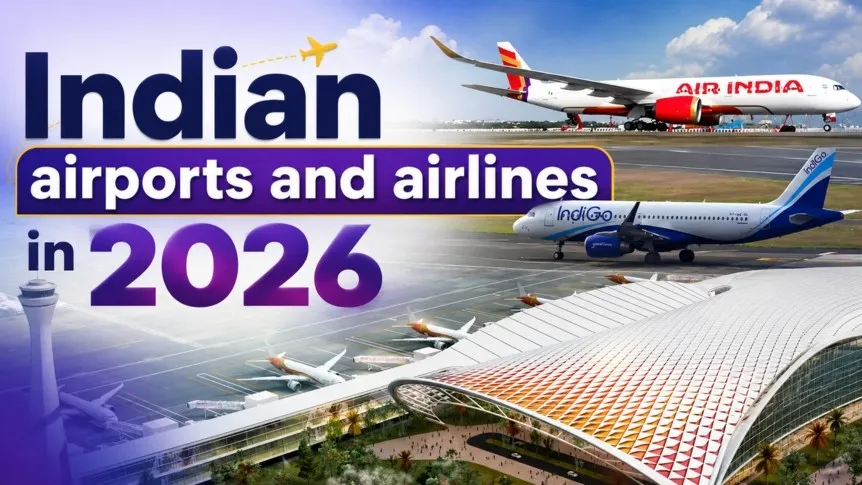
India is currently witnessing one of the most explosive aviation transformations in global history. Positioned as the third-largest domestic aviation market in the world, the Indian skies are busier, faster, and more expansive than ever before. From mega greenfield international hubs relieving choked metropolitan spaces to a scheduled airline fleet crossing 822 active aircraft, the sector is rapidly reshaping mobility for over 1.4 billion people.
Part 1: Evolution of Indian Airports – From History to Modern Mega Hubs
Historical Milestone Tracker
- 1912: Commercial aviation in India took off with the world’s first official airmail flight from Karachi to Madras (operated by Tata Sons and Imperial Airways).
- 1953: The Air Corporations Act nationalized the sector, birthing Indian Airlines (domestic) and Air India (international).
- 1972: The International Airports Authority of India (IAAI) was formed to manage major gateways, later merging into the Airports Authority of India (AAI) in 1995.
- The Privatization Wave (Late 1990s–2000s): Cochin International Airport became India’s first fully public-private partnership (PPP) airport. Soon after, Delhi, Mumbai, Bengaluru, and Hyderabad were modernized through private consortiums.
The 2026 Landscape: Mega Expansion & Greenfield Hubs
The number of operational airports across India has nearly doubled compared to a decade ago, racing toward a target of over 220 operational airports under regional connectivity schemes like UDAN.
Key Upcoming & Newly Active Mega Airports:
- Noida International Airport (Jewar, Uttar Pradesh): Designed to function as a premier multi-modal cargo and passenger hub for the National Capital Region (NCR), successfully kicking off commercial flight operations to ease massive congestion at Delhi’s IGI Airport.
- Navi Mumbai International Airport: A critical engineering marvel under phased trial and operational rollout, built to support Western India’s exploding air passenger traffic alongside Mumbai CSMIA.
- Dholera International Airport (Gujarat): Set for full phase-1 completion, positioning itself as a high-tech aviation gateway for Gujarat’s emerging smart industrial zone.
- Bhogapuram International Airport (Andhra Pradesh): Strengthening coastal connectivity between Chennai and Visakhapatnam while boosting regional trade and tourism.
Part 2: Major Indian Airlines – History, Fleet, Insights & Market Share
The commercial fleet scale has crossed 822 operational aircraft, driven by record-breaking multi-billion-dollar wide-body and narrow-body aircraft orders.
1. IndiGo (InterGlobe Aviation)
- Founded: 2006 (Commenced operations in August 2006)
- Current Fleet Size (2026): Over 432 aircraft (Dominantly A320neo, A321neo family).
- Market Share: Dominates the domestic space with a staggering 64% to 65% market share, carrying tens of millions of passengers quarterly across 143+ destinations (including nearly 50 international stops).
- Key Insight: Despite battling minor quarterly volatility from global fuel cost pressures, IndiGo remains the undisputed backbone of Indian point-to-point and regional connectivity.
2. Air India Group (Air India & Air India Express)
- Founded: 1932 (As Tata Airlines by J.R.D. Tata; nationalized in 1953; re-acquired by the Tata Group in 2022).
- Current Fleet & Network: Features a modern mixed fleet of Boeing 777s, 787 Dreamliners, cutting-edge Airbus A350s, and single-aisle A320 families alongside Air India Express operations.
- Market Share: Holds the second-largest domestic position at roughly 25.5% to 26% market share, steering aggressive transformations to capture long-haul global transit.
- Key Insight: Under Tata ownership, the airline is undergoing a multi-year consolidation and re-branding campaign to rival top global legacy carriers.
3. Akasa Air
- Founded: 2021 (Commenced operations in August 2022)
- Market Share: Steady around 5.5%, carving out a stellar operational reputation.
- Key Insight: Akasa Air consistently leads industry charts in Passenger Load Factor (PLF) hovering above 92% and superior punctuality (OTP), establishing itself as a preferred low-cost alternative.
4. SpiceJet
- Founded: 2005 (Roots dating back to ModiLuft in the 1990s).
- Market Share: Around 3.3% of the domestic market.
- Key Insight: While facing historical financial headwinds and fleet restructuring, SpiceJet remains an essential player on regional routes and continues recovery efforts under structured capital infusions.
5. Regional & Commuter Carriers (Star Air, Fly91, IndiaOne Air)
- Fleet & Focus: These regional airlines operate smaller ATR turboprops and regional jets, bridging remote Tier-2 and Tier-3 cities under the government’s UDAN (Ude Desh ka Aam Nagrik) scheme, making air travel accessible to smaller towns.
Part 3: Key Challenges and Future Outlook
- Fuel and Currency Pressures: Surging Aviation Turbine Fuel (ATF) costs and fluctuations in the USD-INR exchange rate keep operating expenditure tightly monitored across boards.
- Pilots & Engineering Talent: The massive influx of new aircraft has sparked an unprecedented demand for certified commanders, first officers, and Maintenance, Repair, and Overhaul (MRO) facilities domestically.
- Passenger Growth Projections: With international passenger traffic for Indian carriers growing steadily and domestic counts touching nearly 170 million annually, India’s skies are poised for monumental, tech-driven expansion through 2030.
Also read, Top 5 Haunted Places in India (2026 Guide): History, Legends & Mystery
Watch Latest News Videos on KRH News: Click Here