


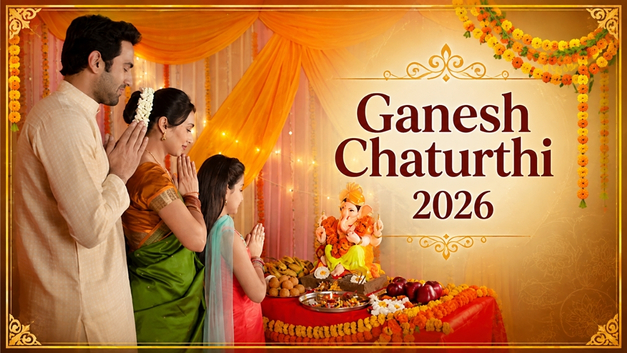
Ganesh Chaturthi 2026 will be celebrated on Monday, September 14, 2026, across India and by Hindu communities around the world. The festival marks the birth of Lord Ganesha, who is worshipped as the remover of obstacles, the god of wisdom, prosperity, good fortune and new beginnings.
The festival is also known as Vinayaka Chaturthi and Ganeshotsav. While Ganesh Chaturthi is observed for a single principal day, celebrations in many parts of India continue for several days and traditionally conclude with Ganesh Visarjan on Anant Chaturdashi.
In 2026, Anant Chaturdashi falls on Friday, September 25, marking the traditional conclusion of the 10-day Ganeshotsav period. According to the Hindu lunar calendar, Ganesh Chaturthi is observed on the Chaturthi, or fourth day, of the Shukla Paksha in the month of Bhadrapada, which generally falls during August or September in the Gregorian calendar.
The exact duration of celebrations varies between families, communities and regions. Some devotees keep Ganesha idols for one and a half days, while others observe the festival for 3, 5, 7, 10 or 11 days. Maharashtra Tourism notes that different durations are followed across communities, with the celebrations culminating in immersion.
What Is Ganesh Chaturthi?
Ganesh Chaturthi is one of the most widely celebrated Hindu festivals dedicated to Lord Ganesha.
Lord Ganesha is traditionally associated with:
- Wisdom and knowledge
- Prosperity and good fortune
- New beginnings
- Removal of obstacles
- Intelligence and learning
- Success in important undertakings
Devotees believe that worshipping Ganesha before beginning a new venture brings auspiciousness and helps remove obstacles. This is why Ganesh Puja is commonly performed before important occasions such as starting a business, beginning studies, moving into a new home or commencing a major project.
The festival is therefore not only a religious celebration but also represents hope, renewal, community and new beginnings.
History of Ganesh Chaturthi
Ganesh worship has ancient roots in Hindu religious traditions, and Ganesh Chaturthi has been observed for centuries.
However, the modern public form of Ganeshotsav in Maharashtra became especially prominent during the late 19th century.
Indian freedom activist and social reformer Lokmanya Bal Gangadhar Tilak played an important role in transforming Ganesh Chaturthi into a large-scale public festival. In 1893, Tilak encouraged public celebrations of Ganesh Chaturthi as a way of bringing people together. Public Ganesh festivals provided communities with a common platform for cultural activities, social interaction and discussions at a time when public political gatherings faced restrictions under British rule.
The public celebration subsequently became deeply associated with Maharashtra’s cultural identity and eventually spread in different forms to many other parts of India. The Government of India’s Incredible India tourism portal also credits Tilak’s 1893 initiative with transforming Ganesh Chaturthi into a major public celebration aimed at bringing people together.
From Household Worship to Community Festival
Traditionally, many families worshipped Ganesha privately at home.
Over time, especially after the growth of public Ganeshotsav, communities began installing large idols in neighbourhood pandals.
These public celebrations developed into major cultural events featuring:
- Decorative pandals
- Daily aarti
- Cultural programmes
- Music
- Community gatherings
- Social initiatives
- Processions
- Ganesh Visarjan
Today, both home-based and public celebrations remain important.
Why Is Ganesh Chaturthi Important?
Ganesh Chaturthi has religious, cultural and social significance.
1. Worship of Lord Ganesha
Ganesha is regarded as the remover of obstacles, traditionally called Vighnaharta. Devotees seek his blessings for wisdom, prosperity and success.
2. Symbol of New Beginnings
Ganesha is traditionally worshipped before important beginnings. This makes Ganesh Chaturthi particularly significant for students, entrepreneurs, families and people starting new ventures.
3. Community Unity
Public Ganeshotsav brings together people from different backgrounds within neighbourhoods and communities. Large celebrations often involve volunteers, cultural groups and local residents working together.
4. Cultural Preservation
Music, traditional decorations, aarti, devotional performances and regional customs help preserve cultural traditions and pass them on to younger generations.
5. Social Activities
Many modern Ganesh mandals use the festival to organize blood donation drives, educational activities, charity initiatives, health camps and other community programmes.
How Is Ganesh Chaturthi Celebrated?
Although customs vary, the festival generally follows a familiar pattern.
1. Bringing Home the Ganesha Idol
Families or community groups bring a Ganesha idol home or install it in a public pandal. The idol may be decorated with flowers, lights and traditional ornaments.
2. Ganesh Sthapana
The idol is ceremonially installed and worshipped. The ritual is accompanied by prayers, offerings and aarti.
3. Daily Puja and Aarti
During the festival, devotees perform daily prayers and aarti.
Offerings commonly include:
- Modak
- Fruits
- Flowers
- Coconut
- Jaggery
- Durva grass
- Other traditional sweets and offerings
Modak is particularly associated with Lord Ganesha.
4. Cultural Programmes
Public celebrations often include music, devotional performances, cultural programmes and community activities.
5. Ganesh Visarjan
At the end of the chosen celebration period, the idol is taken in a procession and immersed in water. This ritual is known as Ganesh Visarjan. The traditional belief associated with the immersion is that Ganesha returns to his divine abode after blessing devotees.
Ganesh Chaturthi Celebrations Across Different Indian States
Ganesh Chaturthi is celebrated throughout India, but every region has developed its own traditions.
Maharashtra
Maharashtra is perhaps the most famous centre of public Ganeshotsav. Mumbai and Pune are particularly well known for their large public Ganesh mandals and elaborate celebrations.
Mumbai sees thousands of household and public idols, while major pandals attract large crowds during the festival. The final Visarjan processions are among the most recognizable aspects of Mumbai’s Ganeshotsav. Pune also has a long-standing Ganeshotsav tradition, with several prominent Ganapati mandals playing an important role in the city’s cultural life.
What Makes Maharashtra Special?
- Large public pandals
- Elaborate decorations
- Traditional dhol-tasha performances
- Massive Visarjan processions
- Community celebrations
- Famous Ganapati mandals
Goa
In Goa, Ganesh Chaturthi is widely celebrated in homes and communities. The festival is locally associated with family traditions, decorated homes, devotional rituals and gatherings. A distinctive feature is the importance of the festival as a family-centred celebration, with relatives often returning home to celebrate together.
Karnataka
Karnataka celebrates Ganesh Chaturthi with both household and public events. Cities such as Bengaluru see community pandals, devotional programmes and cultural activities. In parts of Karnataka, Ganesha worship is closely integrated with local traditions and neighbourhood celebrations.
Telangana and Andhra Pradesh
Ganesh Chaturthi is celebrated on a large scale in Telangana and Andhra Pradesh. Hyderabad is particularly famous for its huge Ganesha idols and grand Visarjan processions.
The immersion procession in Hyderabad attracts large crowds and is one of the city’s major annual religious and cultural events. Ganesh Chaturthi is also widely celebrated across Andhra Pradesh through household worship and community installations. The Government of India’s Utsav portal lists Andhra Pradesh among the major states where the festival is observed with enthusiasm.
Tamil Nadu
In Tamil Nadu, Ganesh is widely worshipped as PillaiyarGanesh Chaturthi is celebrated in homes, temples and public spaces. Devotees offer prayers, sweets and flowers, while clay Ganesha idols are commonly used for the festival.
Gujarat
Ganesh Chaturthi has become increasingly visible across Gujarat, particularly in cities and urban communities. Cities such as Ahmedabad, Surat and Vadodara see household celebrations as well as community Ganesh installations.
Gujarati communities may combine traditional Ganesh Puja with local cultural programmes and community gatherings. Eco-friendly celebrations and smaller clay idols are also becoming increasingly popular.
Madhya Pradesh
Ganesh Chaturthi is celebrated across Madhya Pradesh through household worship and public events. Cities including Bhopal and Indore see community installations, cultural programmes and immersion processions.
Odisha
Although Ganesh Chaturthi is not as dominant as in Maharashtra, the festival is observed in several parts of Odisha, particularly in educational institutions, businesses and urban communities. Ganesha is especially revered among students and educational communities as a symbol of wisdom and learning.
Ganesh Chaturthi Around the World
Ganesh Chaturthi is no longer limited to India. Indian communities living abroad have carried the festival to different parts of the world.
Celebrations can be found among Hindu and Indian diaspora communities in countries including:
- United States
- United Kingdom
- Canada
- Australia
- New Zealand
- Singapore
- Malaysia
- Mauritius
- South Africa
- Fiji
- Trinidad and Tobago
- Guyana
- Suriname
The festival is also observed by Indian communities in other parts of Europe and Asia.
How Is It Celebrated Abroad?
International celebrations generally combine Indian religious traditions with local community settings.
Depending on the country, celebrations may include:
- Community Ganesh Puja
- Cultural programmes
- Indian classical music
- Dance performances
- Vegetarian community meals
- Children’s activities
- Eco-friendly idol installations
- Community Visarjan events
Because environmental rules and access to natural water bodies differ between countries, some overseas communities use designated immersion facilities or symbolic immersion practices.
Ganesh Visarjan: Why Is the Idol Immersed?
Ganesh Visarjan is one of the most emotional parts of the festival. After the chosen number of days, devotees carry the idol in a procession and immerse it in water. The immersion symbolizes the temporary nature of the physical form and the return of Ganesha to his divine abode.
The ritual also represents the broader idea that everything in the material world is temporary. The final major immersion is traditionally associated with Anant Chaturdashi, which falls on September 25 in 2026.
Why Eco-Friendly Ganesh Chaturthi Is Becoming Important
Traditional clay idols can naturally dissolve in water, but the increased use of plaster-of-Paris idols, synthetic paints and other materials has raised environmental concerns.
As a result, many devotees and organizations are encouraging:
- Natural clay idols
- Water-soluble colours
- Natural decorations
- Reusable decorations
- Artificial immersion tanks
- Smaller idols
- Community eco-friendly celebrations
Eco-friendly Ganesh Chaturthi allows devotees to maintain religious traditions while reducing the environmental impact of the festival.
Interesting Facts About Ganesh Chaturthi
1. Ganesh Chaturthi Falls on Different Gregorian Dates
Because the festival follows the Hindu lunar calendar, its date changes every year. In 2026, it falls on September 14.
2. The Festival Can Last Up to 10 Days
Many public Ganeshotsav celebrations continue from Ganesh Chaturthi until Anant Chaturdashi. However, families may choose shorter periods such as one and a half, three, five or seven days.
3. Modak Is Closely Associated With Ganesha
Modak, a traditional sweet, is one of the most commonly offered foods during Ganesh Chaturthi.
4. Ganesh Is Worshipped Before New Beginnings
Ganesha is traditionally invoked before starting important activities because he is regarded as the remover of obstacles.
5. Public Ganeshotsav Has a Strong Social History
The modern public festival in Maharashtra grew significantly after Lokmanya Tilak promoted public Ganesh celebrations in 1893.
6. Visarjan Is Not the End of Devotion
The immersion represents a symbolic farewell. Devotees continue to worship and remember Ganesha after the festival.
7. Ganesh Chaturthi Has Become a Global Festival
Indian diaspora communities around the world now organize Ganesh Chaturthi celebrations, making it an important expression of Indian culture internationally.
Ganesh Chaturthi 2026: A Festival of Faith, Culture and Community
Ganesh Chaturthi has evolved from traditional household worship into one of India’s most recognizable cultural celebrations.
From the massive Ganeshotsav celebrations of Mumbai and Pune to family celebrations in Goa, Karnataka, Gujarat and South India, the festival takes different forms while retaining its central devotion to Lord Ganesha. Its message of wisdom, new beginnings, removal of obstacles and community unity continues to make the festival relevant to millions of people.
In 2026, Ganesh Chaturthi will be celebrated on Monday, September 14, with the major 10-day Ganeshotsav period traditionally concluding on Friday, September 25, Anant Chaturdashi. As celebrations grow across India and around the world, the increasing focus on eco-friendly idols and responsible Visarjan also highlights how an ancient festival can adapt to modern environmental concerns while preserving its cultural and spiritual significance.
Also read, Krishna Janmashtami 2026: Date, History, Significance, Celebrations, Food and Traditions Across India
Watch Latest News Videos on KRH News: Click Here