


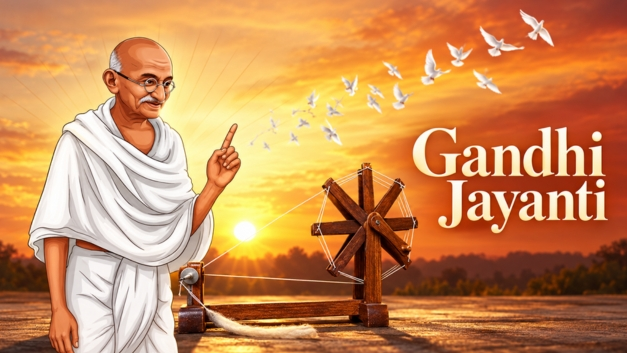
Gandhi Jayanti 2026 will be observed on Friday, October 2, 2026, marking the 157th birth anniversary of Mahatma Gandhi, who was born on October 2, 1869, in Porbandar, Gujarat. In India, the day is observed as Gandhi Jayanti, while October 2 is also recognised globally as the International Day of Non-Violence by the United Nations.
Every year, October 2 provides an opportunity to remember Gandhi’s ideas of truth, non-violence, equality, self-reliance, simplicity and service. The day is marked through prayer meetings, cultural programmes, educational activities, cleanliness drives and tributes across India.
But Gandhi Jayanti is more than a birth anniversary. It is also a day to understand how Gandhi’s ideas and methods became an important part of India’s freedom movement and later influenced movements for civil rights and peace around the world.
When Is Gandhi Jayanti 2026?
Gandhi Jayanti 2026 Date: October 2, 2026
Day: Friday
Occasion: 157th Birth Anniversary of Mahatma Gandhi
Also Observed As: International Day of Non-Violence
October 2 is observed annually in India as Gandhi Jayanti. The United Nations also observes the date as the International Day of Non-Violence following a General Assembly resolution adopted in 2007.
Who Was Mahatma Gandhi?
Mohandas Karamchand Gandhi, popularly known as Mahatma Gandhi or Bapu, was born on October 2, 1869, in Porbandar in present-day Gujarat. He studied law in London and later worked in South Africa, where his experiences with racial discrimination influenced the development of his approach to social and political action.
After returning to India, Gandhi became one of the most prominent leaders of India’s independence movement. His political philosophy emphasised Satyagraha, non-violence, truth, self-discipline and mass participation.
Gandhi used non-violent resistance as a method of challenging unjust laws and colonial rule. His approach became closely associated with several major movements during India’s struggle for independence.
Gandhi Jayanti History
Gandhi Jayanti is observed every year on October 2 because it marks Gandhi’s birth anniversary. Gandhi’s role in India’s freedom movement included participation in and leadership of several important campaigns, including the Champaran Satyagraha, Kheda Satyagraha, Non-Cooperation Movement, Salt March and Quit India Movement.
His approach sought to involve ordinary citizens in India’s independence struggle rather than treating freedom as a matter limited to political leaders. Gandhi also connected India’s freedom movement with social issues such as sanitation, removal of untouchability, village development, education, self-reliance and the promotion of indigenous products.
The Gandhi Heritage Portal records that Gandhi stayed at Sabarmati Ashram in Ahmedabad from 1917 to 1930, where the ashram became an important centre of the independence movement and his experiments with truth, non-violence, service and community life.
Why Is Gandhi Jayanti Celebrated?
Gandhi Jayanti is celebrated to remember Mahatma Gandhi’s life, contributions and philosophy.
The occasion focuses particularly on values associated with Gandhi, including:
- Truth
- Non-violence
- Peace
- Equality
- Simplicity
- Self-reliance
- Service to society
- Cleanliness
- Social harmony
The day also encourages people to think about how these principles can be applied to contemporary social life. Government institutions, schools, colleges and community organisations commonly organise programmes around these themes.
What Is the Importance of Gandhi Jayanti?
The importance of Gandhi Jayanti extends beyond India’s freedom struggle.
1. Remembering India’s Freedom Movement
Gandhi played a major role in mobilising people during India’s struggle against British colonial rule. His methods helped bring large sections of society into political movements.
2. Promoting Non-Violence
Non-violence became one of the defining elements of Gandhi’s philosophy. The United Nations’ decision to designate October 2 as the International Day of Non-Violence reflects the international relevance attributed to the principle.
3. Encouraging Social Responsibility
Gandhi connected political freedom with responsibilities within society, including sanitation, community service, equality and care for disadvantaged groups.
4. Remembering Simplicity and Self-Reliance
Gandhi promoted Swadeshi, encouraging Indians to support locally produced goods and develop greater economic self-reliance.
5. Connecting India With a Global Message
Although Gandhi’s work was closely connected with India’s independence movement, the principles associated with non-violent resistance have been discussed and applied in social and civil-rights movements outside India as well.
The United Nations notes that Gandhi’s ideas have influenced movements around the world, including those associated with figures such as Martin Luther King Jr. and Nelson Mandela.
How Is Gandhi Jayanti Celebrated in India?
Gandhi Jayanti celebrations take place across India in schools, colleges, government offices, public institutions and communities.
Prayer Meetings and Tributes
One of the most prominent observances takes place at Raj Ghat in New Delhi, where tributes are paid to Gandhi. Prayer meetings and remembrance programmes are also organised at Gandhi memorials and institutions across the country.
School and College Programmes
Educational institutions commonly organise:
- Essay writing competitions
- Speech competitions
- Drawing and poster competitions
- Quiz programmes
- Debates
- Cultural performances
- Gandhi-themed exhibitions
- Prayer meetings
- Educational presentations
These activities help students learn about Gandhi’s life, India’s freedom struggle and the principles associated with his philosophy.
Cleanliness Drives
Cleanliness and sanitation have become an important part of Gandhi Jayanti-related public activities. Government departments and community organisations have conducted cleanliness campaigns and Shramdaan activities around October 2. In 2025, for example, the Department of Posts organised a cleanliness drive and Shramdaan activity as part of Gandhi Jayanti observances.
Khadi and Handicrafts
Gandhi’s association with Khadi, village industries and Swadeshi has also made October 2 an occasion for promoting traditional and locally produced goods. The Press Information Bureau has noted that Gandhi Jayanti observances have included efforts connected with the revival of Khadi and rural industries.
Gandhi Jayanti Celebration at Raj Ghat
Raj Ghat in New Delhi is one of the most important locations associated with Gandhi Jayanti celebrations. National leaders traditionally pay tribute at Gandhi’s memorial, while prayer meetings and other commemorative activities take place.
The observance is intended to remember Gandhi’s contribution to India’s history and reflect on values such as truth, non-violence and service.
Gandhi Jayanti Celebrations in Gujarat
Gujarat has a particularly strong connection with Gandhi’s life and legacy. Gandhi was born in Porbandar, and several important locations associated with his life are located in Gujarat.
These include:
- Kirti Mandir, Porbandar
- Kaba Gandhi No Delo, Rajkot
- Sabarmati Ashram, Ahmedabad
- Kochrab Ashram, Ahmedabad
- Gujarat Vidyapith, Ahmedabad
The Gandhi Heritage Portal identifies these among the important Gandhi Heritage Sites in Gujarat.
Gandhi Jayanti in Ahmedabad
Ahmedabad holds particular significance because of Gandhi’s long association with Sabarmati Ashram. According to the Gandhi Heritage Portal, Gandhi stayed at Sabarmati Ashram from 1917 to 1930. The ashram became a centre for his activities and India’s independence movement.
The Dandi March, one of the most iconic events associated with Gandhi, also began from Sabarmati Ashram in 1930. The Gandhi Heritage Portal records that Gandhi led the Salt March from the ashram towards Dandi in South Gujarat to oppose the British salt tax. For Gujarat, therefore, Gandhi Jayanti is not only a national occasion but also an important part of the state’s historical heritage.
Gandhi and the Dandi March
The Dandi March, also known as the Salt March, became a major episode in India’s freedom struggle.
Gandhi and his followers marched from Sabarmati Ashram to Dandi to protest the British salt tax. The Gandhi Heritage Portal states that Gandhi undertook a 385-kilometre march with 80 fellow marchers over 25 days, walking approximately 15–16 kilometres a day.
The march demonstrated how a seemingly simple issue such as salt could become a powerful symbol of resistance against colonial rule. Dandi and the wider South Gujarat region therefore hold an important place in the history remembered during Gandhi Jayanti.
Gandhi Jayanti and the International Day of Non-Violence
One of the most important global aspects of October 2 is its designation as the International Day of Non-Violence. The United Nations General Assembly adopted the relevant resolution in 2007. The day is intended to promote awareness of non-violence through education and public awareness and to reinforce ideas of peace, tolerance and understanding.
This means October 2 has two connected identities:
In India: Gandhi Jayanti
Internationally: International Day of Non-Violence
This global recognition has helped extend the significance of Gandhi’s birth anniversary beyond India’s national history.
How Is Gandhi Jayanti Celebrated Around the World?
Gandhi Jayanti itself is primarily India’s national observance, while October 2 is observed internationally as the International Day of Non-Violence.
The United Nations and Indian diplomatic missions organise programmes focused on Gandhi’s message of non-violence, peace and social harmony. According to a 2025 Press Information Bureau backgrounder, commemorations have taken place in countries including Belgium, the United States, Spain, Serbia, Switzerland, Thailand, Kazakhstan and the Netherlands.
International observances can include:
- Discussions on non-violence
- Educational programmes
- Peace-related events
- Cultural programmes
- Seminars and conferences
- Tributes to Mahatma Gandhi
- Activities promoting tolerance and peaceful conflict resolution
The United Nations describes October 2 as an occasion to spread the message of non-violence through education and public awareness.
What Impact Did Mahatma Gandhi Have on India?
Gandhi’s influence on India can be seen in several areas of public life.
Impact on the Freedom Movement
Gandhi helped transform India’s independence struggle into a mass movement by encouraging participation from people across different sections of society.
Impact on Non-Violent Political Action
His use of non-violent resistance became a distinctive feature of several major campaigns against British rule.
Impact on Rural India
Gandhi placed considerable emphasis on villages, local production, rural employment and self-reliance.
Impact on Khadi and Swadeshi
Khadi became an important symbol of self-reliance and resistance to imported goods during the freedom movement.
Impact on Social Reform
Gandhi also campaigned against social discrimination and promoted sanitation, community service and social equality.
Impact on Public Life
Ideas of service, simplicity, civic responsibility and peaceful resistance remain part of the way Gandhi is remembered in Indian public life.
Gandhi Jayanti and Swachh Bharat
Cleanliness has become closely associated with modern Gandhi Jayanti observances. Government institutions have used the period around October 2 for cleanliness drives, awareness programmes and Shramdaan.
In 2025, the Department of Posts linked its Gandhi Jayanti observance with the Swachh Bharat Mission, organising cleanliness activities and highlighting Gandhi’s association with cleanliness and service. This has given Gandhi Jayanti a practical dimension: instead of limiting the occasion to speeches and ceremonies, organisations can use the day to participate in community service.
10 Ways to Celebrate Gandhi Jayanti 2026
People can observe Gandhi Jayanti in simple and meaningful ways:
- Learn about Mahatma Gandhi’s life and India’s freedom movement.
- Visit a Gandhi memorial or heritage site.
- Participate in a local cleanliness drive.
- Take part in community service or Shramdaan.
- Read about Satyagraha and non-violent resistance.
- Support local artisans and Khadi products.
- Organise an essay or quiz competition in schools.
- Discuss Gandhi’s ideas of truth and non-violence with students.
- Avoid unnecessary conflict and promote peaceful communication.
- Spend October 2 doing an activity that benefits the local community.
Gandhi Jayanti 2026: Why October 2 Still Matters
Gandhi Jayanti 2026 will mark 157 years since the birth of Mahatma Gandhi, but the occasion continues to connect India’s history with contemporary discussions about peace, non-violence, social responsibility and community service.
From Porbandar and Rajkot to Ahmedabad’s Sabarmati Ashram and Dandi in South Gujarat, Gandhi’s life is deeply connected with Gujarat’s historical landscape.
At the national level, October 2 is a day to remember India’s freedom movement and Gandhi’s contribution to it. At the international level, the United Nations’ International Day of Non-Violence gives the date a broader message centred on peace, tolerance and non-violent action.
For Gandhi Jayanti 2026, the most meaningful observance may therefore go beyond remembering a historical figure. It can also be an opportunity to understand India’s freedom struggle, learn about Gujarat’s Gandhi heritage and reflect on the continuing relevance of truth, non-violence, service and social responsibility.
Also read, October 2026 Calendar: Indian Festivals, National and International Days
Watch Latest News Videos on KRH News: Click Here