


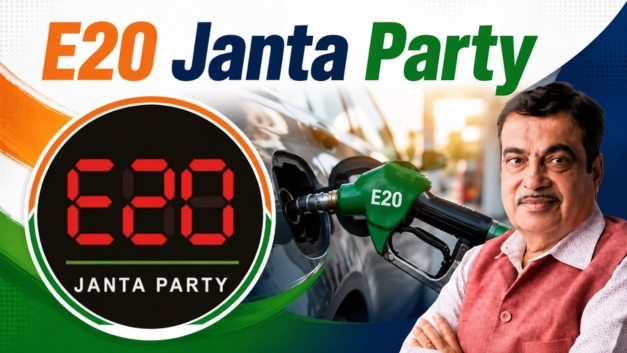
NEW DELHI – Fresh off the monumental digital and street mobilization of the “Cockroach Janta Party” (CJP) which recently rattled political corridors and culminated in high-profile government changes, a new pressure group has captured the nation’s attention. Operating under the banner of the E20 Janta Party, this emergent online campaign has put the central government’s flagship ethanol-blended fuel policy back under the public microscope.
Within hours of launching its digital handles, the movement witnessed an unprecedented surge in digital engagement, morphing overnight from a niche critique into a mainstream national debate.
The Growth Metrics & Instagram Explosion
The digital trajectory of the E20 Janta Party mirrors the rapid-fire viral growth strategy popularized by the CJP. Metrics captured across major platforms highlight how quickly public sentiment crystallized around the campaign:
- Instagram Phenomenon: Starting with modest figures, the campaign’s official Instagram handle experienced an explosive surge. Within a single day of active tracking, followers skyrocketed from under 9,000 to over 140,000 to 200,000 followers, making it one of the fastest-growing policy-critique pages on the platform.
- X (formerly Twitter) Traction: The campaign’s X account scaled rapidly past tens of thousands of active digital supporters, driving hyper-targeted hashtags like
#E20JantaPartyand#EthanolBlendedPetrolto the top of national trending charts. - Demographic Support: The core demographic fueling the movement consists of urban commuters, middle-class vehicle owners, gig-economy delivery drivers, and commercial transport operators who feel directly impacted by shifts in fuel performance.
Core Demands: Consumer Choice, Not Policy Rejection
Unlike traditional political organizations seeking seats or state power, the E20 Janta Party defines itself as an independent consumer rights advocacy group. Its organizers have repeatedly clarified that they are neither demanding government subsidies, free fuel, nor an outright termination of India’s green energy roadmap. Instead, their manifesto centers around four non-negotiable consumer demands:
- The Right to Choose (Pure Petrol Option): The primary demand insists that retail fuel bunks across India must provide an accessible option to purchase 100% unblended pure petrol alongside standard E20 fuel (20% ethanol blend), allowing owners of older or legacy internal combustion engines to protect their hardware.
- Transparent Fuel Labelling: Clear, unambiguous indicators at fuel dispensers so motorists can instantly recognize the exact ethanol composition of the fuel they are pumping.
- Data and Research Transparency: Publication of comprehensive, independent, and government-backed scientific studies detailing long-term engine wear, tailpipe emissions, mileage drops, and maintenance overheads associated with blended fuels.
- No Forced Policy Experiments: The campaign argues that personal vehicles purchased through hard-earned savings should not serve as testing grounds for macro-level state energy transitions without adequate consumer protection.
The Political Backlash and Ground Transport Backing
The digital momentum has quickly spilled over from virtual feeds into physical ground action. Major transport bodies including regional taxi, auto-rickshaw, and tourist transport unions have voiced open sympathy for the movement, pointing out noticeable drops in vehicle mileage and increased maintenance frequencies since the rollout of higher ethanol blends.
Adding a sharp political edge to the agitation, prominent online voices within the movement have directed criticism toward Union Road Transport and Highways Minister Nitin Gadkari, with radical factions even calling for accountability or resignation over the strict execution of the policy. This mirrors the playbook used during the CJP protests, which successfully maintained pressure on the establishment until major political concessions were secured.
Conversely, the central government maintains that its green transition targets are vital for reducing crude oil import dependency and lowering carbon emissions. Petroleum ministry officials have previously noted in Parliament that widespread or formally substantiated technical complaints regarding engine destruction due to E20 fuel remain limited.
Also read, CJP Demands ₹1 Crore Compensation, Action Against Police After Dharmendra Pradhan’s Resignation
Watch Latest News Videos on KRH News: Click Here