


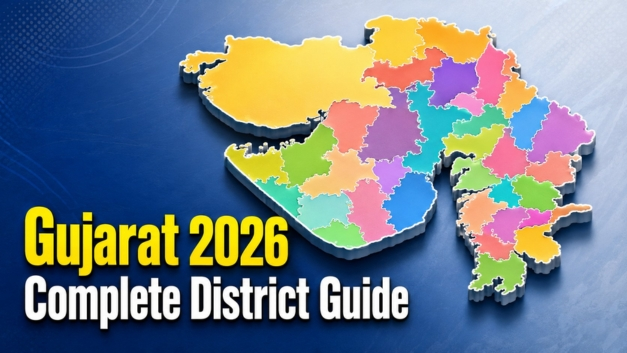
As one of India’s fastest-growing industrial and economic powerhouses, Gujarat regularly scales its administrative structure to ensure smooth governance. For students, civil service aspirants, and general knowledge enthusiasts, keeping up with these shifts is essential. A highly searched query online is: How many districts and talukas are there in Gujarat in 2026?
Following historic decentralization updates rolled out by the state government, the administrative map of Gujarat has evolved. To keep you accurately informed, KRH News presents the complete, updated guide to the districts and talukas of Gujarat.
Total Number of Districts and Talukas in Gujarat (2026)
As of 2026, Gujarat is officially divided into 34 districts and 265 talukas (administrative blocks).
For over a decade, Gujarat operated with 33 districts after a major restructuring in 2013 under then-Chief Minister Narendra Modi. However, to streamline governance and bring public offices closer to local citizens, the state cabinet headed by Chief Minister Bhupendra Patel approved the creation of Gujarat’s 34th district: Vav-Tharad. Carved out from the northern edges of Banaskantha, Vav-Tharad operates with Tharad as its administrative headquarters.
Simultaneously, the state approved the formation of 17 new talukas, expanding the total sub-district block count from 248 to 265 talukas. This marks the largest single administrative expansion in the state since 2013.
Regional Breakdown of Gujarat’s 34 Districts
To understand the geographical spread, Gujarat’s 34 districts are categorized into four distinct geographical zones.
1. Saurashtra & Kutch Region
Saurashtra and Kutch encompass the peninsular and westernmost parts of the state, heavily driven by ports, agriculture, and tourism.
- Amreli
- Bhavnagar
- Botad
- Devbhoomi Dwarka
- Gir Somnath
- Jamnagar
- Junagadh
- Kutch (The largest district in India by land area)
- Morbi
- Porbandar
- Rajkot
- Surendranagar
2. North Gujarat Region
Known for its dairy industries and historic roots, this region now includes the newly formed border district.
- Aravalli
- Banaskantha
- Gandhinagar (State Capital)
- Mahesana
- Patan
- Sabarkantha
- Vav-Tharad (The newly formed 34th district)
3. Central Gujarat Region
The commercial and educational backbone of the state.
- Ahmedabad
- Anand
- Chhota Udaipur
- Dahod
- Kheda
- Mahisagar
- Panchmahal
- Vadodara
4. South Gujarat Region
The textile, diamond, and heavy chemical industrial hub of the state.
- Bharuch
- Dang (The smallest district by area and population)
- Narmada
- Navsari
- Surat
- Tapi
- Valsad
Quick Facts for Competitive Exams (GPSC, UPSC, SSC)
If you are preparing for competitive government examinations, these critical demographic and geographic parameters are vital for your preparation:
| Feature | Entity Name | Key Statistical Data |
| Largest District by Area | Kutch | 45,674 sq km (Largest in India) |
| Smallest District by Area | Dang | 1,764 sq km |
| Most Populous District | Ahmedabad | Over 7.2 Million (2011 Census base) |
| Least Populous District | Dang | Approximately 228,000 residents |
| State Administrative Capital | Gandhinagar | Known as the ‘Green City’ |
The New Administrative Additions
The 17 newly created talukas were carved out to minimize travel time for rural residents seeking government services. Key additions include Rah (carved from Tharad), Ukai (from Songadh), Areth (from Mandvi), and Ambika (from Mahuva). These newly designed blocks receive specialized financial grants under the Chief Minister Gramotthan Yojana to accelerate urban-style local infrastructure development.
Also read, How Many States Are There in India in 2026? Full List & Facts (Updated list)
Watch Latest News Videos on KRH News: Click Here