


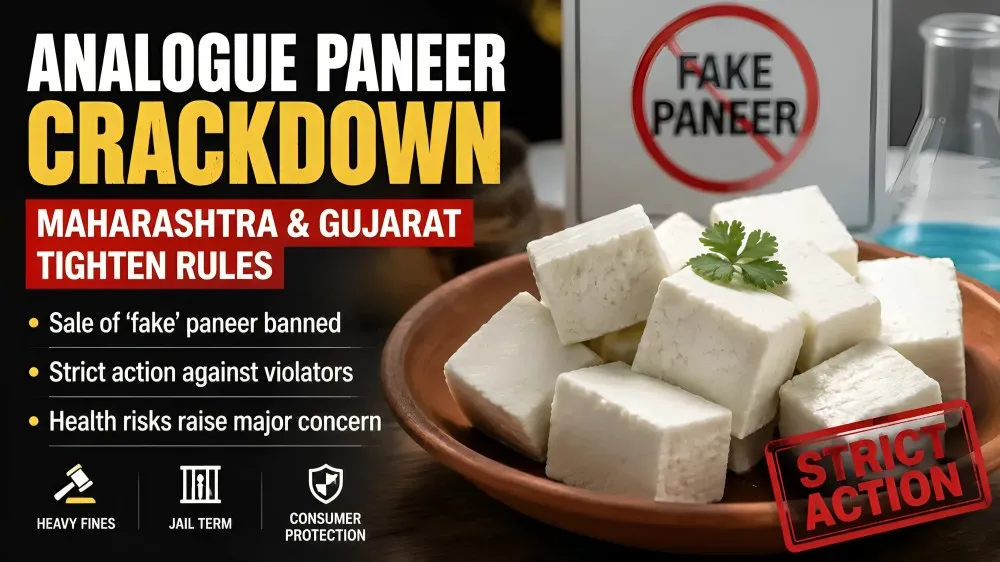
Breaking News: States Crack Down on Non-Dairy Substitutes
The beloved staple of Indian households paneer is facing unprecedented regulatory scrutiny. Following in the footsteps of Chhattisgarh, Maharashtra and Gujarat have officially cracked down on the commercial production, distribution, and sale of analogue paneer (commonly referred to as “fake” or “artificial” paneer).
With state Food and Drug Administrations (FDAs) reporting alarmingly high rates of adulteration and deceptive trade practices, governments are stepping up enforcement. Violators now face strict penalties, ranging from hefty fines to potential imprisonment.
What Exactly is Analogue Paneer?
To understand the current regulatory panic, it is crucial to understand what analogue paneer actually is.
According to the Food Safety and Standards Authority of India (FSSAI), an “analogue” is a food product where constituents not derived from milk replace either in part or in whole natural milk fats and solids.
- The Ingredients: Instead of fresh cow or buffalo milk, analogue paneer is typically manufactured using refined vegetable oils (such as palm oil), starches, emulsifiers, chemical additives, and cheap milk powders.
- The Cost Factor: It is significantly cheaper to produce than genuine dairy paneer, giving unscrupulous manufacturers and commercial operators a high-profit margin incentive.
- The Deception: While analogue products are technically legal if properly labeled and sold as non-dairy items, hotels, restaurants, and caterers have frequently passed them off as traditional, pure-milk paneer to unsuspecting consumers without disclosure.
Why Are States Imposing Bans?
1. Shocking Failure Rates in Quality Tests
In Maharashtra, a rigorous year-long surveillance and enforcement drive conducted by the FDA revealed a grim picture of the market. Out of hundreds of paneer samples collected from across the state and tested in authorized laboratories, 35.4% failed to meet prescribed standards. Authorities found widespread substitution of natural milk fats with vegetable oils, alongside unhygienic transportation without original packaging, batch numbers, or traceability labels.
2. Severe Public Health Risks
Health experts and nutritionists have raised red flags regarding the long-term consumption of analogue substitutes.
- Trans Fats and Saturated Fats: Vegetable fats and hydrogenated oils used in fake paneer can significantly increase low-density lipoprotein (LDL/bad cholesterol) levels.
- Cardiovascular Risks: Regular intake of hidden industrial fats is directly linked to chronic inflammation, obesity, and an elevated risk of heart disease.
- Nutritional Void: Traditional paneer is prized by vegetarians as a stellar source of high-biological-value protein and calcium. Analogue variants severely lack these required protein metrics, substituting them with empty, low-grade calories.
The Penalty Matrix: What Happens to Violators?
Governments are no longer treating dairy fraud as a simple administrative mistake. Under the Food Safety and Standards Act, 2006, the penalties are severe:
- General Violations (Manufacturing, Storage, Distribution): Up to 6 months of imprisonment and a fine scaling up to ₹1 lakh.
- Severe/Lethal Cases: In extreme scenarios where the consumption of adulterated or unsafe food leads to severe injury or death, provisions under the law allow for life imprisonment and minimum fines starting at ₹10 lakh.
- Unfair Trade Practices: Serving analogue paneer in restaurants and eateries without explicitly stating it on menus or invoices is classified as deliberate consumer deception.
How to Identify Real Paneer vs. Analogue Paneer at Home
Because fake paneer mimics the soft texture and white appearance of real dairy paneer almost identically, it is difficult to spot with the naked eye at a restaurant table. However, you can use these simple verification methods:
- The Iodine / Starch Test: Boil a small sample of paneer in water, let it cool, and add a few drops of iodine tincture. If the sample turns blue or black, it indicates the presence of starch a dead giveaway for analogue paneer.
- The Rubbing Test: Rub a small piece of paneer between your palms. Real dairy paneer (made from pure milk fat) will crumble slightly and release a rich, milky aroma. Analogue paneer, due to its high oil and starch content, often feels unusually rubbery, elastic, or excessively greasy.
- The Texture on Boiling: When cooked in a curry, real paneer absorbs flavors while retaining a soft, crumbly bite. Fake paneer tends to become overly chewy, rubbery, or dissolves entirely due to heavy emulsifiers and vegetable fats.
Consumer Checklist: Protecting Your Plate
- Ask Questions at Restaurants: Given that consumer affairs ministries and food safety boards are pushing for mandatory menu disclosures, don’t hesitate to ask your local diner if they source certified pure-dairy paneer.
- Check Packaging Labels: If buying packaged paneer from supermarkets, always check the ingredient list for vegetable oils, palm oil, or non-dairy starches.
- Beware of “Too Good to Be True” Prices: Pure milk paneer requires a substantial volume of milk to produce, making unusually low market prices a major red flag for chemical or oil-based substitutes.
As the regulatory net tightens across more states, India’s dairy sector is moving toward strict compliance, ensuring that consumers get what they pay for and what their bodies actually need.
Must read, Gujarat Weather Forecast (August 10 to 17, 2026): IMD Predicts Widespread Monsoon Rains Across the State
Watch Latest News Videos on KRH News: Click Here