


For many farmers, increasing income does not always mean owning more land. Sometimes, it can begin with trying a different crop on a small part of the existing farm.
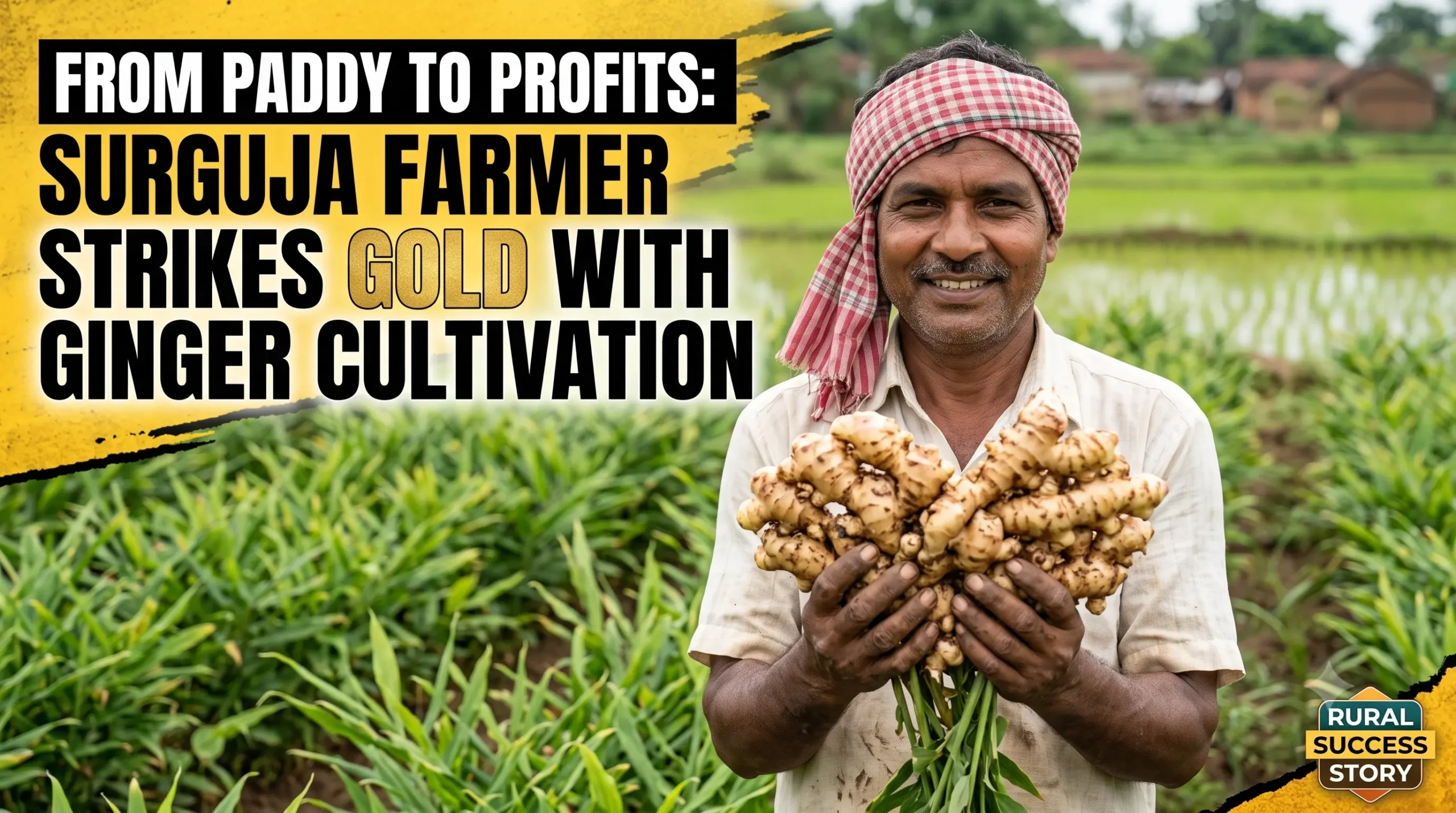
The story of Santosh Kumar Singh, a young farmer from Darima village in Chhattisgarh’s Surguja district, is one such example. Along with traditional paddy cultivation, Santosh experimented with ginger farming and, according to his account, earned around ₹4 lakh from about three-quarters of an acre after getting good production and favourable market prices.
His experience is now drawing attention as an example of how crop diversification and market awareness can potentially improve farm income.
The Experiment Started With a Small Area
Santosh Kumar Singh had been involved in traditional farming, including paddy cultivation. Instead of completely abandoning his existing farming model, he decided to experiment with ginger on a smaller portion of his land.
Last year, he cultivated ginger on approximately three-quarters of an acre and reportedly harvested around 30 to 35 quintals of ginger.
At the time, the market price was around ₹150 per kilogram, according to the report. With the combination of production and market price, Santosh said the crop generated a profit of approximately ₹4 lakh. For him, the result was significant enough to encourage him to expand the cultivation area.
From Three-Quarters of an Acre to One Acre
After seeing the results of his first ginger-farming experiment, Santosh increased the area under ginger cultivation to around one acre this year.
However, his story also highlights an important point: farming income depends on several factors, including production, input costs, weather conditions, crop quality and market prices.
Therefore, the results achieved by one farmer should not be treated as a guaranteed income figure for every ginger grower.
Why Crop Diversification Matters
Santosh’s biggest lesson is perhaps not about ginger alone. It is about not depending entirely on a single traditional crop.
Farmers can explore additional crops depending on their soil, water availability, climate and local market demand. Such diversification can provide another potential source of income while reducing dependence on one crop.
But choosing an alternative crop should be based on proper planning. Farmers need to understand cultivation costs, expected production, availability of buyers and likely market prices before making a major investment.
Market Knowledge Can Be as Important as Production
Growing a good crop is only one part of farming success. Selling it at an appropriate price is equally important.
Santosh reportedly takes his harvested ginger to the market, where the price depends on its quality. His experience shows why farmers considering cash crops should research local demand, market prices and selling channels before planting.
This approach can help farmers make more informed decisions rather than choosing a crop simply because its market price is currently high.
A Lesson for Young Farmers
Santosh Kumar Singh’s journey offers a simple message to young farmers: innovation in agriculture does not always require a huge investment or a complete change in farming methods.
A small experiment, proper planning and learning from the results can be the beginning of a bigger change.
His decision to expand ginger cultivation after seeing positive results demonstrates the importance of evaluating an idea before scaling it up.
The Bigger Message Behind the ₹4 Lakh Story
The most motivating part of Santosh’s story is not simply the reported ₹4 lakh income. It is the decision to experiment.
Starting with a relatively small area, observing the results and then increasing cultivation shows a practical approach to farming. It also demonstrates why farmers should continuously evaluate new crops and agricultural opportunities instead of relying only on traditional practices.
At the same time, ginger farming, like every agricultural activity, carries risks. Weather, disease, production costs and fluctuations in market prices can significantly affect the final income.
Santosh’s experience therefore offers inspiration, but it should be viewed as one farmer’s success story rather than a guaranteed farming formula.
Watch Latest News Videos on KRH News: Click Here