


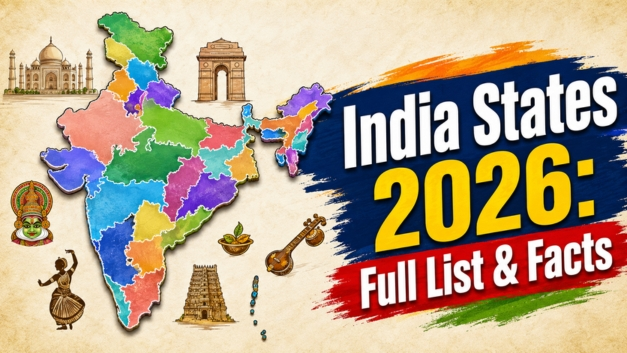
As India cements its position as the world’s most populous country, keeping track of its internal borders and administrative updates remains a top priority for students, competitive exam aspirants, and general knowledge enthusiasts. A common question continuing to trend across search engines is: How many states are there in India in 2026?
To give you the most accurate and up-to-date answer for your general knowledge and educational needs, KRH News brings you the complete, comprehensive guide to the states, capitals, and union territories of India.
Total Number of States and Union Territories in India (2026)
Currently, India is a constitutional federal republic comprising 28 states and 8 Union Territories (UTs), making a total of 36 distinct administrative entities.
While many people still mistakenly search for the “29 states of India,” the count officially changed following major geopolitical restructuring by the Central Government. In 2014, Telangana was carved out of Andhra Pradesh to briefly become the 29th state. However, in October 2019, the state of Jammu and Kashmir was reorganized into two separate Union Territories- Jammu & Kashmir and Ladakh. This transition permanently brought the total number of Indian states back down to 28.
Additionally, in January 2020, the union territories of Dadra and Nagar Haveli and Daman and Diu were merged into a single entity, finalizing the UT count at 8.
Full List of 28 States in India and Their Capitals
The administrative framework of India relies heavily on its unique regional divisions. Below is the updated, official list of all 28 states alongside their designated executive and legislative capitals:
| No. | State | Capital | Official Language |
| 1 | Andhra Pradesh | Amaravati | Telugu |
| 2 | Arunachal Pradesh | Itanagar | English |
| 3 | Assam | Dispur | Assamese |
| 4 | Bihar | Patna | Hindi |
| 5 | Chhattisgarh | Raipur | Hindi |
| 6 | Goa | Panaji | Konkani |
| 7 | Gujarat | Gandhinagar | Gujarati |
| 8 | Haryana | Chandigarh | Hindi |
| 9 | Himachal Pradesh | Shimla (Summer) / Dharamshala (Winter) | Hindi |
| 10 | Jharkhand | Ranchi | Hindi |
| 11 | Karnataka | Bengaluru | Kannada |
| 12 | Kerala | Thiruvananthapuram | Malayalam |
| 13 | Madhya Pradesh | Bhopal | Hindi |
| 14 | Maharashtra | Mumbai (Summer) / Nagpur (Winter) | Marathi |
| 15 | Manipur | Imphal | Meitei (Manipuri) |
| 16 | Meghalaya | Shillong | English |
| 17 | Mizoram | Aizawl | Mizo |
| 18 | Nagaland | Kohima | English |
| 19 | Odisha | Bhubaneswar | Odia |
| 20 | Punjab | Chandigarh | Punjabi |
| 21 | Rajasthan | Jaipur | Hindi |
| 22 | Sikkim | Gangtok | Nepali / Sikkimese |
| 23 | Tamil Nadu | Chennai | Tamil |
| 24 | Telangana | Hyderabad | Telugu / Urdu |
| 25 | Tripura | Agartala | Bengali / Kokborok |
| 26 | Uttar Pradesh | Lucknow | Hindi |
| 27 | Uttarakhand | Dehradun (Winter) / Gairsain (Summer) | Hindi / Sanskrit |
| 28 | West Bengal | Kolkata | Bengali |
The 8 Union Territories of India
Unlike states, which have their own elected local governments, Union Territories are administrative divisions directly governed by the Central Government of India, though a few possess partial self-governance via their own legislative assemblies.
List of UTs and Administrative Capitals
- Andaman and Nicobar Islands – Port Blair
- Chandigarh – Chandigarh (Serves as the joint capital for Punjab and Haryana)
- Dadra and Nagar Haveli and Daman and Diu – Daman
- Delhi (NCT) – New Delhi
- Jammu and Kashmir – Srinagar (Summer) / Jammu (Winter)
- Ladakh – Leh (Administrative Capital) / Kargil
- Lakshadweep – Kavaratti
- Puducherry – Puducherry
Essential Facts About Indian Geography for Competitive Exams
If you are preparing for UPSC, SSC, banking, or state PSC exams, these crucial geographical and population metrics are highly likely to appear on your test papers:
Largest and Smallest Entities by Area
- Largest State: Rajasthan spans a massive 342,239 sq km, making it larger than many European countries like Germany.
- Smallest State: Goa covers an area of just 3,702 sq km along India’s western coast.
- Largest UT: Ladakh holds the highest territory by area, spanning across the scenic Himalayan terrain.
- Smallest UT: Lakshadweep is an archipelago totaling just 32 sq km in land area.
Population Dynamics
- Most Populous State: Uttar Pradesh remains the most heavily inhabited state, boasting an estimated population crossing 240 million residents.
- Least Populous State: Sikkim holds the distinction of having the lowest population among all Indian states.
State Capitals with Multi-Season Variations
To optimize governance amidst challenging weather patterns, a few states maintain a dual-capital setup. For instance, Himachal Pradesh shifts its legislative focus to Dharamshala in the winter, Maharashtra moves its winter assembly to Nagpur, and Uttarakhand utilizes Gairsain as its summer administrative hub.
Also read, How Many Districts and Talukas Are There in Gujarat in 2026? Full List & Facts (Updated list)
Watch Latest News Videos on KRH News: Click Here