


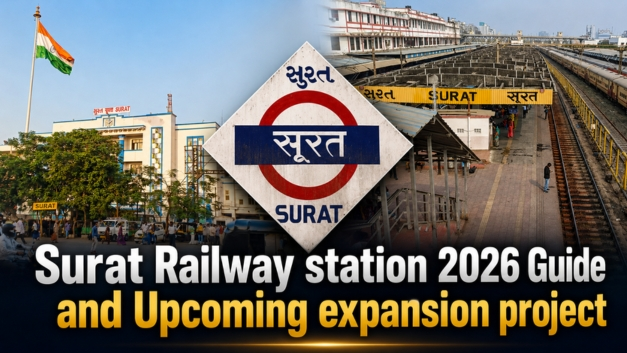
Surat, widely celebrated as India’s “Diamond City” and a booming commercial powerhouse, is undergoing one of the most ambitious infrastructure overhauls in its history. At the absolute center of this transformation is the iconic Surat Railway Station.
As part of the central government’s Amrit Bharat Station Scheme, the station is rapidly morphing into a world-class Multi-Modal Transport Hub (MMTH). Handled by the Surat Integrated Transportation Development Corporation Limited (SITCO)- a powerhouse joint venture of the Ministry of Railways, GSRTC, and the Surat Municipal Corporation (SMC)- this multi-crore mega-development is officially pacing ahead in 2026.
Here is your definitive 2026 guide to the history, records, features, and upcoming expansion details of the Surat Railway Station.
The Golden History and Fast Facts of Surat Railway Station
A Quick Historical Glance
The initial foundation of Surat’s modern rail connectivity dates back to the British era when the Western Railway line connected the textile hub to Mumbai and Ahmedabad. However, the existing main station building was constructed post-independence in 1952. For over seven decades, this structure served as the primary gateway for millions of traders, weavers, diamond merchants, and tourists entering South Gujarat.
Key Facts and Records
- Strategic Junction: Operating under the Mumbai WR division, Surat is historically one of the highest revenue-generating and busiest railway stations in India.
- Massive Passenger Footfall: The station currently handles hundreds of thousands of daily commuters, a number projected to cross 5 lakh (500,000) passengers daily upon full expansion.
- Economic Lifeline: It serves as the primary transit vein for India’s largest synthetic textile market and the world’s largest diamond cutting and polishing industry.
The 2026 Mega Expansion: Transforming into an MMTH
The limitations of the 1952 building have paved the way for a futuristically designed transport system. The total estimated cost of this massive redevelopment project stands at a staggering Rs 1,500 crore.
According to Western Railway updates, the mega-project is being executed in a phased manner with a 50-year future vision in mind. The project has achieved a massive milestone with 50% physical progress achieved on Phase 1 (valued at Rs 980 crore).
1. Seamless Integration of 5 Transport Modes
The ultimate goal of the Surat MMTH is to make travel completely seamless. Once fully ready, a passenger can switch between five different modes of transit under one roof without ever stepping onto the congested city streets:
- Indian Railways network
- Surat Metro Rail (underground and elevated lines)
- GSRTC Interstate Bus Terminal (ISBT)
- BRTS / City Bus Services
- Intermediate Public Transport (IPT) like auto-rickshaws and taxis
2. The Futuristic Central Deck and Station Layout
The station layout is split cleanly into East-Side and West-Side buildings. Unifying these structures at the second level is an architectural marvel: a massive Central Concourse/Deck measuring 145 meters by 85 meters.
Acting as a passenger interchange plaza, this sustainable deck features a seating capacity for over 2,000 people at any given second. It will house centralized ticketing, premium waiting lounges, world-class retail spaces, and a massive food court.
3. Upgraded Rail Track Infrastructure and Platforms
To eradicate delays and increase train handling capacity, major expansion works are underway on the tracks:
- Suburban Infrastructure: Alongside the existing 4 platforms, two additional suburban platforms are being constructed- one dedicated toward Vadodara and the other toward Mumbai.
- Long Distance Trains: Two more platforms for mail and express trains are in the planning pipeline to accommodate 24-car trains easily.
Best Smart and Green Amenities to Look Out For
The 2026 expansion isn’t just about size; it’s about smart, eco-friendly, and inclusive engineering.
- World-Class Accessibility: The new complex will feature a network of 45 high-speed lifts and 70 escalators, alongside fully wheelchair-accessible, ‘Divyangjan-friendly‘ facilities.
- 5-km Elevated Ring Road: To eliminate the notorious traffic congestion around the station area, an elevated corridor extending over 4 kilometers is being constructed to connect all sides of the hub seamlessly.
- Green Building Infrastructure: The hub is heavily integrated with a Building Management System (BMS), solar roof panels, rainwater harvesting, and advanced on-site solid waste management.
Project Timeline: What Lies Ahead?
While the newly constructed Gujarat State Road Transport Corporation (GSRTC) terminal building is already complete and operations are scaling up, the extensive core station redevelopment of Phase 1 is racing toward its final targeted completion date of December 2027.
As Surat expands its boundaries and targets a population of over 8 million by 2035, this Multi-Modal Transport Hub is set to stand as a definitive global landmark of modern Indian engineering.
Also read, Surat International Airport: Everything You Need to Know (Updated Guide 2026)
Watch Latest News Videos on KRH News: Click Here