


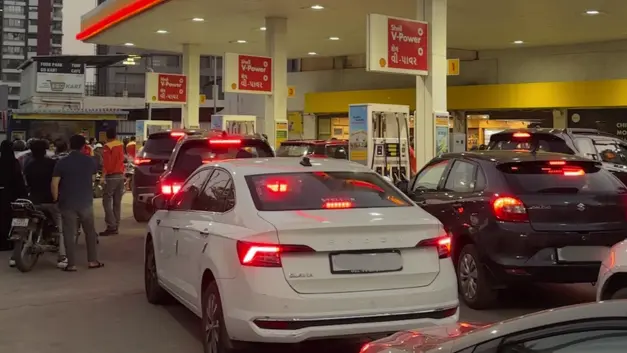
Common Man Hit Hard as State-Run Oil Companies Pass on Mounting Losses Amid Rising Global Crude Pressures
Petrol, Diesel Prices Rise Again: Domestic fuel consumers woke up to another financial jolt on Tuesday, May 19, 2026, as state-run Oil Marketing Companies (OMCs) implemented a fresh round of retail price revisions. In the second price hike within a mere five days, retail prices for both petrol and diesel were scaled up by approximately 90 paise per litre across the nation.
Following this revision, a litre of petrol in New Delhi escalated by 87 paise, shifting from ₹97.77 to ₹98.64. Concurrently, the price of diesel in the national capital climbed by 91 paise, moving from ₹90.67 to ₹91.58. Financial hubs and other major metropolitan cities experienced a proportional surge depending on local value-added taxes (VAT), pushing Mumbai’s petrol prices closer to the ₹108 mark, while Hyderabad recorded petrol crossing ₹111 per litre.
Understanding the Back-to-Back Hikes in May 2026
This latest price adjustment comes on the heels of a massive ₹3 per litre hike enacted just last Friday. That initial hike ended a nearly four-year-long historic freeze on retail fuel revisions maintained by state-run fuel providers.
The primary catalyst forcing the hands of Indian oil corporations is a sharp, volatile spike in global crude benchmarks. Following a series of severe geopolitical conflicts in West Asia, including military strikes impacting Iran and subsequent logistical disruptions along the strategic Strait of Hormuz shipping route, the Indian crude basket has averaged a steep $106.69 per barrel since the start of May. On Tuesday morning, international Brent crude futures continued their upward trajectory, trading firmly above $109 per barrel.
For months, domestic retail rates were insulated from real-time global market trends to shield price-sensitive consumers. However, with oil marketing companies running heavy under-recoveries, passing a fraction of the structural losses onto retail consumers became unavoidable.
Beyond Petrol and Diesel: The Rising Cost of Alternate Fuels
The ongoing energy crisis is not confined entirely to conventional liquid fuels. Commuters using clean transit alternatives have faced sequential financial adjustments over the past week as well. Compressed Natural Gas (CNG) prices experienced an increment of ₹2 per kg on May 15 across metropolitan distributions, followed swiftly by an additional Re 1 per kg hike this past Sunday.
Commercial LPG cylinders have similarly faced volatile market pricing, hitting a high of ₹3,071.50 following recent revisions, though domestic cooking gas (LPG) remains strictly monitored at approximately ₹913 per cylinder to protect household expenditures.
Economic Implications and the Growing Impact on Households
Economic analysts warn that consecutive price hikes in transport fuels will trigger a cascading effect on essential supply chains. Daily logistics, freight forwarding, and agricultural distribution rely heavily on diesel transport, meaning a prolonged high-price environment will directly feed into broader wholesale and consumer retail food inflation.
For the middle-class segment and daily commuters navigating localized transport expenses, the dynamic changes have immediate household impact. Local commuters using personal two-wheelers and commercial taxi networks have expressed deep concerns regarding immediate budgeting, urging the central government to consider a rationalization of central excise duties and state-level VAT structures to absorb future geopolitical price shocks.
With international crude volatility showing no signs of cooling down due to tight global supplies and intense naval monitoring near critical sea lanes, industry sources hint that further minor fuel price adjustments could remain on the horizon if international costs do not stabilize.
Also read, India Hikes Gold and Silver Import Duty to 15% to Support Rupee
Watch Latest News Videos on KRH News: Click Here