


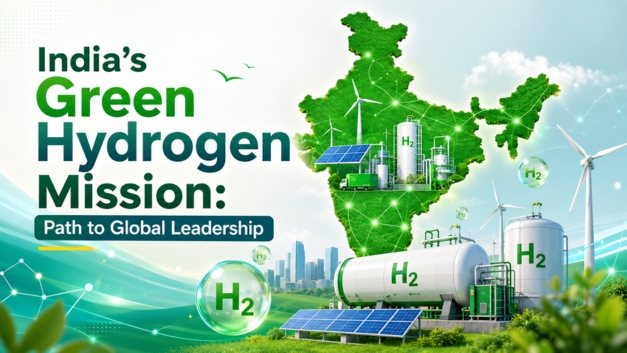
India’s National Green Hydrogen Mission: The global energy landscape is undergoing a monumental shift. As nations race to achieve Net-Zero targets, green hydrogen has moved from an experimental alternative to the undisputed fuel of the future. At the very forefront of this transformation is India.
With an ambitious vision to break away from crude oil import dependency and decarbonize hard-to-abate heavy industries, the National Green Hydrogen Mission is positioning India not just as a self-reliant energy nation, but as a dominant global exporter.
Here is an in-depth, high-intent look at how India is building an unrivaled green hydrogen ecosystem, the core policies driving it, and the milestones achieved so far.
What is India’s National Green Hydrogen Mission?
Launched with an initial financial outlay of ₹19,744 crore, the National Green Hydrogen Mission (NGHM) is a strategic roadmap designed to scale up green hydrogen production, build domestic electrolyser manufacturing capabilities, and integrate clean fuel into heavy industries like steel, petroleum refining, and fertilizer production.
Unlike grey or blue hydrogen, which rely on fossil fuels, green hydrogen is produced via water electrolysis powered entirely by renewable energy (solar and wind).
The Core Pillars of the India’s National Green Hydrogen Mission:
- The SIGHT Programme (₹17,490 crore): Strategic Interventions for Green Hydrogen Transition offers direct financial incentives for manufacturing electrolysers and producing green hydrogen.
- Pilot Projects (₹1,466 crore): Supporting early-stage adoption across commercial shipping, steel plants, and long-haul transport routes.
- Research & Development (₹400 crore): Scaling up next-generation, globally competitive technologies under public-private partnerships.
Crucial Targets: The 2030 Clean Energy Vision
The Government of India has outlined highly specific, quantifiable milestones to be achieved by 2030. These targets underscore the immense scale of the infrastructure shift currently underway:
| Metric / Objective | Target Goal by 2030 |
| Annual Green Hydrogen Production | At least 5 MMT (Million Metric Tonnes) per annum |
| Associated Renewable Energy Capacity | Direct addition of approximately 125 GW |
| Total Ecosystem Investment | Over ₹8 Lakh Crore ($90+ Billion) |
| Employment Generation | Creation of over 4.4 Million (44 Lakh) clean energy jobs |
| Fossil Fuel Import Reduction | Cumulative savings exceeding ₹1 Lakh Crore |
| Carbon Abatement | Preventing nearly 50 MMT of annual greenhouse gas emissions |
On-Ground Execution: Where India Stands Today
Moving swiftly beyond policy roadmaps, the rollout has entered a definitive phase of industrial execution. Recent data highlights incredible ground-level momentum:
- Production Capacity Growth: As of early 2026, around 8,000 tonnes per annum (TPA) of green hydrogen capacity has already been successfully commissioned across select refineries and steel plants, with a pipeline surging toward 40,000 TPA.
- Electrolyser Manufacturing Boost: Under the SIGHT program, manufacturing contracts totaling 3,000 MW per annum have been awarded to 15 leading domestic and international companies to fast-track localized manufacturing.
- Green Offtake Agreements: Major state-run entities have completed massive commercial biddings. For instance, long-term supply agreements for green ammonia to fertilizer units were locked in at competitive rates of ₹55.75 per kg.
- Standardization & Certifications: The Ministry of New and Renewable Energy (MNRE) officially notified distinct national standards for green ammonia and green methanol, launching the Green Hydrogen Certification Scheme of India to streamline international export verification and track carbon credit linkages.
Why India Holds a Distinct Global Advantage
The global cost of producing green hydrogen is heavily dictated by input power costs. According to data from the World Bank Group, renewable power accounts for roughly 50% to 70% (approx. ₹235 per kg) of the total production cost.
This reality places India in an exceptionally dominant position due to three critical factors:
1. Ultra-Low Renewable Tariffs
India boasts some of the lowest solar and wind power generation costs in the world. By deploying mega solar parks and establishing dedicated Green Energy Corridors, India can generate the massive volumes of cheap electricity required to feed electrolysers efficiently.
2. Aggressive Policy Waivers
To eliminate financial friction, the government has fully waived Inter-State Transmission System (ISTS) charges for green hydrogen production facilities commissioned before December 2030. Additionally, 100% Foreign Direct Investment (FDI) is permitted through the automatic route, pulling massive global capital into the domestic sector.
3. Immediate Domestic Demand Co-location
Unlike countries that must build expensive international supply chains to sell their hydrogen, India possesses a massive built-in domestic market. Coastal ports like the Deendayal Port in Kandla and V.O. Chidambaranar Port are being developed into hyper-localized Green Hydrogen Hubs, co-locating production with fertilizer plants, refineries, and shipping terminals to eliminate initial logistical costs.
The Hurdles Ahead: Efficiency and Grid Infrastructure
While the path to leadership is clear, the clean energy transition is not without its roadblocks. The primary challenge remains electrical efficiency. Producing 1 kg of hydrogen demands roughly 50 to 55 units of green electricity, and the process of conversion and compression involves inherent energy losses.
As consumption spikes over the coming decade, keeping pace by reinforcing grid infrastructure, eliminating transmission congestion, and closing the initial project financing liquidity gaps will be vital to keeping domestic production cost-competitive on the global stage.
Final Thoughts: The Clean Energy Superpower
India’s National Green Hydrogen Mission is a masterclass in combining aggressive industrial policy with natural geographical advantages. By driving down the cost of production toward the target goal of $1.5 per kg, India is systematically rewriting its economic future.
The transition protects the country against volatile global oil crises, cleans up heavy industries, and opens up multi-billion dollar clean derivative export opportunities to Europe and parts of Asia. What started out as a climate target is officially paving the definitive path to global energy leadership.
Also read, World Environment Day 2026: Theme, Key Facts, and the Crucial Future of Our Earth
Watch Latest News Videos on KRH News: Click Here