


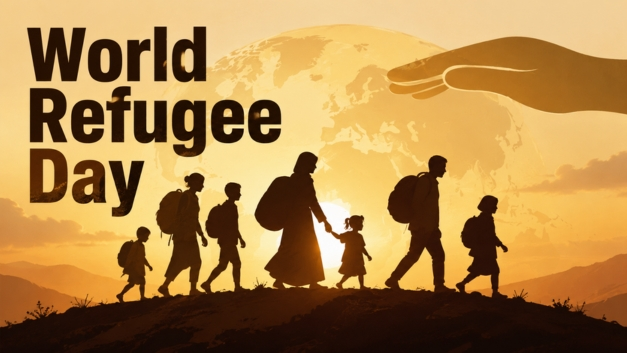
World Refugee Day 2026: On June 20, 2026, the global community observes World Refugee Day. This international day, designated by the United Nations honors the courage, strength, and resilience of millions of individuals forced to flee their homelands to escape conflict, persecution, or systemic violence.
The year 2026 carries profound historical significance. It marks the 75th anniversary of the 1951 Geneva Convention– the foundational international treaty that first defined and protected the legal rights of refugees worldwide. Yet, as the world reflects on this milestone, human displacement has escalated to the highest levels ever recorded in modern history.
Here is an in-depth breakdown of World Refugee Day 2026, the global numbers, and where India stands amid the crisis.
The Theme for 2026: “Until Everyone Is Safe”
The official UNHCR campaign theme for World Refugee Day 2026 is “Until Everyone Is Safe”. This directive serves as a reminder that safety is not divisible; no community is entirely secure while vulnerable, displaced populations are denied basic legal protections, dignity, and a real chance to rebuild their fractured lives.
Simultaneously, international humanitarian groups are championing the core value of Courage highlighting the daily, invisible bravery of families who must navigate entirely new societies, languages, and economies from scratch.
The Brief History of World Refugee Day
For decades, various regional factions observed localized events, most notably Africa Refugee Day. However, on December 4, 2000, the United Nations General Assembly officially adopted a resolution to align international awareness.
The UN designated June 20 as World Refugee Day to coincide with the 50th anniversary of the 1951 Convention relating to the Status of Refugees. The first official global observance took place on June 20, 2001.
The 2026 Global Situation: A Crisis of Unprecedented Scale
The gap between growing humanitarian needs and the resources available to meet them has reached a critical tipping point.
- The Massive Scale: According to tracking reports from the UNHCR and humanitarian groups, over 123 million individuals are currently living in a state of forced displacement globally. This means roughly 1 in every 67 people on Earth has been uprooted.
- Refugees vs. IDPs: Out of this staggering total, the vast majority are actually Internally Displaced Persons (IDPs). IDPs account for roughly 70% of the displaced population; they have fled their homes for the exact same survival reasons but have not crossed an international border.
- The Resettlement Deficit: The UNHCR estimates that over 2.5 million refugees worldwide are in urgent need of permanent resettlement to a third country in 2026, but global placement slots remain severely limited.
Major ongoing geopolitical conflicts, economic collapses, and climate-induced environmental disasters continue to drive populations out of regions like Ukraine, Syria, Sudan, Afghanistan, and parts of Latin America.
The Situation in India: A Unique and Complex Reality
India’s relationship with refugees is historically rich yet legally distinct from Western frameworks.
1. A History of Open Arms
Despite its dense population and domestic challenges, India has historically been a massive safe haven in South Asia. The country hosts hundreds of thousands of refugees from neighboring nations across different eras, including:
- Tibetans: Hosting the Central Tibetan Administration in Dharamshala since 1959.
- Sri Lankan Tamils: Tens of thousands residing across specialized camps in Tamil Nadu.
- Chakmas and Hajongs: Displaced from present-day Bangladesh.
- Afghan and Rohingya Populations: Fleeing conflict and targeted persecution.
2. The Legal Matrix: Why India is Different
Unlike most major democracies, India is not a signatory to the 1951 UN Refugee Convention or its 1967 Protocol. Furthermore, India does not possess a specific, unified domestic law defining or managing “refugees.”
Consequently, the Indian government legally classifies all undocumented cross-border entrants under the Foreigners Act of 1946. This gives the state absolute administrative discretion to treat displaced populations on a case-by-case, community-by-community basis through ad-hoc political policies rather than standardized international legal obligations.
3. The Current Tension
In 2026, India continues to balance its long-standing humanitarian ethos with strict national security concerns. While the government routinely coordinates with the UNHCR office in New Delhi to issue identity cards to certain urban asylum seekers, undocumented migration from neighboring borders remains a highly sensitive political and legal debate regarding resource distribution and regional demographic balance.
Why This Day Matters: Moving Beyond Awareness
World Refugee Day is not just a date to audit grim global statistics. It is a call to action for civil societies to support localized integration. True refugee protection requires offering people basic human dignity: the right to work legally, access comprehensive healthcare, enroll children in schools, and live free from systemic xenophobia or political weaponization.
Also read, World Elder Abuse Awareness Day 2026: Moving “Beyond Awareness” to Protect Our Global Elders
Watch Latest News Videos on KRH News: Click Here