


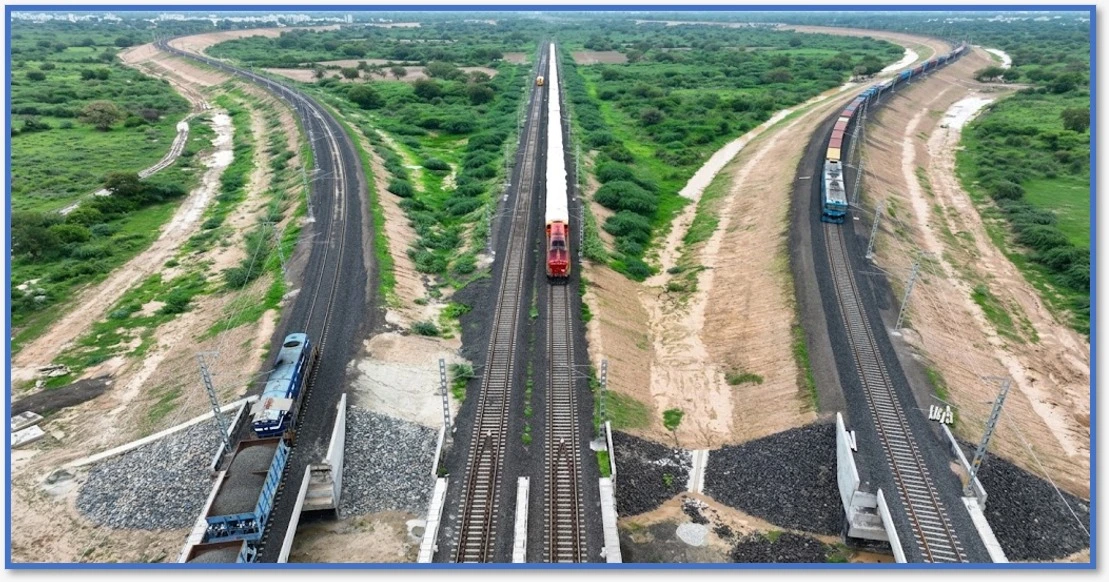
Vadodara, September 10, 2026: The Western Dedicated Freight Corridor (WDFC) has reached a major milestone with the completion and commissioning of its entire 1,504-km route, establishing direct freight connectivity between Dadri in Uttar Pradesh and Jawaharlal Nehru Port (JNPT) in Maharashtra.
The project, developed with financial and technical assistance from the Japan International Cooperation Agency (JICA) and implemented by the Dedicated Freight Corridor Corporation of India Limited (DFCCIL) under the Ministry of Railways, marks a significant achievement in India’s freight and logistics infrastructure.
Prime Minister Narendra Modi on Wednesday dedicated key completed sections of the Western Dedicated Freight Corridor to the nation from Vadodara, Gujarat.
Big Highlight: 1,504-Km Western Dedicated Freight Corridor Completed
The completion of the WDFC provides a direct freight railway connection between Dadri and JNPT, creating a dedicated high-capacity route for the movement of goods across some of India’s most important industrial and commercial regions.
The corridor passes through major economic regions and connects industrial centres in Uttar Pradesh, Haryana, Punjab, Rajasthan and Gujarat with important port and market networks in western India.
Key WDFC Figures at a Glance
| Project | Details |
|---|---|
| Total WDFC Length | 1,504 km |
| Connectivity | Dadri to JNPT |
| Major sections dedicated | 326 km |
| Cost of three sections | ₹20,703 crore |
| JICA ODA loan | JPY 620,787 million |
| Approx. Indian value of JICA loan | ₹37,658 crore |
| Key implementing agency | DFCCIL |
| Financial & technical partner | JICA |
| Major port connected | JNPT |
| Project milestone | Entire WDFC commissioned |
₹20,703 Crore Investment in Three Major Sections
During the event in Vadodara, three important sections with a combined length of 326 km were dedicated to the nation.
These include:
- New Sanand North – New Makarpura
- New Umargam – New Saphale
- New Saphale – New JNPT
The combined construction cost of these three sections is reported at approximately ₹20,703 crore.
The commissioning of these sections completes the direct rail connectivity required to connect the WDFC network with Jawaharlal Nehru Port Authority (JNPA).
India-Japan Partnership Gets Major Boost
The completion of the WDFC is also being viewed as an important milestone in the long-term India-Japan infrastructure partnership.
JICA has provided substantial financial and technical support for the project. According to the information released regarding the project, JICA has extended a total Official Development Assistance (ODA) loan of JPY 620,787 million, equivalent to around ₹37,658 crore.
The funding has supported the development and modernisation of the freight corridor and India’s broader efforts to strengthen logistics infrastructure.
JICA’s assistance has combined financing with technical cooperation, making WDFC an important example of bilateral infrastructure collaboration.
What Is the Western Dedicated Freight Corridor?
The Western Dedicated Freight Corridor is a specialised railway freight route designed to separate a significant portion of freight movement from conventional passenger-and-freight railway routes.
Instead of freight trains competing for railway capacity with passenger services on heavily utilised routes, a dedicated freight corridor provides infrastructure specifically designed for goods transportation.
The WDFC connects Dadri in Uttar Pradesh with JNPT near Mumbai, covering a total distance of approximately 1,504 km.
Its strategic location allows freight movement between northern India’s industrial regions and western India’s ports and commercial centres.
Faster Freight Movement and Lower Logistics Costs
One of the biggest expected benefits of the completed WDFC is improved efficiency in India’s logistics network.
The dedicated corridor is expected to help:
- Reduce freight transportation time
- Improve the reliability of goods movement
- Reduce logistics costs
- Increase railway freight capacity
- Improve connectivity with major ports
- Support industrial growth along the corridor
- Reduce pressure on conventional railway routes
- Strengthen India’s multimodal logistics network
Faster movement of goods between industrial centres and ports can also improve supply-chain efficiency for manufacturers, exporters and other businesses.
Mumbai Railway Network to Get Relief
The WDFC is also strategically important because it can help reduce freight traffic on existing railway routes around Mumbai.
Mumbai’s railway network carries large volumes of passenger and freight traffic. Moving more freight through a dedicated corridor can free up capacity on conventional routes.
This can potentially improve operational efficiency for both freight and passenger railway services.
Major Industrial Regions Connected
The Western Dedicated Freight Corridor connects several strategically important industrial and economic regions.
The network provides connectivity between industrial areas in:
Uttar Pradesh – Haryana – Punjab – Rajasthan – Gujarat – Maharashtra
The corridor also connects these industrial regions with major ports, including JNPT, strengthening the movement of goods destined for domestic markets as well as international trade. Areas around Palghar, Thane and Raigad in Maharashtra are among the important industrial regions that benefit from improved connectivity to northern and western India’s economic centres.
Gujarat’s Role in the Western Freight Corridor
The completion of key sections in Gujarat makes the state an important part of the WDFC’s western network.
The New Sanand North–New Makarpura section is particularly significant for Gujarat because it strengthens freight connectivity between industrial areas around Ahmedabad and Vadodara and the wider dedicated freight network. Improved freight connectivity can support Gujarat’s manufacturing, industrial and export-oriented sectors by providing more efficient access to ports and national markets.
JICA Calls WDFC More Than Just a Railway Project
JICA India Chief Representative Takeuchi Takuro described the WDFC as more than a railway infrastructure project, highlighting the long-term cooperation and commitment behind its development.
According to JICA, the project demonstrates what can be achieved through sustained cooperation and long-term infrastructure investment. The project is also expected to strengthen the strategic partnership between India and Japan, particularly in infrastructure development and economic growth.
What Does WDFC Mean for India’s Logistics Sector?
India has been working to improve logistics efficiency and reduce the cost and time involved in transporting goods across the country.
Dedicated freight corridors are an important part of this strategy.
The completed WDFC can provide:
Higher freight capacity: Dedicated infrastructure allows more freight trains to operate efficiently.
Improved port connectivity: Direct connectivity with JNPT can facilitate movement between ports and inland industrial centres.
Better supply chains: More predictable freight movement can help businesses manage inventories and transportation schedules.
Reduced congestion: Shifting freight movement to dedicated infrastructure can reduce pressure on conventional railway routes.
Industrial development: Improved transportation infrastructure can encourage investment and economic activity around connected regions.
Why the WDFC Completion Is Important
The completion of the 1,504-km Western Dedicated Freight Corridor represents a major transformation in India’s railway freight infrastructure. More importantly, the project connects India’s northern industrial heartland with one of the country’s most important maritime gateways.
For businesses, manufacturers, exporters and logistics operators, improved rail connectivity can translate into a more efficient movement of goods. For India, the project represents another major step toward building a modern, integrated and high-capacity logistics network.
India-Japan Infrastructure Cooperation: A Long-Term Partnership
The WDFC is one of the prominent examples of India’s infrastructure cooperation with Japan.
Through JICA, Japan has provided long-term financial assistance and technical cooperation for major development projects in India. The WDFC demonstrates how international development finance and technical expertise can contribute to large-scale infrastructure projects designed to support economic growth over several decades.
Key Highlights
🔹 1,504 km — Total length of the completed WDFC
🔹 Dadri to JNPT — Direct freight connectivity across northern and western India
🔹 326 km — Combined length of the three major sections dedicated on September 9
🔹 ₹20,703 crore — Construction cost of these three sections
🔹 ₹37,658 crore — Approximate value of JICA’s total ODA loan
🔹 JPY 620,787 million — Total JICA ODA loan
🔹 Vadodara — Venue from where Prime Minister Narendra Modi dedicated the key completed sections
🔹 India-Japan partnership — Major example of bilateral infrastructure cooperation
Western Dedicated Freight Corridor: The Road Ahead
With the WDFC now fully operational, attention will shift towards maximising the corridor’s freight-handling capacity and integrating it with India’s wider logistics and transportation network.
The corridor’s direct connection to JNPT can strengthen the relationship between India’s manufacturing centres, logistics hubs and maritime trade gateways.
The project is therefore not simply a new railway route but an important component of India’s long-term effort to create a faster, more efficient and better-connected freight transportation system.
Conclusion
The completion of the 1,504-km Western Dedicated Freight Corridor marks a major milestone for Indian Railways, DFCCIL and India’s logistics infrastructure.
With Dadri now directly connected to JNPT, the corridor is expected to improve freight movement between northern India’s industrial centres and western India’s ports.
The project also represents a significant achievement in the India-Japan infrastructure partnership, backed by JICA’s financial and technical support.
As India’s freight demand continues to grow, the WDFC could play an increasingly important role in reducing transportation bottlenecks, improving logistics efficiency and supporting industrial and economic growth.
Also read, Gujarat to Get ₹30,766 Crore Railway Projects as PM Modi Visits Vadodara
Watch Latest News Videos on KRH News: Click Here