


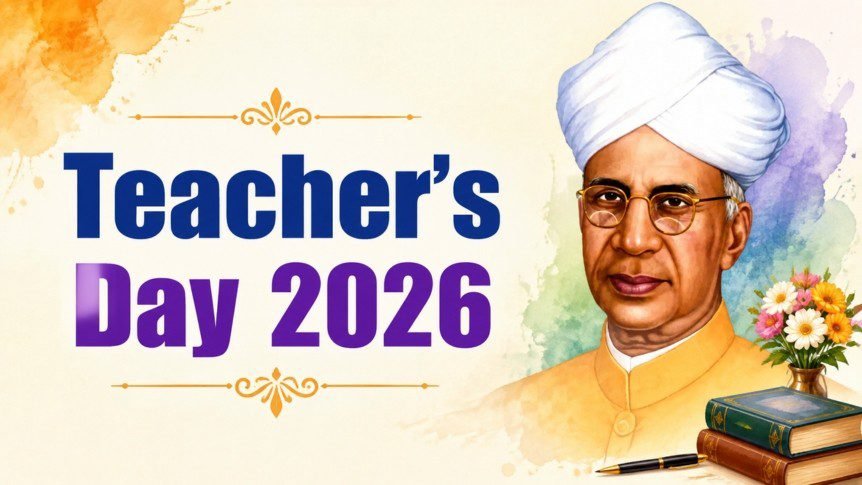
Every year, September 5 brings back a familiar feeling to schools and colleges across India. Classrooms look a little different. Students prepare performances, write thank-you notes, organise activities and sometimes even take on the role of teachers for a day. For many people, Teachers’ Day brings back memories of the teacher who encouraged them, corrected them when they needed it and perhaps said something that stayed with them for years.
In India, Teachers’ Day is celebrated every year on September 5. The date is not random. It marks the birth anniversary of Dr. Sarvepalli Radhakrishnan, one of India’s most respected philosophers, educators and former Presidents.
In 2026, Teachers’ Day will be celebrated on Saturday, September 5. But the day is about much more than greeting teachers or organising a school function. It is an opportunity to think about the role teachers play in shaping individuals, communities and the future of a country.
When is Teachers’ Day 2026 in India?
Teachers’ Day 2026 in India will be celebrated on Saturday, September 5, 2026.
The day is observed annually to honour teachers and recognise their contribution to education and society. Unlike some public holidays, Teachers’ Day is primarily an educational and commemorative occasion. Schools, colleges and educational institutions generally organise their own programmes and activities.
Why is Teachers’ Day celebrated on September 5?
The reason goes back to Dr. Sarvepalli Radhakrishnan, who was born on September 5, 1888. Radhakrishnan was a distinguished philosopher, scholar and teacher who went on to become India’s first Vice President and second President.
According to the official profile of the President of India, his birthday is celebrated as Teachers’ Day in India as a tribute to his contribution to education and philosophy. There is a popular story behind the choice of the date.
When some of Radhakrishnan’s students and friends wanted to celebrate his birthday, he reportedly suggested that instead of celebrating his birthday personally, the day should be observed as Teachers’ Day. That idea transformed September 5 into a day dedicated to teachers across India.
Who was Dr. Sarvepalli Radhakrishnan?
Dr. Sarvepalli Radhakrishnan was much more than a political leader.
Born in 1888, he became one of India’s best-known philosophers and academics. His academic career included teaching and major university positions, and his work helped introduce aspects of Indian philosophy to wider audiences. He believed strongly in the power of education and the importance of teachers in developing responsible and thoughtful citizens. His journey from a teacher and scholar to the highest constitutional offices in India also became an example of how education can open doors to public life and leadership.
Radhakrishnan served as:
- India’s first Vice President, from 1952 to 1962
- India’s second President, from 1962 to 1967
- A distinguished philosopher and academic
- A major figure in Indian education and philosophy
His official presidential profile notes that he was widely respected for his wisdom, scholarship and understanding of Indian culture and philosophy.
Why is Radhakrishnan important to Teachers’ Day?
The connection between Radhakrishnan and Teachers’ Day is important because it puts education and the teaching profession at the centre of his legacy.
Rather than treating September 5 simply as the birthday of a former President, India uses the occasion to recognise teachers as people who influence the next generation. A teacher’s influence is often difficult to measure. A good teacher may help a student discover a subject they love. Another may encourage a nervous child to speak confidently. Someone else may notice potential in a student before the student notices it themselves.
That human connection is at the heart of Teachers’ Day.
How is Teachers’ Day celebrated in India?
There is no single way to celebrate Teachers’ Day. The celebrations vary from school to school, college to college and even from one city to another.
Students organise special programmes
Schools often organise cultural programmes, speeches, music, dance performances, quizzes and other activities. Students may prepare small performances dedicated to their teachers, creating a more relaxed atmosphere than a normal school day.
Students become teachers for a day
One of the most popular traditions is for senior students to temporarily take on teaching responsibilities. They may conduct classes, explain lessons or manage activities while their teachers become observers. It is fun, but it can also be surprisingly educational. Standing in front of a classroom can make students realise how much preparation, patience and confidence teaching actually requires.
Thank-you cards and messages
For many teachers, the simplest gestures can be the most meaningful. Students often write personalised cards, letters and messages expressing their gratitude. Some former students also reconnect with teachers they have not spoken to in years.
College celebrations
Universities and colleges may organise seminars, cultural events, discussions, competitions and appreciation ceremonies. Some institutions also use the occasion to discuss broader issues affecting education and the teaching profession.
Teachers’ Day is not only about school teachers
When people hear “teacher”, they often think of the person standing in front of a classroom. But education happens in many places.
College professors, university lecturers, vocational instructors, mentors and educators working in different learning environments all contribute to the larger purpose of teaching. Even outside formal education, people often remember someone who taught them an important skill or helped them understand something about life. That is why Teachers’ Day can mean something different to every person.
Teachers’ Day vs World Teachers’ Day: Are they the same?
No. This is an important distinction.
India celebrates Teachers’ Day on September 5, in memory of Dr. Sarvepalli Radhakrishnan. World Teachers’ Day is observed internationally on October 5.
UNESCO has observed World Teachers’ Day since 1994. October 5 commemorates the adoption of the 1966 ILO/UNESCO Recommendation concerning the Status of Teachers, an international framework addressing teachers’ rights, responsibilities and professional conditions. So, while both occasions celebrate teachers, their histories are different.
How is World Teachers’ Day celebrated around the world?
World Teachers’ Day is marked in many countries through conferences, educational programmes, campaigns, awards, discussions and activities designed to recognise teachers.
The international observance is not simply about saying “thank you”. It also draws attention to the challenges faced by teachers and the need to support the profession. UNESCO describes the day as an opportunity to celebrate teachers’ contribution while also considering the support they need to fulfil their role effectively.
In 2026, World Teachers’ Day will be particularly significant because it marks 60 years of the 1966 ILO/UNESCO Recommendation concerning the Status of Teachers. UNESCO’s 2026 focus is on protecting and advancing the status of the teaching profession in a rapidly changing world.
Interesting Teachers’ Day facts
Here are some facts worth knowing:
1. India’s Teachers’ Day is September 5.
The date marks the birth anniversary of Dr. Sarvepalli Radhakrishnan.
2. Radhakrishnan was India’s second President.
He served as President from 1962 to 1967.
3. He was also India’s first Vice President.
He held the position from 1952 to 1962.
4. Radhakrishnan was a philosopher and academic.
His contribution to philosophy and education was central to his public legacy.
5. World Teachers’ Day is October 5.
It is different from India’s September 5 Teachers’ Day.
6. World Teachers’ Day has been celebrated since 1994.
UNESCO established the international observance to recognise teachers globally.
7. 2026 marks 60 years of the 1966 ILO/UNESCO Recommendation.
The anniversary gives this year’s international observance additional significance.
Why teachers still matter in the digital age
Education has changed dramatically. Students today have access to online courses, educational videos, digital libraries, artificial intelligence tools and information that previous generations could hardly imagine. So, does technology make teachers less important?
In many ways, it makes their role even more important. Finding information is easier than ever. Knowing which information to trust, how to understand it and how to use it responsibly is a different challenge.
Teachers provide context, encouragement, discipline, feedback and human connection. A search engine can provide an answer. An AI tool can explain a concept. But a teacher can notice that a student is struggling, understand why and change the way the lesson is explained. That human element remains difficult to replace.
Teachers and the future of education
The role of teachers is also changing. Today’s educators are expected to work with technology, adapt to different learning needs and prepare students for a world that is changing quickly.
UNESCO has highlighted challenges including digital technologies, climate change, inclusion, migration and displacement as factors affecting the teaching profession. This means Teachers’ Day is also a good moment to ask a bigger question:
Are we giving teachers the support they need to educate the next generation?
Appreciating teachers is important, but supporting them with good working conditions, professional development, resources and respect is equally important.
Simple ways students can celebrate Teachers’ Day 2026
Celebrating Teachers’ Day does not have to involve an expensive gift.
Students can:
- Write a personal thank-you note
- Share a memorable classroom experience
- Send a thoughtful message to a former teacher
- Create a handmade card
- Organise a small classroom activity
- Help teachers with school activities
- Simply tell a teacher, “Thank you”
Sometimes a sincere sentence can mean more than an elaborate celebration.
Teachers’ Day 2026: More than a celebration
Every September 5, social media fills with photographs, quotes and messages celebrating teachers. But perhaps the most meaningful way to observe Teachers’ Day is to remember why teachers matter in the first place.
Teachers do not simply teach mathematics, science, languages or history. They teach students how to ask questions, deal with mistakes, communicate with others and keep learning. Dr. Sarvepalli Radhakrishnan’s legacy gives India a reason to pause every September 5 and recognise that contribution.
In 2026, as classrooms become increasingly digital and the world of education continues to change, that message remains relevant. Because years after students leave school or college, they may forget a particular lesson or examination question. But they often remember the teacher who believed in them. And that may be the most powerful lesson of all.
Also read, Ganesh Chaturthi 2026: Date, History, Significance, Celebrations and Interesting Facts
Watch Latest News Videos on KRH News: Click Here