


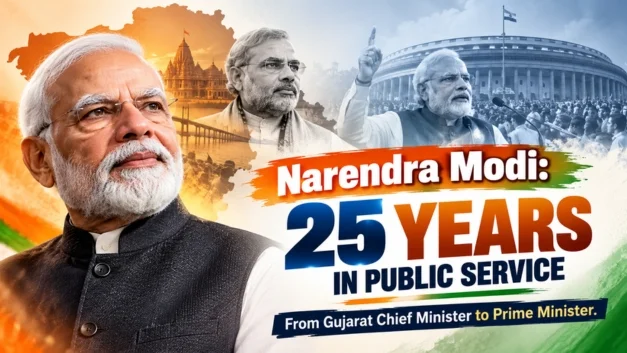
New Delhi: Prime Minister Narendra Modi has completed 25 years in continuous public office, marking a political journey that began on October 7, 2001, when he took oath as the Chief Minister of Gujarat. Over the past quarter century, his career has taken him from Gujarat’s state administration to the highest elected office in India.
The milestone is being observed across the country with programmes and public outreach initiatives, as the Bharatiya Janata Party marks 25 years of Modi’s leadership in government.
Beginning of the Journey in Gujarat
Narendra Modi became Gujarat Chief Minister on October 7, 2001, at a time when the state was recovering from the devastating Kutch earthquake earlier that year. Reconstruction, infrastructure development, water management and restoring public confidence became some of the immediate challenges before the new government.
During his more than 12 years as Gujarat Chief Minister, Modi’s administration focused on electricity, irrigation, agriculture, infrastructure, investment and administrative reforms. Initiatives such as Jyotigram Yojana and the Vibrant Gujarat Summit became prominent parts of the state’s development strategy.
The administration’s governance approach was subsequently described by supporters as the “Gujarat Model”, while critics have raised questions over the distribution of economic growth and social outcomes.
From Gandhinagar to New Delhi
In 2013, Narendra Modi was named the BJP’s prime ministerial candidate. In the 2014 Lok Sabha elections, the BJP secured a majority, and Modi became India’s Prime Minister on May 26, 2014.
His move from Gujarat to Delhi marked a transition from state-level governance to national administration. Over the following years, his government introduced and expanded several major economic, welfare, infrastructure and digital initiatives. Among the prominent policy decisions of his tenure were Make in India, Jan Dhan Yojana, Digital India, GST, the Insolvency and Bankruptcy Code, UPI expansion and major infrastructure programmes.
The introduction of the Goods and Services Tax in 2017 created a common indirect-tax framework across much of the country, while India’s digital public infrastructure expanded significantly during the same period.
Major National Challenges
Modi’s tenure has also included several major national and global challenges. The government faced the COVID-19 pandemic, followed by a nationwide vaccination campaign. India also witnessed major developments in defence and national security, including responses to cross-border terrorism.
His government has additionally placed strong emphasis on infrastructure development, renewable energy, manufacturing, technology, space exploration and India’s role in international diplomacy.
Third Consecutive Term as Prime Minister
After the 2024 Lok Sabha elections, Narendra Modi took oath as Prime Minister for a third consecutive term.
His current political agenda includes the vision of “Viksit Bharat 2047”, which aims to position India as a developed and globally competitive nation by the centenary of independence. The Union Cabinet, in a resolution marking 25 years of Modi’s continuous leadership, highlighted themes including governance reforms, welfare delivery, infrastructure, technology, women empowerment, national security and India’s growing international profile.
25 Years of Continuous Public Leadership
The completion of 25 years marks a rare political milestone in India’s contemporary history. From taking charge of Gujarat during a period of reconstruction in 2001 to leading the country since 2014, Modi’s political journey has remained closely associated with development, governance reforms, political centralisation and a strong focus on national-level transformation.
The anniversary is being marked through the Seva Sankalp Abhiyan, including public programmes and yatras connecting Vadnagar, Modi’s birthplace, with Varanasi, his parliamentary constituency.
As Narendra Modi enters the next phase of his political career, the focus remains on his government’s Viksit Bharat 2047 vision and the broader question of how India’s development, economy, infrastructure and global position will evolve in the coming years.
Also read, Surat New Civil Hospital DEIC to Add 3 Advanced Facilities for Children
Watch Latest News Videos on KRH News: Click Here