


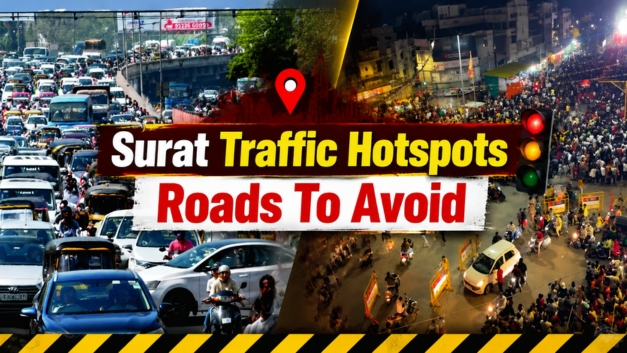
Surat Traffic Hotspots Guide: Surat’s growing population and rising number of private vehicles are making daily commuting increasingly challenging. In 2026, the city has nearly 35 lakh two-wheelers, while around 12,500 new two-wheelers are reportedly being added every month, increasing pressure on major roads.
For commuters, knowing the city’s major congestion corridors can help save time during morning and evening peak hours.
1. Ring Road and Central Surat
Ring Road remains one of Surat’s key commercial corridors, particularly around the textile-market area. Heavy business activity, loading vehicles and daily commuter traffic can make this stretch busy during working hours.
SMC’s mobility planning has also identified Ring Road and several major radial roads as important traffic and accident hotspot locations.
Avoid: Peak business and evening hours when possible.
2. Varachha Main Road
The Varachha corridor carries substantial residential, commercial and commuter traffic. The wider Varachha area also continues to see infrastructure development and planned road projects.
SMC’s feasibility projects include proposed flyover works around Varachha and Surat-Kamrej Road.
Tip: Consider alternate routes when travelling through Varachha during evening rush hour.
3. Udhna–Sachin Corridor
The Udhna-Sachin route is an important industrial and commuter corridor. SMC’s mobility plan identifies the Udhna Gate-Sachin stretch among major traffic hotspot locations.
Heavy industrial movement combined with daily commuting can make travel slower during peak periods.
4. Surat–Kamrej Road
The Surat-Kamrej corridor carries significant traffic connecting eastern Surat with surrounding areas.
During monsoon conditions, waterlogging can further affect traffic movement. In July 2026, service roads along NH-48 in Kamrej experienced waterlogging that temporarily disrupted traffic.
5. Athwa Gate and Athwa–Adajan Route
The Athwa Gate area and the Tapi crossings towards Adajan can become busy during office and evening commuting hours.
SMC’s bridge infrastructure plans include multiple projects connecting Athwa and Adajan, reflecting the importance of this corridor for city connectivity.
6. Adajan and Major Tapi Bridges
Adajan is one of Surat’s major residential areas, and traffic can increase significantly around bridge approaches during peak periods.
Rain can make the situation worse. During heavy rainfall in 2026, Adajan, Vesu and City Light were among areas where waterlogging disrupted movement.
7. Vesu–Althan Roads
Vesu and Althan have experienced rapid residential and commercial development. During the 2026 monsoon, both areas faced significant waterlogging during heavy rainfall, affecting commuters.
During normal weather, office and school traffic can also make important junctions busy during peak hours.
What Are Peak Traffic Hours for Surat Traffic?
For most commuters, the busiest periods are generally:
Morning: 8:00 AM–10:30 AM
Evening: 5:00 PM–8:30 PM
Actual congestion varies by road, day, weather, school timings and local events.
2026 Traffic Tips for Surat Commuters
- Check live traffic conditions before leaving.
- Avoid major commercial corridors during peak hours where possible.
- Keep extra travel time during monsoon showers.
- Use BRTS or city buses for suitable routes.
- Avoid unnecessary lane changes in congested areas.
- Check for roadwork or diversions before starting a longer journey.
- During festivals and major events, expect additional traffic around market and celebration areas.
Final Word
Surat’s traffic challenge is closely linked to the city’s rapid growth and increasing dependence on private vehicles. With nearly 35 lakh two-wheelers currently on the city’s roads, congestion is likely to remain an important issue in 2026.
For daily commuters, keeping an eye on Ring Road, Varachha, Udhna-Sachin, Surat-Kamrej Road, Athwa-Adajan and Vesu-Althan can help when planning journeys during peak hours.
Also read, History of Traffic Signals: From Manual Control to Smart AI System 2026
Watch Latest News Videos on KRH News: Click Here