


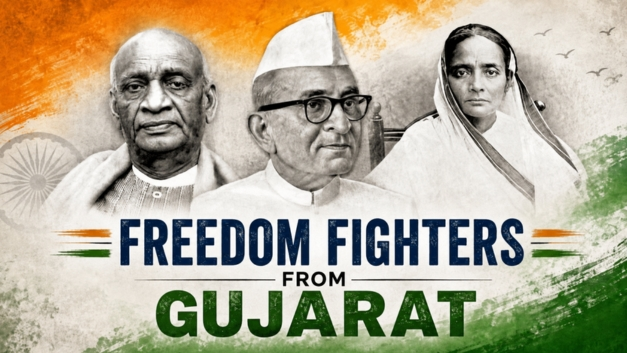
As India prepares to celebrate its 80th Independence Day on August 15, 2026, the country remembers the people who dedicated their lives to the struggle against British rule.
Gujarat occupies a special place in India’s freedom movement. From Mahatma Gandhi’s Sabarmati Ashram and Dandi March to the Kheda and Bardoli Satyagrahas, the state became one of the most important centres of India’s non-violent resistance. Gujarat was also home to leaders who fought British rule through political organisation, economic nationalism, journalism, social reform and mass movements. On Independence Day 2026, here are 8 important freedom fighters from Gujarat whose contributions continue to influence India’s history.
1. Mahatma Gandhi – The Leader Who Turned Non-Violence Into a National Movement
Born: October 2, 1869, Porbandar, Gujarat
Mahatma Gandhi is perhaps the most internationally recognised figure associated with India’s freedom struggle. Born in Porbandar, Gujarat, Gandhi returned to India from South Africa in 1915 and soon became one of the central leaders of the national movement.
His approach was based on Satyagraha, non-violence, civil disobedience and mass participation. Gujarat became one of the major centres of his activities. His association with Ahmedabad and the Sabarmati Ashram turned the city into an important base for the freedom movement.
Gandhi’s Role in India’s Independence
Some of his most important movements included:
- Kheda Satyagraha
- Non-Cooperation Movement
- Civil Disobedience Movement
- Dandi March and Salt Satyagraha
- Quit India Movement
The historic Dandi March began from Sabarmati Ashram on March 12, 1930, with Gandhi and 78 volunteers. The 24-day march covered approximately 390 km before reaching Dandi, where Gandhi challenged the British salt monopoly.
Why Gandhi Remains Important
Gandhi demonstrated that a mass movement could challenge a powerful colonial government through organised non-violent resistance. The Gujarat government’s official history also identifies Gandhi as one of the prominent figures from Gujarat who played a major role in India’s freedom struggle.
2. Sardar Vallabhbhai Patel – The Iron Man of India and Leader of Bardoli
Born: October 31, 1875, Kheda district, Gujarat
Sardar Vallabhbhai Patel emerged as one of the most powerful organisers of India’s freedom movement. His most famous contribution from Gujarat came through the Bardoli Satyagraha of 1928, when farmers opposed increased land revenue imposed by the colonial government. Patel organised the farmers and helped turn the local protest into a disciplined mass movement.
The Bardoli Satyagraha
The movement became a major turning point in Patel’s political career. Women participating in the movement famously began referring to him as “Sardar.” His speeches and organisational skills helped farmers resist colonial pressure and remain united.
The Government of India’s Azadi Ka Amrit Mahotsav records also document Patel’s speeches and mobilisation efforts in Gujarat during the period.
Role Beyond Bardoli
Patel later became one of the major leaders of the:
- Non-Cooperation Movement
- Civil Disobedience Movement
- Quit India Movement
He was imprisoned by the British during the freedom struggle.
Why Sardar Patel Is Important
Patel demonstrated the power of organisation, unity and disciplined mass mobilisation. After Independence, he also played a historic role in integrating India’s princely states. Today, the Statue of Unity in Gujarat stands as one of the most prominent monuments dedicated to his legacy.
3. Dadabhai Naoroji – Gujarat’s Pioneer of Economic Nationalism
Born: September 4, 1825, Navsari, Gujarat
Dadabhai Naoroji was one of the earliest Indian leaders to systematically expose the economic impact of British colonial rule. Born in Navsari, he became known as the “Grand Old Man of India.” Unlike many later mass movements, Naoroji’s contribution centred heavily on political representation and economic analysis.
The Drain of Wealth Theory
Naoroji developed the famous Drain of Wealth theory, arguing that British colonial policies were systematically transferring India’s wealth to Britain. His book Poverty and Un-British Rule in India became an important work of Indian economic nationalism.
His Political Contribution
Naoroji was:
- A founding figure in early Indian political organisation
- A prominent leader of the Indian National Congress
- President of the Congress three times
- A member of the British Parliament
He used his position in Britain to raise Indian political and economic concerns directly before British lawmakers.
Why Naoroji Is Important
Dadabhai Naoroji helped establish an intellectual and economic foundation for Indian nationalism. His work showed Indians that colonialism was not only a political problem but also an economic one.
4. Shyamji Krishna Varma – Gujarat’s Revolutionary Nationalist Voice
Born: October 4, 1857, Mandvi, Kutch, Gujarat
Shyamji Krishna Varma was an influential nationalist, revolutionary thinker and advocate of India’s independence. Born in Mandvi in Kutch, he eventually moved to Britain and became deeply involved in the international side of India’s freedom movement.
India House in London
One of his most significant contributions was establishing India House in London, which became an important centre for Indian nationalists and students abroad. He also founded and supported nationalist publications and used political writing to challenge British rule.
Why Shyamji Krishna Varma Is Important
While Gandhi and Patel built mass movements inside India, Shyamji Krishna Varma represented another dimension of the freedom struggle: international political activism and revolutionary nationalism.
His activities helped connect Indian independence supporters with networks outside colonial India. His birthplace, Mandvi in Kutch, remains an important part of Gujarat’s freedom movement heritage.
5. Abbas Tyabji – The “Grand Old Man of Gujarat”
Born: 1854, Baroda State, Gujarat
Justice Abbas Tyabji had a remarkable transformation from a senior judicial figure to a dedicated participant in India’s freedom movement.
He served as Chief Justice of the Baroda State and initially belonged to an elite administrative and legal background. His political outlook changed significantly after the Jallianwala Bagh massacre.
From Judge to Freedom Fighter
Tyabji supported the national movement and became closely associated with Mahatma Gandhi. He also supported Sardar Patel during the Bardoli Satyagraha. When Gandhi was arrested during the Salt Satyagraha in 1930, Tyabji took charge of the movement. On May 7, 1930, he initiated the Dharasana Satyagraha in Gujarat against the British salt laws.
Why Abbas Tyabji Is Important
His journey demonstrates how people from India’s legal and administrative elite also joined the struggle against colonial rule. Mahatma Gandhi later remembered him as the “Grand Old Man of Gujarat.”
6. Indulal Yagnik – The “Indu Chacha” Who Mobilised Gujarat
Born: February 22, 1892, Nadiad, Gujarat
Indulal Yagnik was a prominent freedom activist, writer, journalist and peasant leader. He became closely associated with Mahatma Gandhi and worked for nationalist causes during the early decades of the freedom movement.
Role in the Freedom Movement
Yagnik worked among rural communities and farmers and participated in the wider nationalist movement. He was associated with the Kheda Satyagraha and other campaigns involving peasants and rural Gujarat. His work focused heavily on mobilising ordinary people and bringing rural communities into political movements.
Later Mahagujarat Movement
Yagnik’s activism continued after Independence. He became the leading face of the Mahagujarat Movement, which demanded a separate Gujarati-speaking state from the bilingual Bombay State. The movement ultimately contributed to the creation of Gujarat on May 1, 1960.
Why Yagnik Is Important
Yagnik’s legacy extends beyond the 1947 independence struggle. He represents the continuation of popular political mobilisation in Gujarat after colonial rule ended.
7. Ravishankar Maharaj – Freedom Fighter Who Made Social Service His Mission
Born: February 25, 1884, Kheda district, Gujarat
Ravishankar Vyas, popularly known as Ravishankar Maharaj, combined India’s freedom struggle with social reform and community service. He became closely associated with Mahatma Gandhi and Sardar Vallabhbhai Patel.
Role in India’s Freedom Struggle
Ravishankar Maharaj participated in the national movement during the 1920s and 1930s. He was associated with the Bardoli Satyagraha and later participated in the Quit India Movement, for which he was imprisoned.
Social Reform After Independence
His contribution did not end with India’s independence. He devoted much of his later life to social service, rural development and reform.
Why Ravishankar Maharaj Is Important
His life shows that the freedom struggle was not only about achieving political independence. For many activists, Swaraj also meant social improvement, equality and service to ordinary people.
8. Kalyanji Viththalbhai Mehta – The Organiser Behind Gujarat’s Grassroots Movement
Born: November 7, 1890, Vanz village, Surat district
Kalyanji Viththalbhai Mehta was an important freedom fighter and organiser from Surat district. His contribution is particularly significant for Gujarat because he worked extensively with farmers, students and local political organisations.
His Role in the Freedom Movement
Mehta became involved with the Home Rule League and later served as secretary of the Surat District Congress Committee. He donated his property to the Tilak Swaraj Fund in 1921 and worked to organise farmers for the no-tax movement.
During the Bardoli Satyagraha of 1928, he served as president of the Bardoli Taluka Congress Committee and worked as Sardar Patel’s secretary. He also played a role in the Salt Satyagraha and was imprisoned for participating in the movement.
Education and Social Work
Mehta established and supported educational institutions, including national schools and schools serving rural and tribal communities. He also founded the Kasturba Ashram at Maroli in 1931.
Why Kalyanji Mehta Is Important
His contribution demonstrates how the freedom struggle depended on thousands of organisers working at the grassroots level—not just nationally famous leaders.
Gujarat’s Wider Role in India’s Freedom Struggle
The stories of these eight freedom fighters reveal that Gujarat’s contribution to India’s independence was much broader than the achievements of a few famous personalities.
The region became a centre for:
- Peasant movements
- Satyagraha
- Civil disobedience
- Salt Satyagraha
- Nationalist journalism
- Economic nationalism
- Social reform
- Grassroots mobilisation
The Kheda Satyagraha of 1918 brought farmers together against revenue demands during a period of famine and disease, while the Bardoli Satyagraha of 1928 became one of the most important peasant movements of the freedom struggle.
Gujarat also became the starting point of the historic Dandi March, which transformed the salt issue into a powerful nationwide challenge to British authority.
Why We Should Remember Gujarat’s Freedom Fighters in 2026
Independence Day is more than a national holiday. It is an opportunity to understand the sacrifices, struggles and ideas that made freedom possible.
The freedom fighters of Gujarat came from very different backgrounds – lawyers, farmers’ leaders, journalists, judges, social workers and political activists. Their methods also differed. Some organised farmers. Others challenged colonial economic policies. Some went to prison, while others built institutions, newspapers and political networks. Together, their stories demonstrate that India’s independence was the result of collective action across generations and communities.
Independence Day 2026: A Time to Learn From Their Legacy
As India celebrates Independence Day on August 15, 2026, remembering Gujarat’s freedom fighters can help younger generations understand the meaning behind the national celebrations.
The tricolour, national anthem and Independence Day ceremonies represent the outcome of a much longer struggle. From Porbandar to Navsari, Kheda to Bardoli, Surat to Kutch, Gujarat played a major role in that journey. The best way to honour these freedom fighters is not simply to remember their names, but to understand the values they represented—courage, unity, service, justice and responsibility toward the nation.
Conclusion
Gujarat’s history is deeply connected with India’s freedom struggle. Mahatma Gandhi gave the national movement a powerful philosophy of non-violence, Sardar Patel demonstrated the strength of organised mass resistance, Dadabhai Naoroji exposed colonial economic exploitation, and Shyamji Krishna Varma carried the nationalist message beyond India’s borders.
Abbas Tyabji, Indulal Yagnik, Ravishankar Maharaj and Kalyanji Mehta further demonstrate how Gujarat’s freedom movement was strengthened by lawyers, activists, farmers’ organisers, social workers and grassroots leaders. On Independence Day 2026, these stories remind us that freedom was built through the courage and sacrifice of countless Indians—and Gujarat was one of the movement’s most important centres.
Also read, Why Independence Day Is Still Important in 2026: Meaning, History and Relevance in Modern India
Watch Latest News Videos on KRH News: Click Here