

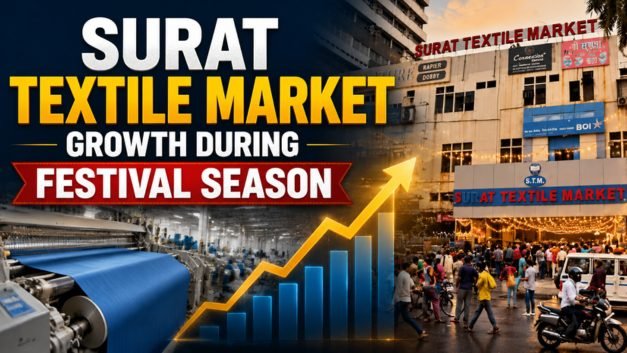
Surat textile market is entering one of the most important business periods of 2026 as India moves into a long festive and wedding-demand cycle.
From Independence Day and Raksha Bandhan in August to Janmashtami, Ganesh Chaturthi, Navratri, Dussehra and Diwali, the coming months could create multiple waves of demand for sarees, dress materials, kurtis, lehengas, ethnic wear, fabrics, embroidery and fashion accessories.
For Surat, this seasonal cycle is particularly important because the city remains one of India’s biggest hubs for man-made fabrics and textile manufacturing. The industry has a production capacity of around 6 crore metres of fabric a day, according to recent industry reporting, making seasonal demand an important factor for traders, manufacturers, processors, transporters and retailers.
However, the 2026 outlook is not simply about rising demand. Higher raw-material costs, labour shortages, geopolitical uncertainty and supply-chain disruptions continue to put pressure on the sector.
Why Festival Season Matters So Much for Surat Textiles
Festival shopping creates demand at multiple levels of the textile supply chain.
Retailers across India begin purchasing festive collections weeks before major celebrations. Wholesale traders then place orders with Surat suppliers for products that can reach markets in Gujarat, Maharashtra, Rajasthan, Uttar Pradesh, Bihar, West Bengal, Madhya Pradesh and other regions.
The result is a seasonal cycle:
Festival → Retail Demand → Wholesale Orders → Surat Textile Markets → Manufacturing → Processing → Transportation → Retail Stores
This cycle makes the August-November period particularly significant for Surat’s textile ecosystem. Past Diwali seasons have demonstrated how quickly demand can translate into logistics pressure. In October 2024, Surat textile traders were sending around 350 trucks a day to different parts of India, while special textile goods trains were arranged to move large volumes of parcels before Diwali.
Independence Day and Raksha Bandhan: The First Festive Push
The 2026 festive cycle has already begun with Independence Day celebrations followed by Raksha Bandhan.
Independence Day itself is not traditionally one of India’s biggest textile-buying festivals, but it contributes to demand for clothing, institutional uniforms, event merchandise and tricolour-themed products. The bigger opportunity comes around Raksha Bandhan on August 28, 2026.
Raksha Bandhan creates demand for:
- Women’s ethnic wear
- Sarees
- Kurtis
- Suit sets
- Men’s ethnic clothing
- Kidswear
- Gift-oriented fashion
- Designer fabrics
- Festive accessories
For Surat wholesalers, this period can act as an early indicator of consumer sentiment before the much larger September-November festival cycle.
September 2026: Janmashtami and Ganesh Chaturthi Bring New Demand
The next major phase arrives in September. According to the 2026 festival calendar, Krishna Janmashtami falls on September 4, while Ganesh Chaturthi is on September 14, followed by Ganesh Visarjan and Anant Chaturdashi on September 25.
These festivals generate demand for traditional and contemporary ethnic clothing.
Janmashtami-related demand can include:
- Traditional kurtas
- Lehenga-choli
- Children’s Krishna-themed outfits
- Sarees
- Printed ethnic fabrics
- Embroidered garments
Ganesh Chaturthi also creates demand across Maharashtra and other markets where the festival is celebrated extensively. For Surat suppliers, this is particularly important because Maharashtra is a major destination for textile products manufactured and traded in the city.
Navratri 2026 Could Become a Major Turning Point
One of the biggest opportunities for Surat’s textile industry arrives in October. Navratri begins on October 11, 2026, with Vijayadashami/Dussehra falling on October 20.
For Gujarat, Navratri is much more than a religious festival. It is also a major fashion and cultural season.
The demand for:
- Chaniya choli
- Ghagra
- Dupattas
- Embroidered fabrics
- Mirror-work textiles
- Designer blouses
- Garba outfits
- Men’s traditional wear
can significantly increase during this period.
Surat’s manufacturing ecosystem gives traders the ability to produce and distribute large quantities of fashion-oriented fabrics and garments to retailers across India. This makes September and early October particularly important for stocking and advance wholesale orders.
Diwali 2026: The Biggest Business Opportunity
The most important festival in the upcoming textile calendar is Diwali on November 8, 2026, with Dhanteras on November 6 and Govardhan Puja and Bhai Dooj following shortly afterward. Diwali traditionally creates one of the strongest periods of consumer spending in India.
For Surat’s textile market, demand can come from:
- Sarees
- Dress materials
- Designer fabrics
- Kurtis
- Readymade garments
- Lehenga sets
- Ethnic wear
- Party wear
- Wedding collections
- Gift-oriented apparel
The Diwali cycle also overlaps with India’s wedding season, making the overall demand window longer than the festival itself.
Recent Surat market data supports the importance of this period. In 2024, traders reported strong Diwali business, with hundreds of trucks carrying textile products every day and special railway arrangements being made to move large volumes to northern and northeastern markets.
Wedding Season Could Extend the Demand Cycle
One of the biggest advantages for Surat textile businesses is that festival demand does not necessarily end with Diwali. The festive period often transitions into the winter wedding season.
That means manufacturers and traders can potentially see continued demand for:
- Bridal sarees
- Wedding dress materials
- Designer lehengas
- Party wear
- Embroidery
- Lace
- Blouse fabrics
- Men’s ethnic clothing
This creates a longer business cycle from Raksha Bandhan through Diwali and into the wedding season.
But 2026 Is Not Without Challenges
While the festive calendar creates opportunities, Surat’s textile industry is entering the season under pressure. Earlier in 2026, textile processing units announced reduced operating schedules because of rising processing costs, coal shortages and sluggish demand.
The industry has also faced higher yarn and raw-material prices. Industry representatives warned earlier this year that geopolitical tensions and crude-oil movements could push up costs because Surat’s man-made fibre industry is heavily linked to petroleum-derived raw materials.
Labour availability is another concern. Surat’s textile ecosystem depends heavily on migrant workers, and seasonal migration can affect production capacity during important periods. Therefore, stronger festival demand does not automatically mean higher profits.
What Could Drive Surat Textile Market Growth?
Several factors could support the industry’s longer-term growth.
1. India’s Growing Ethnic Wear Market
Indian consumers continue to purchase ethnic and fusion clothing for festivals, weddings and family events. This creates opportunities for Surat manufacturers producing affordable fashion products at scale.
2. E-Commerce Expansion
Online fashion marketplaces are giving manufacturers and traders access to customers beyond traditional wholesale markets. A Surat-based textile supplier can increasingly serve retailers and brands across India through digital ordering and B2B platforms.
3. Export Opportunities
Surat’s textile ecosystem is also looking toward international markets. Improved logistics, ports, freight networks and export-focused initiatives can create opportunities for manufacturers willing to meet international quality and compliance requirements.
4. Technology and Modern Manufacturing
Automation, digital printing, advanced embroidery and modern weaving technology can help manufacturers improve product variety and efficiency. The Surat International Textile and Machinery Expo in 2026 attracted significant interest, with organisers expanding the event and expecting more than 25,000 visitors, highlighting continued interest in textile technology and machinery.
5. Government Support
Recent policy developments have also created optimism in the textile sector. The 2026 Union Budget highlighted technology-upgradation support for major textile clusters and announced centres of excellence, while industry representatives also pointed to opportunities for MSMEs through expanded credit support.
What Textile Traders Should Watch During Festival Season 2026
For traders and manufacturers, the most important factors will be:
- Demand: Monitor advance orders rather than producing solely on speculation.
- Raw-material prices: Polyester and other man-made fibres remain sensitive to petroleum and global market conditions.
- Inventory: Festival fashion changes quickly, making overstock a significant risk.
- Credit: Traders should carefully monitor payment cycles and buyer credibility.
- Logistics: Festival demand can create shortages of trucks, railway capacity and warehouse space.
- Product trends: Lightweight ethnic wear, embroidered fabrics, designer sarees, festive suits and affordable fashion collections could remain important categories.
Surat Textile Market Growth Outlook for 2026
The outlook for Surat’s textile industry during the 2026 festival season can best be described as opportunity mixed with caution.
The festival calendar provides several consecutive demand windows:
Raksha Bandhan → Janmashtami → Ganesh Chaturthi → Navratri → Dussehra → Diwali → Wedding Season
This creates a potentially extended period of business activity rather than a single short-term spike. However, recent industry reports show that Surat’s textile sector is still dealing with raw-material inflation, labour constraints, production adjustments and uneven demand. Therefore, the businesses most likely to benefit will be those that combine festive demand with disciplined inventory management, competitive pricing, better designs, technology adoption and reliable distribution.
Final Outlook
Surat’s textile market is preparing for one of the most important commercial periods of 2026. With Raksha Bandhan arriving in August and major festivals including Janmashtami, Ganesh Chaturthi, Navratri, Dussehra and Diwali following through September, October and November, the city is positioned for multiple waves of textile demand.
The biggest opportunity may come from the combination of festival shopping and the wedding season, which can extend the demand cycle well beyond Diwali. At the same time, rising production costs, labour shortages and global uncertainty mean that growth should not be measured only by order volumes.
For Surat’s textile industry, the real opportunity in 2026 will be converting festive demand into sustainable business growth through better products, technology, efficient production and stronger national and international distribution.
Also read, Why Independence Day Is Still Important in 2026: Meaning, History and Relevance in Modern India
Watch Latest News Videos on KRH News: Click Here