


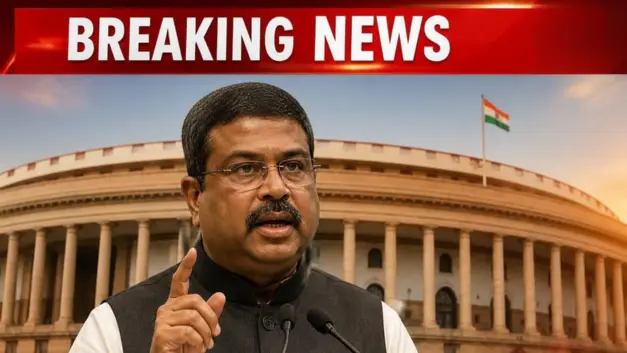
July 25: In a dramatic political development that has sent shockwaves through Indian politics, Union Education Minister Dharmendra Pradhan has tendered his resignation from the Union Council of Ministers. His resignation comes on the heels of weeks of intense, high-stakes student protests spearheaded by youth movements and the Cockroach Janata Party (CJP) at New Delhi’s Jantar Mantar.
The protests, driven by widespread public fury over the NEET-UG examination paper leak controversy, turned Pradhan’s exit into a non-negotiable demand. Pradhan formally submitted his resignation letter to Prime Minister Narendra Modi, emphasizing that he stepped down voluntarily to protect national unity and prevent malicious entities from hijacking student agitations.
The Breaking Point: Why Dharmendra Pradhan Resigned
The pressure on the Ministry of Education had reached a boiling point following months of relentless opposition pressure and grassroots student mobilization. The primary flashpoint originated from irregularities identified in the NEET-UG examination held on May 3.
While the central government quickly handed over the investigation to the Central Bureau of Investigation (CBI), canceled the compromised test, and coordinated a re-examination, public trust had already taken a severe hit. The subsequent announcement of results on July 16, followed by 10 days of continuous civil unrest at Jantar Mantar led by CJP leader Abhijeet Dipke, created an environment that Pradhan described as deeply distressing.
Full Text & Key Takeaways from Dharmendra Pradhan’s Resignation Letter
In an open emotional letter addressed to students and the public, Dharmendra Pradhan detailed his four-decade career dedicated to education reform while defending the government’s procedural actions.
“To ensure that anti-national forces do not exploit the situation arising at Jantar Mantar and across the country, that national unity remains intact, that no student’s future gets tangled in legal complexities, and that our children can focus their time on studying… I have submitted my resignation to the Honorable Prime Minister.”
— Dharmendra Pradhan
Core Highlights from the Letter:
- Accountability Taken: Pradhan noted that he never turned his back on the crisis, maintaining that his primary objective was shielding meritorious students from examination mafias.
- CBT Transition Plans: Reaffirmed that starting next year, competitive testing infrastructure would transition fully to Computer-Based Test (CBT) formats to plug systemic security vulnerabilities.
- Accusations of Political Obstruction: Pradhan expressed deep anguish that certain individuals occupying positions of responsibility deliberately misled students and obstructed administrative solutions during the July results window.
- Protection of Youth Power: Asserted that India’s youth represent the true architects of Viksit Bharat (Developed India) and must not be trapped in a “web of confusion”.
“Democracy Wins”: CJP and Student Protesters React
As news of the resignation broke, jubilant scenes erupted at the Jantar Mantar protest site. Abhijeet Dipke, founder of the Cockroach Janata Party (CJP), addressed hundreds of cheering supporters, marking the exit as a massive landmark victory for peaceful civil resistance.
- Tributes Paid: Before continuing celebrations, student leaders paused to observe a two-minute silence honoring students who fell victim to exam-related stress and anxiety during the crisis.
- Continued Demands: CJP leadership asserted that while the minister’s resignation was a vital first step, the movement would press forward until complete justice, including financial compensation for affected student families and institutional accountability, is fully materialised.
- Security Mobilization: Following the sudden announcement, security and police forces moved into high gear around core protest zones in the national capital to manage crowds and maintain public order.
Political Fallout and What Lies Ahead for the Ministry
Dharmendra Pradhan’s exit leaves a monumental vacuum within the Union Cabinet at a time when structural reforms in national testing bodies are heavily mandated.
- Opposition Reactions: Major opposition parties hailed the resignation as a vindication of youth power, criticizing the ruling administration’s handling of systemic leaks.
- Next Steps for the Centre: The Prime Minister’s Office (PMO) is expected to announce an interim or permanent successor to oversee the Ministry of Education. The incoming leadership will face immediate pressure to fast-track the newly proposed anti-paper leak legal frameworks, overhaul the National Testing Agency (NTA), and restore absolute confidence among millions of aspirants preparing for premier medical and engineering entrances.
Also read, Gujarat Government Transfers 28 IAS Officers in Major Bureaucratic Reshuffle
Watch Latest News Videos on KRH News: Click Here