


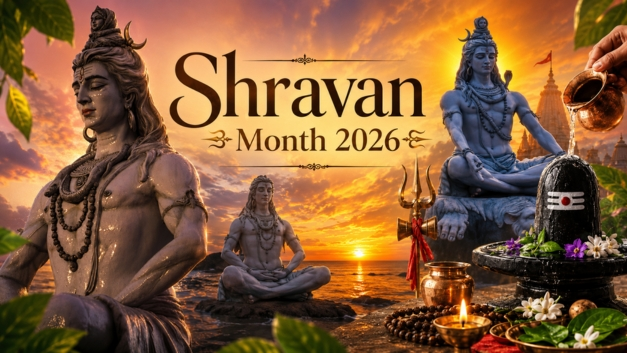
The arrival of the monsoon season brings with it Shravan Month (also known as Sawan Maas), the holiest period in the Hindu calendar. Dedicated entirely to Lord Shiva and Goddess Parvati, this auspicious month is a time of intense devotion, spiritual cleansing, and profound fasting rituals.
During this sacred period, the cosmos is said to be charged with divine energies. Devotees crowd temples to perform Jalabhishek and Rudrabhishek to seek the blessings of Mahadev for prosperity, health, and spiritual liberation.
Shravan Month 2026: Important Start and End Dates
Because India follows two distinct lunar calendar systems, the Shravan date varies depending on your region:
- Purnimanta Calendar (North India): Celebrated in Uttar Pradesh, Bihar, Madhya Pradesh, Rajasthan, Delhi, and Punjab. The month begins on the day after the full moon.
- Amavasyant Calendar (South & West India): Followed in Maharashtra, Gujarat, Karnataka, Andhra Pradesh, Telangana, and Tamil Nadu. The month begins on the day after the new moon.
| Region | Shravan Start Date | Shravan End Date |
| North India | Thursday, July 30, 2026 | Friday, August 28, 2026 |
| South & West India | Thursday, August 13, 2026 | Friday, September 11, 2026 |
Shravan Somvar Vrat Dates 2026
Mondays (Somvar) during this month hold immense significance. Observing the Shravan Somvar Vrat is believed to fulfill all desires and grant a peaceful mind. For those looking to start the legendary Solah Somvar Vrat (16 consecutive Mondays fast), the first Monday of Shravan is considered the most auspicious day to take the Sankalp (solemn vow).
Here is the complete Sawan Somvar calendar for 2026:
North India Sawan Somvar Dates
- 1st Shravan Somvar: August 3, 2026
- 2nd Shravan Somvar: August 10, 2026
- 3rd Shravan Somvar: August 17, 2026 (Coincides with Nag Panchami – highly auspicious)
- 4th Shravan Somvar: August 24, 2026
South & West India (including Maharashtra & Gujarat) Shravan Somvar Dates
- 1st Shravan Somvar: August 17, 2026
- 2nd Shravan Somvar: August 24, 2026
- 3rd Shravan Somvar: August 31, 2026
- 4th Shravan Somvar: September 7, 2026
The Ancient Story Behind Shravan Month: Samudra Manthan
The spiritual significance of Sawan is deeply rooted in the Puranic history of the Samudra Manthan (the churning of the cosmic ocean). During the grand churning, a highly toxic poison called Halahala emerged, threatening to annihilate all of creation. To protect the universe, Lord Shiva consumed the poison. He held it in his throat, turning it blue, earning him the name Neelkanth.
The poison generated intense heat inside Mahadev’s body. To cool him down, the Devas (gods) and sages continuously poured holy water from the Ganges onto him. The rain god, Lord Indra, unleashed heavy downpours, marking the onset of the monsoon. Ever since, the entire month of Shravan is celebrated by offering cooling elements like water, raw milk, and Bael Patra (wood apple leaves) to the Shivling to alleviate that cosmic heat.
How Shravan is Celebrated: North vs. South India
While devotion to Bholenath remains identical, the regional celebrations feature beautiful cultural diversities.
North India: The Kanwar Yatra
In states like Uttar Pradesh, Bihar, and Uttarakhand, the Kanwar Yatra takes center stage. Millions of saffron-clad devotees, known as Kanwariyas, walk barefoot for miles to fetch holy water from the Ganges at Haridwar, Gaumukh, or Sultanganj. They carry this water on balances over their shoulders to perform Jalabhishek at local Shiva temples.
South & West India: Multi-Deity Festivities
In the Southern states and Western regions like Maharashtra and Gujarat, Shravan is a packed mosaic of various vrats:
- Mangala Gauri Vrat: Observed by married women on every Tuesday of Shravan, dedicated to Goddess Gauri (Parvati) for a long and blissful married life.
- Varalakshmi Vratam: A massive festival in Karnataka, Andhra Pradesh, and Tamil Nadu where married women worship Goddess Lakshmi for wealth and family well-being (falling on August 21, 2026).
- Aadi Perukku & Bonalu: Celebrated in parts of Tamil Nadu and Telangana, honoring localized forms of the divine Mother Goddess.
Fasting Rules: What to Follow & What to Avoid
To experience the psychological and physical benefits of a Sawan fast, one must maintain strict Sattvic discipline.
What to Do (Dos)
- Maintain Cleanliness: Wake up early during Brahma Muhurta, bathe, and wear clean, light-colored clothing.
- The Sawan Puja Vidhi: Offer water, raw milk, honey, sandalwood paste, and Bael Patra to the Shivling.
- Chant Powerful Mantras: Spend time chanting the Maha Mrityunjaya Mantra or the simple yet potent “Om Namah Shivaya” to align your internal energies.
- Falahari Diet: Consume milk, fresh fruits, nuts, makhana (fox nuts), and preparations made from Sabudana (tapioca), Kuttu (buckwheat), or Rajgira (amaranth). Use rock salt (Sendha Namak) instead of regular table salt.
What to Avoid (Don’ts)
- No Tamasik Food: Strictly avoid meat, fish, eggs, alcohol, onions, and garlic throughout the month.
- Spices and Grains: Avoid regular grains (wheat, rice, lentils) and common table salt on your deep fasting days.
- Certain Vegetables: Traditional rules advise avoiding leafy vegetables during Shravan due to the heavy monsoon insect population, as well as brinjals (Baingan), which are considered non-Sattvic during this period.
- Negative Behavior: Avoid practicing anger, using harsh words, or harbouring malicious thoughts. Shravan is as much a mental detox as it is physical.
A Quick Ritual Tip for 2026: On August 17, the third Monday of North India and the first Monday of South India perfectly aligns with Nag Panchami. Offering milk to Lord Shiva alongside prayers to the serpent deities on this rare overlapping day is believed to remove Kaal Sarp Dosha from one’s horoscope.
Also read,
- Chaturmas 2026: The Ultimate Guide to the Four Holy Months of Spiritual Reflection
- Jagannath Rath Yatra 2026: Date, Deep History, and Global Celebrations of the Chariot Festival
- Guru Purnima 2026: The Light That Dispels Darkness
Watch Latest News Videos on KRH News: Click Here