

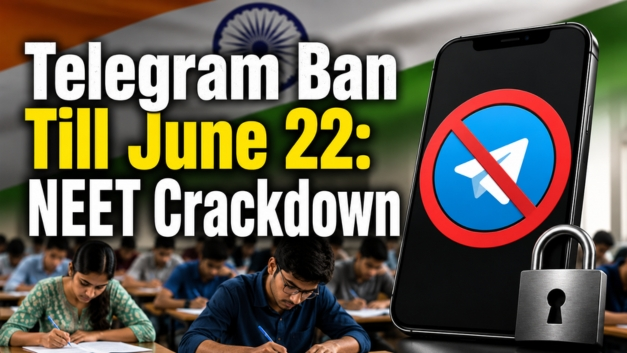
Telegram Ban High Court Case: The ongoing saga surrounding India’s premier medical entrance test, NEET-UG 2026, has taken an unprecedented digital turn. In a massive blow to the instant messaging platform, the Delhi High Court on Friday, June 19, 2026, officially dismissed Telegram’s appeal and upheld the Central Government’s temporary nationwide ban on the application.
This high-stakes legal battle culminated just 48 hours before 22.79 lakh medical aspirants sit for the highly anticipated NEET-UG 2026 Re-Examination on Sunday, June 21, 2026.
Here is an in-depth breakdown of the official directives, Telegram’s legal defense in the High Court, and how these sweeping measures impact students.
The Core Issue: Why Was Telegram Banned?
Following the cancellation of the initial NEET-UG exam held on May 3, 2026, due to widespread allegations of paper leaks and institutional malpractice, the National Testing Agency (NTA) scheduled a nationwide re-examination.
However, state law enforcement- including the Bihar Police Economic Offences Unit (EOU)- flagged organized cheating syndicates leveraging Telegram channels to orchestrate fraud. Acting swiftly on recommendations from the NTA and the Ministry of Education, the Ministry of Electronics and Information Technology (MeitY) issued emergency blocking orders under Section 69A of the Information Technology (IT) Act, 2000.
The Two-Pronged Ban Imposed by MeitY
- Complete Platform Access Restriction: Public access to the Telegram app and web platform is temporarily restricted across India from June 16 to June 22, 2026, covering the day of the Re-NEET exam and its immediate aftermath.
- Disabling the Message-Editing Feature: In an unprecedented move, MeitY ordered Telegram to completely disable its “message-editing” capability within India until June 30, 2026.
According to the official NTA Press Release
“The message-editing feature permits a channel administrator to edit the content of a previously posted message- including substituting attached files like PDFs – while retaining the original send timestamp. This structural feature was actively exploited by cheating rackets to fabricate after-the-event ‘paper leak’ evidence to defraud candidates.”
Telegram’s Appeal in the Delhi High Court
Aggrieved by the sudden blanket ban, Telegram FZ LLC filed an urgent writ petition before the Delhi High Court.
Telegram’s Defense Arguments
- Grossly Disproportionate: Telegram’s counsel argued that a blanket ban punishes over 150 million legitimate users in India, including thousands of educators and lakhs of students who rely on the platform for studying and genuine educational resources.
- Proactive Takedowns: Telegram claimed it used AI/ML tools to actively cooperate with Indian law enforcement, removing over 900 illegal channels and offending links within an hour of receiving official complaints.
- CEO Pavel Durov’s Response: In a public statement, Telegram CEO Pavel Durov heavily criticized the move, noting that a platform-wide ban does not stop the bad actors, who simply migrate to more obscure or encrypted networks, leaving ordinary citizens disconnected.
The Government’s Counter-Argument
Representing the Center, Solicitor General Tushar Mehta and Attorney General R. Venkataramani presented hard data to the court, arguing that Telegram had essentially evolved into a “new dark web” due to its deep architectural anonymity. The Center noted that despite warnings sent since May 2026, the platform failed to fix systemic flaws being weaponized by organized crime networks to jeopardize a national exam.
The Verdict: Delhi High Court Backs the Government
A single-judge bench of Justice Tejas Karia dismissed Telegram’s petition, refusing to grant any interim relief.
The Court observed that the temporary ban met the strict judicial “test of proportionality” given the emergency nature of safeguarding the future of millions of medical aspirants. Justice Karia noted that the government’s measures were the “least restrictive alternative” available to stop instantaneous, viral malpractice before a massive national exam.
Furthermore, the High Court clarified that under the IT Act, digital applications and communication platforms fall well within the definition of “information” that the state is legally empowered to block under Section 69A for the preservation of public order.
Re-NEET 2026 Exam Protocol: What Changes for Aspirants?
Despite the internet disruption, the NTA has confirmed that the NEET-UG 2026 Re-Examination will proceed exactly as scheduled on June 21, 2026. The agency has deployed over 2 lakh personnel across 551 cities in India and 14 international locations to execute a secure, offline, pen-and-paper exam.
| Parameter | Official Details |
| Exam Date | June 21, 2026 (Sunday) |
| Exam Timing | 02:00 PM to 05:15 PM (IST) |
| Total Duration | 195 minutes (Includes an additional 15 minutes added for 2026) |
| Security Measures | GPS-tracked exam transport, Aadhaar-based biometrics, and mandatory CCTV surveillance |
| Important Digital Note | The Union Education Ministry has announced that to completely eliminate paper leaks, NEET-UG will transition to a fully online, computer-based test (CBT) starting in 2027. |
Advisory for Students and Parents
The NTA urges all students to stay completely clear of unverified online groups, alternative proxy networks, or individuals soliciting money in exchange for exam materials. Any encounter with suspicious elements should be immediately flagged to the National Cyber-Crime Helpline at 1930 or reported online via cybercrime.gov.in.
Lakhs of students who rely heavily on Telegram channels for last-minute revision notes, mock test PDFs, and peer discussions have undoubtedly faced severe disruption. However, with the ban lasting until June 22, students must pivot to official portals like neet.nta.nic.in for updates and utilize offline or verified alternative coaching apps for their final push.
Final Words
While digital privacy advocates and cyber-researchers warn that blocking an entire platform sets a worrisome precedent and serves as a mere “band-aid solution” to systemic exam leaks, the Delhi High Court’s ruling makes it clear: protecting the integrity of competitive exams takes absolute priority.
Also read, Western Railway Announces 5 Special Trains for NEET 2026 Candidates; Check Routes, Halts & Schedule
Watch Latest News Videos on KRH News: Click Here