


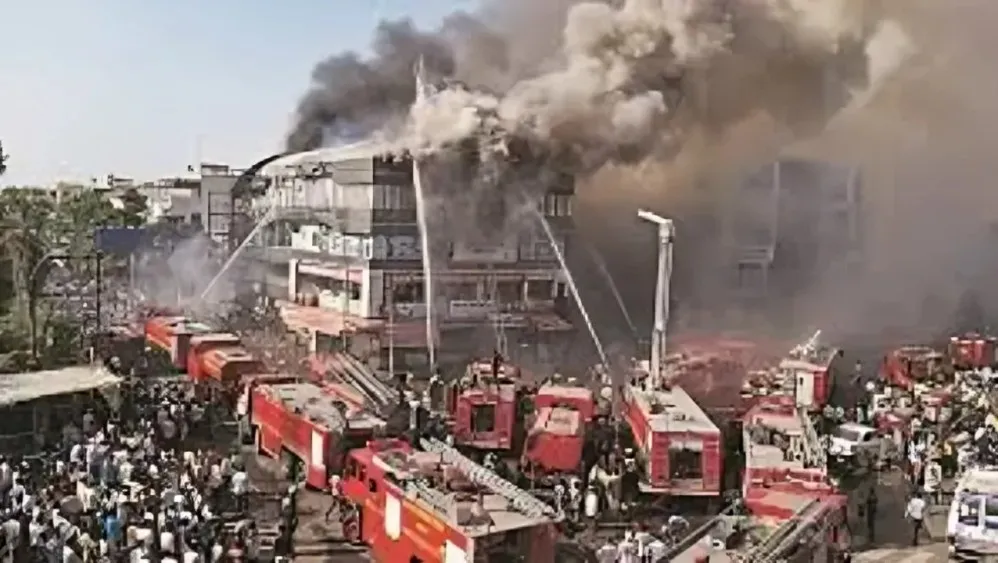
On May 24, 2019, a horrifying afternoon forever scarred the collective conscience of Surat and the entire nation. A massive fire tore through the top floor of the Takshashila Arcade in the Sarthana Jakatnaka area, claiming the lives of 22 young students and leaving 19 others severely injured.
Surat Takshashila Fire Tragedy: Now, exactly seven years later, the families of these children gathered once again outside the commercial complex to light candles and hold a solemn prayer meet. While the tears have not dried, the initial public outrage has faded into a quiet, painful battle for legal accountability. For the parents, the past seven years have been an agonizing cycle of delayed court dates, unfulfilled government promises, and an ongoing fight to ensure that structural greed never steals another innocent life.
Remembering the Day Surat Stood Still
The disaster began at approximately 3:30 PM on a Friday. An electrical short-circuit in an outdoor air-conditioning compressor unit on the third floor quickly triggered a massive blaze. The fire spread with alarming velocity, fueled by highly combustible materials including large flex banners draped along the building’s exterior, wooden paneling, and plastic props.
The Ultimate Death Trap
The fourth floor of the complex hosted an academic coaching center, where students aged between 14 and 17 were attending summer drawing and regular classes. As thick, suffocating smoke filled the interior, the children realized they were completely trapped.
A subsequent administrative inquiry revealed a sequence of structural violations:
- The Sealed Exit: A critical concrete alternate staircase that could have guided the students to safety was permanently closed and sealed at both ends.
- The Illegal Dome: The entire fourth floor was an unauthorized structure built with a synthetic sheet roof, creating a hot zone that trapped toxic smoke.
- Combustible Seating: The studio used discarded synthetic rubber tyres as casual seating for the art students, which caught fire instantly and escalated the smoke density.
Left with no escape route and choking on toxic fumes, desperate teenagers broke through windows. Horrifying video footage captured by onlookers showed children clinging to the building’s exterior before falling or jumping to the ground below.
Seven Years in Court: The Frustratingly Slow Wheels of Justice
Despite immediate public fury and promises of fast-tracked accountability by the state administration, the legal proceedings against the perpetrators have crawled at a snail’s pace.
Judicial Delays Exasperate Victims Families
Following the incident, local police filed a First Information Report (FIR) charging the building’s developers, structural engineers, and coaching class operator with culpable homicide not amounting to murder under relevant sections of the Indian Penal Code. Additionally, a few junior fire and municipal officials were suspended for historical oversight.
However, the trial has faced recurring hurdles. The judicial process has also been repeatedly set back by routine administrative transitions, including the sudden transfer of presiding judges, which forces hearings to be adjourned without any substantial testimony being added to the official record. The families continue to collectively appeal to the High Court of Gujarat to reassign the trial to a dedicated fast-track court.
The Broken Promise of the Sarthana Student Memorial
Beyond the walls of the court, local government commitments have also hit administrative roadblocks. In 2021, the Surat Municipal Corporation (SMC) publicly approved a plan to erect a permanent public memorial to honor the 22 young souls lost in the disaster.
Bureaucratic Inertia Stalls Construction
A 300-square-yard plot was formally allotted at the Sarthana Nature Park corner, directly across from the site of the tragedy. Yet, actual execution on the ground has not even commenced. Municipal authorities state that construction remains halted because complex underground utility pipelines passing beneath the designated zone must first be relocated.
To the victims families, this logistical bottleneck feels like bureaucratic indifference. Parents emphasize that maintaining their annual public prayer meets is a deliberate effort to keep public memory alive, forcing the local administration to acknowledge the devastating cost of regularizing illegal, unsafe structures under the Impact Fee Act.
Has Indian Commercial Infrastructure Become Any Safer?
The structural failure at Takshashila Arcade prompted sudden countrywide fire safety audits of educational institutions, private academies, and high-occupancy public spaces. In response, municipal bodies across Gujarat tightened parameters for issuing Fire Safety Certificates (Fire NOCs) and mandated multi-layered exit strategies.
However, safety analysts note that compliance issues remain widespread. While newer commercial high-rises generally install advanced fire suppression systems, thousands of older, congested properties across Tier-1 and Tier-2 Indian hubs continue to bypass basic building codes. Emergency vehicle access in densely crowded suburban areas like Sarthana remains restricted, and public awareness regarding emergency fire protocols is dangerously low.
The seven-year anniversary of the Surat tragedy serves as a grim warning: without strict, compromise-free enforcement of structural safety laws, structural spaces will continue to put lives at risk.
Also read, Surat: Massive Fire Breaks Out in a Flat at Vesu
Watch Latest News Videos on KRH News: Click Here