


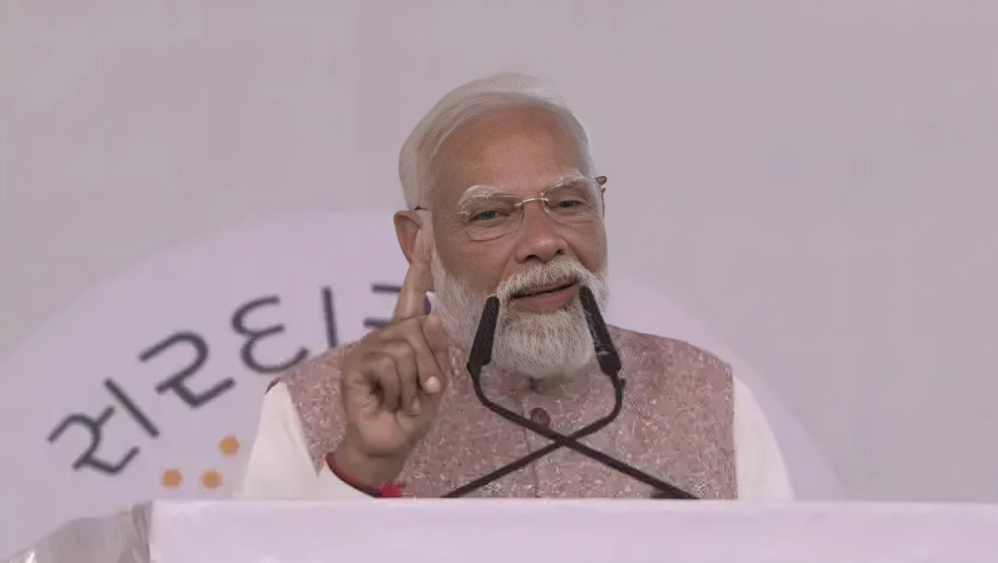
₹150 Crore Milestone in Empowering Youth and Shaping India’s Economic Future
In a significant move toward realizing the vision of “Viksit Bharat” (Developed India), Prime Minister Narendra Modi officially inaugurated Sardar Dham-3 near Waghodia Road, Vadodara. Built at an estimated cost of ₹150 crore, this state-of-the-art complex is designed to provide vocational training and competitive exam coaching to over 2,000 students, serving as a launchpad for the next generation of leaders.
The inauguration ceremony was attended by Gujarat Chief Minister Bhupendra Patel, Minister of State for Home Harsh Sanghavi, and various dignitaries from the Patidar community.
Global Stability and the Call for Economic Resilience
Addressing a massive gathering, Prime Minister Modi touched upon the current global landscape. He noted that the world is grappling with the aftershocks of the pandemic, global economic shifts, and rising conflicts in West Asia.
“In these testing times, the government is committed to ensuring that the common man bears the minimum burden,” PM Modi stated. He emphasized that national strength lies in Self-Reliance (Aatmanirbharta) and urged citizens to turn the ‘Vocal for Local’ campaign into a mass movement.
Reducing the Import Burden: Gold and Oil
The Prime Minister made a specific appeal regarding India’s foreign exchange reserves. He highlighted that a significant portion of national wealth is spent on importing crude oil, edible oil, and gold.
- Gold Imports: He advised citizens to avoid unnecessary gold purchases until global economic conditions stabilize.
- Resource Conservation: He urged a shift in lifestyle to reduce dependence on imported goods, thereby strengthening the local economy.
Promoting Sustainable Living and Green Energy
A major portion of the Prime Minister’s speech was dedicated to environmental and economic sustainability. He linked personal habits to national progress, suggesting several actionable steps for the public:
1. Smart Transportation
To reduce the nation’s fuel bill, PM Modi encouraged the use of Metros, Electric Vehicles (EVs), and public transport. He also advocated for carpooling and the continuation of Work From Home (WFH) and virtual meetings in both public and private sectors to minimize road traffic and fuel consumption.
2. Natural Farming and Solar Power
Turning his attention to the agricultural sector, the PM urged farmers to:
- Adopt Natural Farming techniques to reduce the use of expensive chemical fertilizers.
- Transition from diesel-run pumps to Solar-powered pumps to lower operational costs and carbon footprints.
Focus on Domestic Tourism and ‘Destination Weddings’
In a move to boost the local economy and save foreign exchange, the Prime Minister championed the cause of domestic tourism. “Instead of traveling abroad for summer vacations, explore the rich cultural and historical heritage of India,” he said.
He specifically mentioned the Statue of Unity in Ekta Nagar as a world-class venue and urged the Indian diaspora to encourage foreign nationals to visit India. Furthermore, he appealed to the wealthy to choose Indian locales for ‘Destination Weddings’, rather than spending Indian capital in foreign countries.
Gujarat: The Emerging Global Manufacturing Hub
PM Modi lauded Gujarat’s “Future-Ready” development model. He highlighted that the state is no longer just a trading hub but a leader in advanced sectors:
- Semiconductors: Major projects are underway in Sanand, Dholera, and Surat.
- Aerospace & Engineering: Vadodara has emerged as a powerhouse for manufacturing.
- Transport Innovation: The Prime Minister noted that Metro coaches manufactured in Vadodara are now being exported globally, while Savli continues to produce modern rail coaches.
The establishment of Gati Shakti University in Vadodara was also highlighted as a crucial step in creating a skilled workforce for the logistics and transport sectors.
Education as the Foundation of Nation Building
Chief Minister Bhupendra Patel praised the Prime Minister’s resolve in fulfilling Sardar Patel’s dreams. He noted that Sardar Dham Mission-2026 is pivotal in providing “Shiksha and Sanskar” (Education and Values) to the youth.
PM Modi also spoke about the National Education Policy (NEP), which aims to remove language barriers and focus on skill development and apprenticeship, ensuring that Indian youth are globally competitive.
A Personal Commitment
Upon receiving the Patidar Ratna Gaurav Award, the Prime Minister expressed his gratitude, stating that being honored by his own family (the people of Gujarat) increases his responsibility. “Once I make a resolve, I do not look back,” he affirmed, referring to his dedication to completing the unfinished dreams of Sardar Vallabhbhai Patel.
A United Vision for a Resilient Gujarat
The inauguration of Sardar Dham-3 stands as a testament to the power of collective community action and the “Society to Nation” philosophy. By blending modern educational infrastructure with a strong call for economic discipline and sustainable living, Prime Minister Modi has laid out a clear roadmap for the youth of Vadodara and the wider Patidar community.
As Gujarat continues to lead in sectors like semiconductors and green energy, institutions like Sardar Dham will play a pivotal role in ensuring that the next generation is not just job-ready, but also deeply rooted in the values of self-reliance and national pride. Moving forward, the success of Mission-2026 will depend on this very synergy between government vision and social participation, paving the way for a truly Viksit Gujarat.
Also read, PM Narendra Modi’s Grand Vadodara Roadshow Draws Massive Crowd
Watch Latest News Videos on KRH News: Click Here