


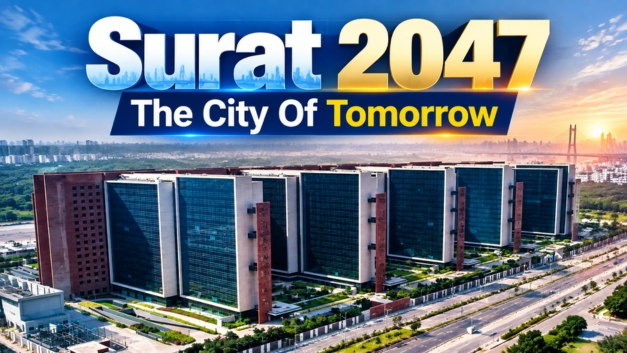
Surat 2047 Vision: What will Surat look like in 2047?
The answer could be very different from the Surat residents know today.
Over the next two decades, the city and its surrounding economic region could see major changes in transport, manufacturing, textiles, diamond and jewellery, logistics, technology, housing, education and urban infrastructure.
This is not simply a prediction based on population growth. A major Economic Master Plan for the Surat Economic Region (SER) prepared by NITI Aayog has already outlined a long-term roadmap aimed at developing the region as a growth hub by 2047. The plan is aligned with the broader Viksit Gujarat@2047 vision.
So, what could Surat look like by the time India celebrates 100 years of independence?
Surat 2047 Vision: From Industrial City to Regional Economic Powerhouse
Surat has traditionally been known for its diamond industry, textile trade, manufacturing and rapidly expanding urban population.
The 2047 vision is considerably broader. The NITI Aayog plan identifies the Surat Economic Region as having the potential for around 20 times economic growth by 2047, with the region potentially contributing more than 35% to Gujarat’s overall economic development.
The larger Surat Economic Region extends beyond the municipal boundaries of Surat and includes parts of Bharuch, Navsari, Tapi, Dang and Valsad. This means the Surat of 2047 could increasingly function not just as a city, but as the centre of a much larger interconnected economic region.
1. Surat Could Become a Major Global Trade and Business Hub
One of the biggest changes could be Surat’s transition from a manufacturing and trading centre into a more diversified international business hub.
The economic master plan identifies opportunities around:
- Textiles and apparel
- Gems and jewellery
- Chemicals
- Manufacturing
- Logistics
- Financial services
- Knowledge-based industries
- Tourism
- Export-oriented businesses
The plan proposes strengthening higher-value activities rather than relying only on traditional large-volume manufacturing. This could create a Surat economy where traditional industries continue to be important while technology, professional services and new businesses become increasingly significant.
2. Surat’s Textile Industry Could Enter a New Phase
Textiles are unlikely to disappear from Surat’s economic identity by 2047. Instead, the industry could become more technologically advanced and globally integrated.
The Surat Economic Region plan identifies textiles and apparel as one of the major sectors for future growth and proposes developing the region as a major trading hub for apparel and textiles.
By 2047, Surat could see greater emphasis on:
- Technical textiles
- High-value fabrics
- Automated manufacturing
- Sustainable production
- International fashion supply chains
- Textile technology
- Export-oriented businesses
This could gradually shift Surat’s image from simply being a textile manufacturing centre to becoming a broader global textile and apparel ecosystem.
3. DREAM City Could Change Surat’s Business Landscape
The Diamond Research and Mercantile (DREAM) City is one of the most important long-term developments associated with Surat’s future.
The project has been positioned as a major business and diamond hub, and its development could create a new commercial centre in the city. The broader Surat economic vision also proposes a B2C zone in DREAM City, while a separate B2B zone is envisioned around the high-speed rail area.
This could mean that by 2047, Surat’s commercial geography looks very different from today. Instead of business activity being concentrated primarily around traditional markets, new business districts could emerge around:
- DREAM City
- High-speed rail infrastructure
- Major highways
- Logistics zones
- Metro corridors
- New residential centres
4. Bullet Train Could Put Surat Closer to Mumbai and Ahmedabad
One of the most visible changes to Surat’s connectivity could come from the Mumbai-Ahmedabad High-Speed Rail Corridor.
The upcoming Surat bullet train station is being developed at Antroli and is designed to connect with other modes of public transport. According to the Ministry of Railways, the station is planned with multimodal integration involving metro, buses, taxis, autos and other local transport. It is around 11 km from the existing Surat Railway Station.
By 2047, high-speed rail could therefore become a major part of Surat’s relationship with other metropolitan regions.
For businesses, this could mean easier access to:
- Mumbai
- Ahmedabad
- Other Gujarat cities
- Major business centres along the high-speed rail corridor
The effect could extend beyond passenger travel because faster connectivity can also influence investment, commercial real estate and business location decisions.
5. Surat Metro Could Reshape Daily Commuting
Another major component of Surat’s long-term urban development is the Surat Metro. The approved Phase-I plan consists of two corridors covering approximately 40.35 km with 38 stations.
The corridors include:
Corridor 1: Sarthana to DREAM City
Corridor 2: Bhesan to Saroli
The original project design also envisages integration with buses, intermediate public transport and non-motorised transport. If the network expands significantly over the coming decades, metro connectivity could influence where people choose to live, work and invest.
Areas around major metro stations could gradually become more commercially active, while dependence on private vehicles could reduce for some daily journeys.
6. Surat Could Become a Much More Connected Multimodal City
The future Surat transport system may not depend on one single mode.
Instead, the city could increasingly function through a combination of:
Metro + BRTS + city buses + railway + bullet train + highways + airport + walking and cycling infrastructure.
The NITI Aayog master plan identifies major connectivity projects including the Mumbai-Ahmedabad High-Speed Rail, Surat Metro, Regional Ring Road, Outer Ring Road, Dedicated Freight Corridor, airport expansion and multimodal transport hubs.
This could eventually make travel between different parts of the wider Surat region significantly easier.
7. Surat Could Become a Major Logistics Hub
Surat’s geographical position gives it another major advantage: connectivity to industrial areas, ports, highways and major markets. The 2047 master plan proposes multimodal logistics parks at Hazira, Olpad and Niyol.
The region could therefore become increasingly important for:
- Warehousing
- Freight movement
- Export logistics
- E-commerce distribution
- Industrial supply chains
- Textile transportation
- Chemical and manufacturing logistics
The combination of highways, rail freight, ports and high-speed passenger connectivity could strengthen Surat’s position within India’s western economic corridor.
8. Hazira Could Become Even More Important
Hazira already plays an important role in Surat’s industrial and port economy.Looking towards 2047, the region could become even more important as industrial and logistics activity expands.
The Surat Economic Region’s development strategy identifies industrial and logistics opportunities around the coastal and Hazira areas, while the broader plan also highlights the potential of Gujarat’s port connectivity for international trade.
This could result in greater demand for:
- Industrial land
- Warehousing
- Logistics services
- Skilled workers
- Engineering services
- Business support services
9. Surat’s Chemical and Manufacturing Industries Could Move Towards Higher Value
Surat’s economic future will not depend only on diamonds and textiles. The Surat Economic Region has a strong chemical and manufacturing base, and the long-term strategy proposes developing the region as a global chemical hub, with greater emphasis on speciality chemicals and higher-value manufacturing.
This could create new opportunities for:
- Chemical research
- Advanced manufacturing
- Industrial automation
- Engineering
- Export businesses
- Environmental technology
- Skilled technical employment
The challenge will be ensuring that industrial growth happens alongside stronger environmental standards.
10. Surat Could Become More Sustainable by 2047
One of the biggest questions for Surat’s future is not simply how large the city becomes, but how sustainably it grows. The Viksit Gujarat@2047 vision includes the goal of creating a sustainable society and achieving net-zero by 2047. It also emphasises clean air and water, sanitation, healthcare and world-class amenities.
For Surat, sustainability could become increasingly important because of:
- Rapid urbanisation
- Industrial activity
- Traffic growth
- Flood risks
- Water management
- Air pollution
- Waste management
- Climate-related challenges
Future development could therefore place greater emphasis on green infrastructure, renewable energy, efficient public transport and improved water management.
11. Tapi River and Flood Management Could Become More Important
Surat’s relationship with the Tapi River is likely to remain an important part of its future. As the city expands, managing flooding, drainage and water resources will become increasingly important. Surat’s existing urban planning challenges include flood vulnerability and the environmental pressures associated with rapid industrial growth.
By 2047, successful urban development could require stronger:
- Stormwater management
- Flood-resilience systems
- Riverfront planning
- Drainage networks
- Water recycling
- Rainwater management
The future Surat will need to be not only bigger, but also more resilient.
12. More New Residential Areas Could Develop Around Transport Corridors
As metro lines, highways and major economic centres expand, residential development is likely to follow. Areas currently considered peripheral could become increasingly connected to the main urban region.
This could gradually reduce the distinction between the traditional city and its outer growth areas. However, whether every proposed corridor develops at the same pace will depend on implementation, demand and future planning decisions.
What Could Surat Look Like in 2047?
If the major planned and proposed infrastructure projects develop successfully, Surat in 2047 could look significantly different. A possible picture would include:
A larger metropolitan region
Surat could function increasingly as the centre of a much wider economic region.
Multiple business districts
Traditional markets could coexist with modern business centres such as DREAM City and new commercial zones.
Integrated public transport
Metro, BRTS, city buses, railway and high-speed rail could operate as parts of a connected transport network.
Advanced manufacturing
Traditional textile, diamond and chemical industries could increasingly adopt automation and high-value production.
Stronger logistics
Ports, freight corridors, highways and logistics parks could make the region an important goods-movement centre.
More sustainable infrastructure
Water management, renewable energy, waste processing and environmental protection could become central to urban planning.
Surat 2047: What Could Change for Ordinary Residents?
The biggest impact of this transformation may not be a particular skyscraper or infrastructure project. It could be the everyday experience of living in Surat.
Residents could potentially have:
- Faster public transport
- More employment opportunities
- Better regional connectivity
- Greater access to specialised healthcare
- More education and skill-development opportunities
- New residential and commercial centres
- Greater access to national and international markets
But rapid development can also create challenges.
Housing affordability, traffic, environmental pollution, infrastructure pressure and inequality will need to be managed carefully.
Final Word
The Surat 2047 Vision is bigger than a single infrastructure project. The next 20 years could see Surat evolve from a powerful textile, diamond and manufacturing centre into a much broader regional economic and logistics hub.
Metro connectivity, the Mumbai-Ahmedabad bullet train, DREAM City, logistics parks, airport expansion, industrial development and new business districts could collectively reshape how people live, work, travel and do business in Surat.
But the real success of Surat 2047 will depend on how effectively the city balances economic growth with sustainability, mobility, affordability and quality of life. If the long-term plans are implemented effectively, the Surat of 2047 may not simply be a bigger version of today’s city; it could be a fundamentally more connected and diversified urban region.
Also read, 2026 Mega Highway Projects in India: Tunnels, Roads and Bridges
Watch Latest News Videos on KRH News: Click Here