


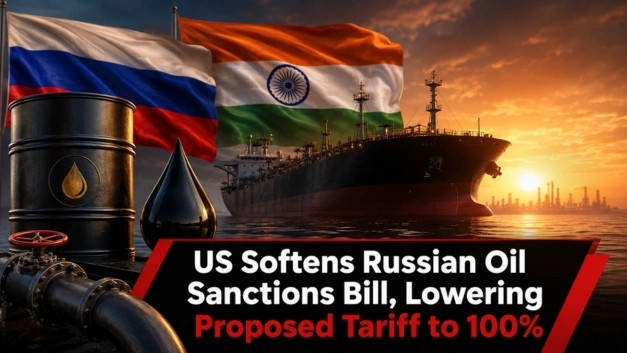
Proposed Tariff 100% for India: In a major geopolitical move, a bipartisan coalition of US Senators has formally introduced a revised, sweeping Russia sanctions bill. The legislation explicitly names India among five key nations that could face punitive tariffs for continuing to import Russian crude oil.
The updated legislation dubbed the “Lindsey Graham Russia Accountability Bill” in honor of the late South Carolina Senator who spearheaded the effort before his sudden passing—has scaled down the maximum tariff penalty to 100%, a significant reduction from the staggering 500% blanket tariff originally proposed.
Key Highlights of the New Sanctions Bill
- Primary Targets: India, China, Slovakia, Hungary, and Azerbaijan are explicitly identified as the five major global buyers of Russian oil facing potential tariff actions.
- Revised Penalty Cap: The maximum tariff rate has been cut from the initial 500% proposal down to a maximum of 100%.
- Trump Administration Support: Lawmakers revealed that the Trump administration has endorsed the revised bill in writing.
- Broad Scope: Beyond import tariffs, the bill imposes full blocking sanctions on Russia’s financial institutions, defense industry, oligarchs, and its “shadow fleet” of oil tankers.
From 500% to 100%: Why the US Eased the Tariff Threat
The earlier iteration of the bill, known as the Sanctioning Russia Act, sent shockwaves through global energy markets with its threat of a 500% tariff on any nation buying Russian-origin petroleum products, uranium, or natural gas.
However, the revised bill seeks a more balanced approach to avoid destabilizing global energy supply chains and alienating key US allies.
“It imposes tariffs that are targeted: narrowly limited to the five major purchasers – up to 100% – with waiver authority that is narrowly tailored and constricted,” stated Democratic Senator Richard Blumenthal, a lead sponsor of the bill.
The bill also includes critical exemptions for European nations importing less than 15% of their natural gas from Russia, provided they are actively working to transition away from Moscow’s energy sector.
| Feature | Original Proposal | Revised Bill (July 2026) |
| Maximum Tariff Rate | Up to 500% | Up to 100% |
| Scope of Target Countries | Broadly targeted up to 63 nations | Narrowed to 5 key oil buyers & 5 gas buyers |
| Key Named Countries | India, China, Brazil | India, China, Slovakia, Hungary, Azerbaijan |
| Presidential Waiver | Highly restricted | Grants US President authority to waive sanctions in the national interest |
India’s Tightrope Walk: Energy Security vs. US Relations
Since the escalation of the conflict in Ukraine, India has consistently defended its purchase of discounted Russian crude as a necessity for its domestic energy security and economic stability. Russian oil has at points comprised a massive share of India’s overall crude basket, helping to cushion Indian consumers from soaring global fuel prices.
New Delhi has maintained that its actions keep global oil markets stable by preventing a massive supply squeeze. However, the looming threat of US tariffs presents a direct challenge to Indian exporters, who rely heavily on access to the lucrative US market.
If passed by both the Senate and the House of Representatives, the bill would represent the first time the US Congress has explicitly authorized using import tariffs as a direct geopolitical weapon to punish third-party nations for trading with a sanctioned state.
What’s Next for the Bill?
The bipartisan bill must now clear standard procedural hurdles in the US Senate and pass the House of Representatives before reaching the President’s desk. Given the strong bipartisan support—and explicit backing from the White House—analysts expect the legislation to move forward rapidly.
All eyes are now on New Delhi to see how India’s Ministry of External Affairs reacts to this targeted economic pressure, and whether India will accelerate plans to diversify its crude oil imports to avoid the impending 100% US tariff threat.
Also read, Indian Sailor Heramb Karmarkar Killed in Strait of Hormuz Ship Attack, India Lodges Strong Protest
Watch Latest News Videos on KRH News: Click Her