


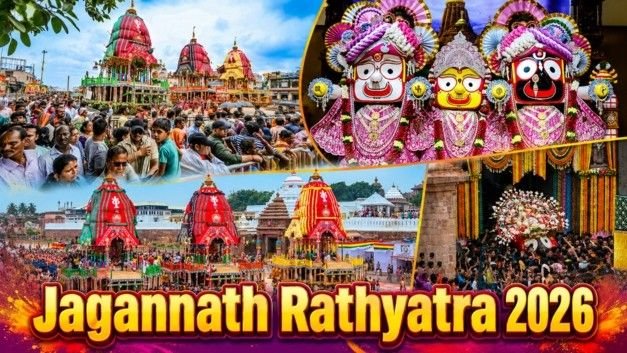
There are religious festivals, and then there is the grand spectacle of the Jagannath Rath Yatra 2026. Every year, the coastal city of Puri in Odisha transforms into a sea of intense devotion as millions of hands pull three massive wooden chariots. This unique festival marks the rare occasion when the Lord of the Universe steps out of his inner sanctum to meet all his devotees directly, irrespective of caste, creed, or nationality.
In 2026, the Jagannath Rath Yatra begins on Thursday, July 16, 2026. For digital creators, travel enthusiasts, and spiritual seekers, understanding the profound history and cross-country footprint of this festival offers a deep glimpse into India’s cultural tapestry.
The Timeless History and Divine Legends
The origins of the Rath Yatra trace back thousands of years, documented extensively in ancient texts like the Skanda Purana, Brahma Purana, and Padma Purana.
The Tale of King Indradyumna
According to sacred lore, King Indradyumna desired to build a magnificent temple for Lord Vishnu. The celestial architect, Vishwakarma, agreed to carve the holy deities out of a massive, sacred log floating on the ocean. However, he placed a strict condition: he must work completely undisturbed inside a sealed room for 21 days.
Overwhelmed by impatience and anxiety, the King opened the door prematurely on the 15th day. Vishwakarma vanished instantly, leaving the statues of Lord Jagannath, his elder brother Lord Balabhadra, and their younger sister Goddess Subhadra without completely formed limbs. The King was heartbroken, but a divine voice reassured him that the Lord wished to manifest in this distinct, abstract form to bless the world during the era of Kali Yuga.
Why the Chariot Journey Happens
The annual Rath Yatra represents the journey of the three siblings from their main home, the 12th-century Jagannath Temple, to their maternal aunt’s home at the Gundicha Temple, located roughly 3 kilometers down the Grand Road (Bada Danda). It symbolizes pure unconditional love, commemorating the moment Lord Krishna returned to Vrindavan to meet his structural gopis and devotees who could not access royal courtrooms.
Why the 2026 Rath Yatra Holds Great Importance
The year 2026 brings an auspicious and tightly packed spiritual calendar. Falling on the Dwitiya Tithi of Shukla Paksha in the traditional month of Ashadha, the 2026 festival aligns beautifully with key monsoon periods. It stands out as an ultimate symbol of social equality and unity in an increasingly digital world.
A stellar example of this equality is the Chhera Panhara ritual. On the morning of the procession, the Gajapati Maharaja (the King of Puri) arrives in a palanquin to clean the peripheral platforms of all three massive chariots using a golden broom and fragrant sandalwood water. This ancient ritual sends a profound message: before the Supreme Creator, a mighty king and a humble laborer hold the exact same status of service.
Complete Schedule and Key Dates for 2026
The Rath Yatra is not just a single-day event; it is a meticulously timed cycle of ancient rituals spanning over a month.
| Ritual / Event | Significance | Date (2026) |
| Snana Purnima | The deities receive a public ceremonial bath with 108 pots of holy water. | June 29, 2026 |
| Anasara (Rest Period) | The deities are believed to catch a fever and recuperate in absolute isolation. | June 30 – July 13, 2026 |
| Netrotsav / Nabajaubana | The fresh eyes of the deities are painted, marking their full recovery. | July 14, 2026 |
| Rath Yatra Day | The grand chariot procession begins toward Gundicha Temple. | July 16, 2026 |
| Hera Panchami | Goddess Lakshmi visits the Gundicha Temple to find Lord Jagannath. | July 20, 2026 |
| Bahuda Yatra | The return journey of the three siblings back to the main temple. | July 24, 2026 |
| Suna Besha | The deities are adorned in magnificent, heavy gold ornaments on their chariots. | July 25, 2026 |
| Niladri Bijay | The deities officially step back inside the sanctum sanctorum. | July 27, 2026 |
Anatomy of the Three Sacred Chariots
Every single year, the three towering chariots are built entirely from scratch using specific timber without utilizing a single metal nail or screw.
- Nandighosha (Lord Jagannath’s Chariot): Standing tallest at approximately 45 feet, it features a canopy of vibrant red and yellow cloth. It rests on 16 massive wooden wheels and is guarded by the deity Garuda.
- Taladhwaja (Lord Balabhadra’s Chariot): Reaching 44 feet high, this chariot sports a red and blue/green canopy, running smoothly on 14 structural wheels.
- Darpadalana (Goddess Subhadra’s Chariot): The compact yet graceful 43-foot chariot features a red and black cloth lining and rolls forward on 12 wheels.
Grand Celebrations in Different Parts of India
While Puri remains the absolute epicenter, the spiritual gravity of the Rath Yatra pulls communities together all across the Indian subcontinent.
1. Ahmedabad, Gujarat (The Second Largest Yatra)
Outside of Odisha, the Rath Yatra at the Jagannath Temple in Jamalpur, Ahmedabad is historically the second largest in terms of sheer scale. Following a century-old path, it features decorated elephants, specialized martial art troupes, and complex trucks carrying moving exhibits. It serves as a historic emblem of communal peace and shared celebration throughout Gujarat.
2. Mahesh, West Bengal
The Rath Yatra of Mahesh, near Serampore, has been celebrated continuously since 1396 CE, making it the oldest unbroken chariot festival outside of Puri. The chariot here is a permanent, towering 4-story iron and wood structure that moves through massive crowds along the Hooghly river banks.
3. International Metros (The Global Footprint)
Through the efforts of ISKCON, the rhythmic chants of “Hare Krishna, Jai Jagannath” ring out globally. From the streets of New York’s Fifth Avenue and London’s Piccadilly Circus to major community celebrations in Mumbai and Bangalore, the Rath Yatra breaks all geographical limits.
The Spiritual Benefit: According to the Skanda Purana, catching even a brief glimpse of Lord Jagannath resting on his chariot (Rathe tu vamanah drstva punarjanma na vidyate) liberates a soul from the unending cycle of rebirth. For millions of matching hearts, pulling the rough coir ropes is a life-changing act of absolute surrender.
Must read, July 2026 Festivals and Days Complete Calendar & Events
Watch Latest News Videos on KRH News: Click Here