


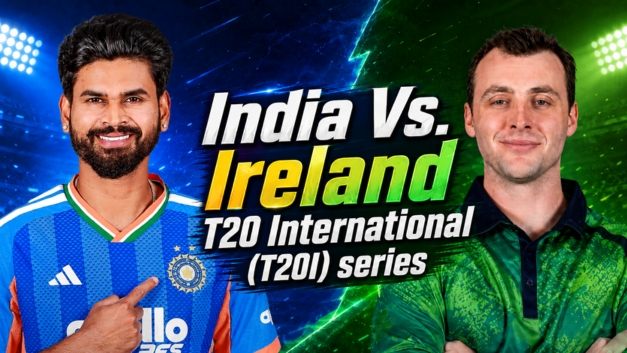
India vs Ireland T20I overall report: In a stunning turn of events at the Stormont Cricket Ground, Ireland secured their first-ever bilateral T20I series victory against India. By winning the second T20I by a razor-thin 1-run margin, the hosts broke India’s formidable 16-series unbeaten streak and handed Shreyas Iyer a disappointing start to his T20I captaincy tenure.
Series Summary
| Match | Toss | Ireland Score | India Score |
| 1st T20I (26 Jun) | IND (Bowl) | 182/9 (20 ov) | 148 (18.5 ov) |
| 2nd T20I (28 Jun) | IND (Bowl) | 154/8 (20 ov) | 153/9 (20 ov) |
Team Management & Tactical Failures in India vs Ireland T20I Series
The management’s blueprint for this transition series faced significant structural criticism. Following the T20 World Cup triumph in March, the sudden overhaul of leadership combined with forced tactical shifts due to injuries left the squad looking heavily disjointed.
Key management issues centered around tactical rigidity, such as winning back-to-back tosses and choosing to field first despite the pitch clearly slowing down as the matches progressed. Furthermore, the inability to shield a highly experimental top-order against swinging conditions proved fatal disaster
10 Major Reasons Behind the 2-0 Series Defeat
- Complete Top-Order Disarray Across Both Games: India’s opening combinations failed to provide a single solid platform in the series. While the second game saw traumatic golden ducks, the first match similarly saw the top three crumble under early pressure, leaving the middle order exposed within the Powerplay in both fixtures.
- Inability to Read Belfast Chasing Pitches: Winning the toss in both matches, the management explicitly chose to bowl first twice. This strategic choice completely misread the nature of the Stormont pitch, which became progressively slow, dry, and abrasive in the second innings, heavily punishing the chasing team.
- Failure Against Fresh Scouting & Debutants: Ireland successfully deployed highly disciplined tactical plans using newer faces like Jai Moondra and Matthew Hollard. The Indian batters showed an extreme lack of adaptability, failing to adjust to the specific angles and variations brought by these fresh bowlers across the two games.
- Glaring Lack of Anchoring Partnerships: Across the 40 overs India batted in the series, there was a noticeable absence of stabilizing, long-term partnerships. The batting unit played in isolated pockets such as Abhishek Sharma’s lone 49 in the first match and Tilak Varma’s 55 in the second rather than building sustained team momentum.
- Middle-Over Power Outage (Dot Ball Crisis): A major trend across the series was India’s inability to rotate strike smoothly against Ireland’s spin and medium-pace squeeze during overs 7 to 15. The accumulation of empty dot balls created massive, unsustainable asking rates toward the back end of both chases.
- Over-Reliance on Individual IPL Muscle: The squad appeared to play as individuals relying on raw boundary-hitting capability rather than adapting to international match awareness. When boundary lengths or windy conditions didn’t favor reckless hitting, the team lacked a ‘Plan B’ to accumulate runs cleanly.
- Disrupted Team Balance Due to Late Injuries: The forced pre-series absences of primary frontline spinner Varun Chakravarthy and explosive all-rounder Nitish Kumar Reddy left India with a heavily experimental and thin bowling tail, severely reducing tactical flexibility during crucial game segments.
- Severe Tail-End Fragility: Unlike Ireland, whose lower order consistently chipped in with vital boundary cameos to push their totals to competitive marks (182/9 and 154/8), India’s lower-order batters and tail collapsed rapidly under pressure in both games, offering zero resistance once main partnerships broke.
- Transition Leadership Deficit: Moving into a new era under Shreyas Iyer’s T20I captaincy immediately following the World Cup triumph proved too sharp of a cultural shift. The squad lacked the steadying, calm presence required to navigate high-pressure, foreign conditions when early wickets fell.
- Complacency Against ‘Underdog’ Tag: Coming in as reigning World Champions, the team arguably underestimated Ireland’s highly evolved home blueprint. Ireland played clinical, high-intensity cricket, while India’s experimental tier-two unit looked underprepared to counter a highly motivated opponent on their own turf.
Must read, India vs England T20 Series 2026: The Ultimate Preview
Watch Latest News Videos on KRH News: Click Here