


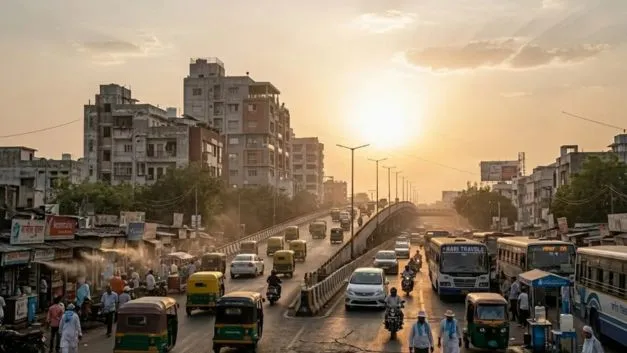
The global climate crisis is hitting close to home as urban centers rapidly transform into literal heat traps. According to a groundbreaking study published by researchers at the University of Oxford, India has emerged as one of the most disproportionately exposed nations to soaring urban heat risks. Strikingly, three prominent Indian cities, Ahmedabad, Nagpur, and Madurai have been ranked among the top ten most heat-vulnerable cities across the globe.
The comprehensive research, featured in the peer-reviewed journal Sustainable Cities and Societies, assessed 205 cities worldwide with populations exceeding one million. The global evaluation is designed to serve as a harmonized framework, allowing policymakers to directly compare urban heat stress, track regional climate adjustments, and allocate environmental resources where they are needed most urgently.
Understanding the Oxford University Heat Study Framework
When analyzing the world’s most heat-vulnerable cities, the Oxford researchers looked far beyond simple raw temperature readings. The study evaluates a complex blend of factors including physical exposure to extreme heat waves, prevailing socioeconomic vulnerabilities, and the intrinsic coping mechanisms available to local populations.
Lead author Nethmi Jayaratne Kariyawasam, a researcher at Oxford’s Smith School of Enterprise and the Environment, emphasized that extreme weather spikes become exceptionally dangerous when they cross paths with high social vulnerability and poor structural coping tools. The metric integrates:
- Demographics & Economics: Population age splits and baseline household income distributions.
- Technological Gaps: True community access to active cooling technologies like air conditioning.
- Ecological Infrastructure: Presence or absence of critical green spaces and urban tree canopies to absorb thermal loads.
Why Developing Economies Bear the Brunt of Climate Shifts
The study outlines an alarming trend: over 95% of the world’s most at-risk urban centers are located in South Asia, Southeast Asia, and Sub-Saharan Africa. Emerging economies like India, Pakistan, Nigeria, and Ghana host the vast majority of these high-risk areas. Rapid, unchecked urbanization combined with structural infrastructure deficits prevents these growing metropolises from adequately shielding their populations from soaring wet-bulb temperatures.
Deep Dive: The Heat Risk Profiles of Ahmedabad, Nagpur, and Madurai
Ahmedabad Heat Risk
Ahmedabad’s inclusion near the top of the global risk index highlights its intense seasonal spikes and dense built environment. While the city pioneered India’s first formal Heat Action Plan (HAP) after a devastating heatwave in 2010, the sheer volume of its concrete footprint and widespread economic stratification keep the vulnerable urban poor highly exposed.
Nagpur Extreme Heat
Positioned right in the geographical heart of India, Nagpur faces harsh continental summer conditions. The city regularly experiences temperatures breaching 45 degrees Celsius. The Oxford study notes that limited access to reliable domestic cooling and declining urban green buffers leave huge swathes of Nagpur’s population exposed to heat-related illnesses.
Madurai Climate Vulnerability
Representing Peninsular India, Madurai’s high risk stems from a combination of high coastal-influenced humidity and socioeconomic factors. In humid urban environments, the human body struggles to cool itself effectively through sweat, magnifying the danger for outdoor laborers and individuals living in substandard housing units.
The Paradox of Modern Cooling Technologies
As global temperatures climb, the natural response for those who can afford it is to purchase intensive air conditioning systems. However, Radhika Khosla, Associate Professor at the University of Oxford, issued a stern warning regarding this trend.
While cooling is rapidly moving from a luxury to a baseline survival need, an exclusive reliance on energy-heavy air conditioning threatens to create a destructive, self-reinforcing climate cycle. The electricity needed to power these units drives higher carbon emissions, which in turn accelerates the broader planetary warming that caused the crisis in the first place. Furthermore, millions of low-income citizens are left completely behind, unable to afford the high electricity costs associated with artificial cooling.
Sustainable Adaptation Strategies for Tomorrow’s Cities
To break this cycle and shield populations in high-risk zones, climate scientists and urban planners are calling for an immediate pivot toward sustainable, low-carbon adaptation strategies:
- Passive Architecture: Expanding building techniques that use natural ventilation, thermal insulation, and reflective “cool roofs.”
- Expanding Urban Forestry: Re-introducing dense tree covers and pocket parks to naturally mitigate the urban heat island effect.
- Low-Energy Alternatives: Enhancing the efficiency and distribution of low-energy cooling devices like advanced ceiling fans and localized evaporative coolers.
Without aggressive structural pivots and dedicated climate funding, developing nations will continue to stand on the front lines of this escalating urban emergency.
Global Ranking: The World’s Most Heat-Vulnerable Cities
The Oxford University study evaluated hundreds of major cities. Below is the verified ranking of the top 10 most heat-vulnerable large urban centers globally based on their integrated exposure, social vulnerability, and coping capacities.
| Global Rank | City Name | Country |
| 1 | Al Basrah | Iraq |
| 2 | Ahmedabad | India |
| 3 | Bamako | Mali |
| 4 | Nagpur | India |
| 5 | Quezon City | Philippines |
| 6 | Baghdad | Iraq |
| 7 | Madurai | India |
| 8 | Faisalabad | Pakistan |
| 9 | Lagos | Nigeria |
| 10 | Hyderabad | Pakistan |
Must read, Indian Region and State-Wise Monsoon Forecast 2026
Watch Latest News Videos on KRH News: Click Here