


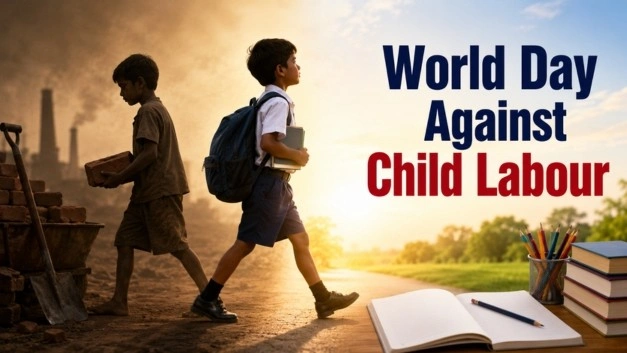
Every year on June 12, the international community halts to observe the World Day Against Child Labour. Established as a unified global front to protect young minds from exploitation, this observance serves as both a reflection on how far global societies have come and a stark reminder of the massive mountain left to climb.
As the world marks this crucial day, the International Labour Organization (ILO) and global partners have launched a renewed rallying cry to move from institutional promises to direct local enforcement.
The Roots of Change: History and Significance
Origin of the Global Observance
The World Day Against Child Labour was officially introduced by the International Labour Organization (ILO) in 2002. The day was born out of a critical need to bring global focus to the plight of millions of underage workers forced into factories, fields, and hazardous environments.
It serves to bolster international support for the ratification of ILO Convention No. 138 (regarding the minimum age for employment) and ILO Convention No. 182 (addressing the worst forms of child labour).
Understanding the 2026 Campaign Theme
The official theme for the 2026 campaign is “Red card to child labour: Fair play for children, decent work for adults.”
Following the landmark Sixth Global Conference on the Elimination of Child Labour held in Marrakech, this year’s focus targets the economic roots of exploitation. It highlights that child exploitation cannot be systematically eliminated unless adult heads-of-households are provided stable livelihoods, fair wages, and baseline universal social protection.
By the Numbers: Global Child Labour Statistics
Reversing the Pandemic-Era Spikes
According to the latest comprehensive joint report by the ILO and UNICEF, the global community has witnessed a welcome return to progress. After an alarming spike in child labour cases between 2016 and 2020, recent global estimates reveal that the total number of children trapped in child labour has dropped to 138 million worldwide.
While this marks a net reduction of more than 22 million children over a four-year window, the world has officially fallen short of its original Sustainable Development Goal (SDG Target 8.7) to eliminate all forms of child labour entirely by 2025. To wipe out the practice within the next five years, global intervention strategies must accelerate at 11 times their current speed.
Breakdown by Economic Sector
Child labour is not uniform across industries; it is heavily tied to specific rural and informal supply chains:
| Sector | Global Percentage | Examples of Work |
| Agriculture | 61% | Unpaid family farming, commercial cocoa, coffee, and cotton harvesting. |
| Services | 27% | Domestic service in third-party homes, market vending, informal retail. |
| Industry | 13% | Small-scale mining, brick kilns, manufacturing, textile workshops. |
The Demographics and Gender Disparity
Data consistently shows that boys are overrepresented in global economic child labour statistics. Approximately 9% of all boys globally are engaged in child labour compared to 7% of girls.
However, researchers note that this gap rapidly narrows or completely reverses when unpaid household chores exceeding 21 hours per week are factored into regional datasets. Furthermore, out of the 138 million affected, 54 million children remain trapped in explicitly hazardous work that directly threatens their physical, mental, and moral well-being.
Countrywise Mobilization: How the World Fights Back
Sub-Saharan Africa: Reversing the Trend
Sub-Saharan Africa continues to shoulder the heaviest global burden, accounting for nearly two-thirds of all global cases with roughly 87 million children affected.
Despite systemic hurdles like rapid population growth and climate-induced food insecurity, nations like Ghana and Uganda have successfully initiated area-based monitoring. Through programs like the CLEAR Supply Chains initiative, communities are combining conditional cash transfers with direct school infrastructure investments to keep children in classrooms.
Asia and the Pacific: Leading Global Reductions
The Asia and the Pacific region achieved the most statistically significant victory over the last reporting period, successfully halving its child labour prevalence rates.
Countries like India continue to combat systemic child labor through robust legislative guardrails such as the Child Labour (Prohibition and Regulation) Amendment Act and integrated social protection schemes like Samagra Shiksha, which directly subsidize the opportunity costs of education for low-income rural families.
Why June 12 Matters Now More Than Ever
Breaking the Intergenerational Cycle of Poverty
Child labour is both a symptom and a direct driver of systemic poverty. When a vulnerable family is forced to send a child into the workforce instead of a classroom, that child is denied the foundational literacy and specialized skills required to secure higher-paying employment in adulthood. This locks families into a perpetual cycle of financial deprivation.
A Call for Decent Work and Stronger Social Safety Nets
To read more about evolving global human rights initiatives and economic updates, bookmark KRH News. True systemic change requires global and domestic funding bodies to protect investments in universal child protection, free high-quality schooling, and strict business accountability metrics within multinational corporate supply chains.
By raising the figurative “Red Card,” local citizens, civil organizations, and world governments can transition away from mere localized remediation and move confidently toward absolute prevention.
Also read, June 2026 Festivals and Days: Complete Calendar & Events
Watch Latest News Videos on KRH News: Click Here