


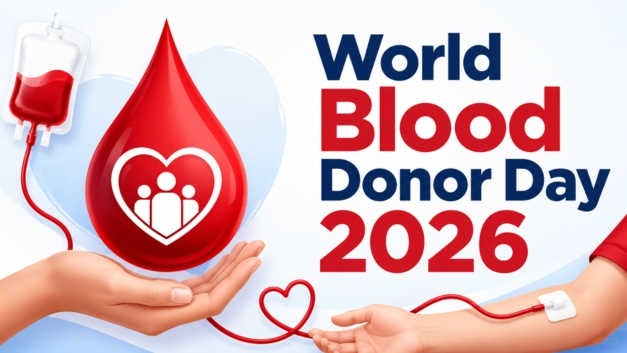
Every year on June 14, the global healthcare community unites to observe a vital campaign: World Blood Donor Day 2026. This day serves two major purposes: to express profound gratitude to millions of selfless, voluntary, unpaid blood donors worldwide, and to raise awareness about the critical, ongoing demand for a safe, accessible blood supply.
Blood is a finite, perishable resource that cannot be synthetically manufactured. Because it can only be obtained through human generosity, understanding why blood donation is important is essential to keeping healthcare systems resilient, functional, and equitable across the globe.
The World Health Organization (WHO) has officially announced the campaign slogan for this year: “One Drop of Humanity. Give Blood. Save Lives.”
Putting Humanity at the Heart of Healthcare
The World Blood Donor Day theme 2026 shifts the conversation from a routine medical procedure to a profound act of global solidarity. It reminds us that humanity is interconnected; a single drop of blood contains the compassion and collective responsibility required to protect human life.
The “Drop Your Drop” Global Initiative
To mark the 2026 campaign, the WHO has rolled out the interactive “Drop Your Drop” digital initiative. Through an interactive online platform, individuals worldwide can scan a QR code to pledge a future donation. When eight distinct donors submit a pledge, they visually form one symbolic “living drop” on a global digital wall, showcasing unity, community action, and an active commitment to fighting blood shortages.
Tracing the Roots: History of World Blood Donor Day
The history of World Blood Donor Day is deeply tied to a monumental breakthrough in medical science.
Honouring Dr. Karl Landsteiner
The event is celebrated annually on June 14 to commemorate the birth anniversary of Dr. Karl Landsteiner, an Austrian biologist and physician. Landsteiner discovered the ABO blood group system in 1901, a revolutionary achievement that made safe, cross-matched blood transfusions medically possible. His work transformed modern surgery, trauma care, and hematology.
Official Establishment by the WHO
In 2004, recognizing the desperate need to coordinate global supply lines, the World Health Organization, alongside the International Federation of Red Cross and Red Crescent Societies (IFRC), launched the first official awareness day. By 2005, during the 58th World Health Assembly, it was formally declared an annual global public health campaign.
Critical Facts: Why Blood Donation is Vital
Understanding the biological realities and logistics behind a blood drive highlights how much patients rely on voluntary donors.
- The 1-to-3 Lifesaving Ratio: A single unit of donated whole blood (roughly 350ml to 450ml) can be separated into three distinct components: red blood cells, plasma, and platelets. This means one donation can save up to three lives.
- Perishable Lifelines: Unlike chemical medications, blood components have a strict shelf life. Red blood cells must be used within 35 to 42 days, while platelets expire in just 5 to 7 days, making continuous, steady donations necessary.
- The Safest Source: WHO data consistently proves that regular, voluntary blood donation benefits patient safety the most. Unpaid volunteers have the lowest prevalence of transfusion-transmissible infections (such as HIV and Hepatitis) compared to family-replacement or paid donors.
Global Disparities: The Blood Supply Situation Across Countries
While advances in medical screening have made transfusions safer than ever, blood safety and availability remain highly unequal across the globe.
The Crisis in Low- and Middle-Income Countries (LMICs)
Developing nations face severe, chronic structural shortages. According to the WHO, a country requires a minimum of 1% to 2% of its population to donate regularly to meet its basic health needs- a target most low-income countries fail to reach. In these regions, blood shortages hit vulnerable groups hardest, directly impacting women facing postpartum haemorrhage and children suffering from severe anaemia caused by malaria or malnutrition. Many healthcare facilities still rely heavily on stressful “family-replacement systems,” where relatives must rush to donate blood before a procedure can take place.
High-Income Nations and the Rise of Plasma Demand
In wealthier nations, while whole blood collection systems are generally robust, the medical sector faces a growing need for plasma donations. Plasma is essential for creating life-saving immunoglobulins used to treat patients with primary immunodeficiencies, cancer, and rare clotting disorders. High-income nations are currently focusing heavily on upgrading infrastructure to make automated plasma collection (apheresis) a routine public habit.
Getting Involved: Who Can Donate Blood?
If you want to support the 2026 global movement, verifying your eligibility is the first step toward becoming a regular donor.
Standard Eligibility Checklist
While specific medical guidelines can vary slightly by country, the general criteria for who can donate blood include:
- Age: Typically between 18 and 65 years old.
- Weight: A healthy minimum weight, usually starting between 45kg to 50kg.
- Hemoglobin Levels: A quick pre-donation finger-prick test ensures your iron levels are completely safe for donation.
- General Health: You must feel well on the day of donation and be free from active infections or recent major medical procedures.
Pledge Your Drop Today
World Blood Donor Day 2026 reminds us that a secure, resilient healthcare system cannot exist without individual action. Turning your intentions into practical support by visiting a local donation camp, volunteering at a blood bank, or joining the global “Drop Your Drop” pledge wall helps ensure that safe blood is always available for everyone, everywhere, exactly when it is needed most.
Must read, June 2026 Festivals and Days: Complete Calendar & Events
Watch Latest News Videos on KRH News: Click Here