


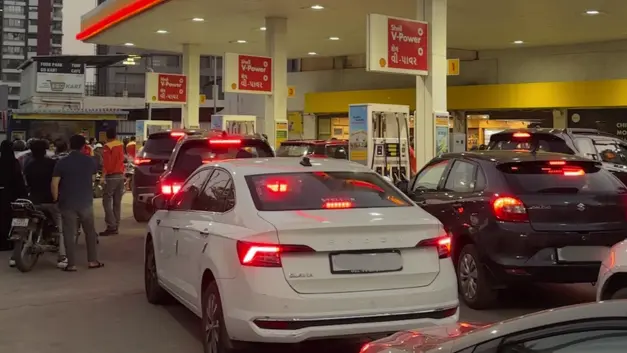
On May 23, 2026, retail petrol prices were increased by 87 paise per litre, while diesel prices were increased by 91 paise per litre.
Petrol and Diesel Rates Increase for the Third Time: The burden on the common man’s pocket continues to intensify as state-run Oil Marketing Companies (OMCs) announced another steep hike in fuel prices across the country.
This latest adjustment marks the third fuel price hike in India in a span of just late ten days, accumulating a total surge of nearly ₹5 per litre since the revisions began on May 15. The recurring updates have sparked widespread financial concern among citizens, transport bodies, and commercial sectors, signaling a looming wave of retail inflation.
New Fuel Rates Across Major Indian Metros
The localized impact of the fuel price hike varies significantly due to different state-level Value Added Tax (VAT) structures and local freight levies.
In the national capital, New Delhi, petrol prices breached previous thresholds to reach ₹99.51 per litre, up from ₹98.64. Concurrently, diesel rates climbed from ₹91.58 to ₹92.49 per litre.
The situation remains more severe in other metropolitan hubs:
- Mumbai: Petrol reached ₹108.49 per litre (up 90 paise), while diesel stood at ₹95.02 per litre.
- Kolkata: The city witnessed the steepest absolute surge, with petrol touching ₹110.64 per litre (up 94 paise) and diesel closing at ₹97.02 per litre.
- Chennai: Petrol was revised upward to ₹105.31 per litre (up 82 paise), and diesel climbed to ₹96.98 per litre.
The Timeline of Recent Escalations
The current cycle of price revisions commenced on May 15, 2026, when OMCs broke an extended price freeze by enforcing a direct ₹3 per litre hike across both fuel types, alongside a ₹2 per kg increase in Compressed Natural Gas (CNG) rates. This was quickly followed by a second nationwide revision of approximately 90 paise on May 19, leading directly into the current May 23 increment.
Why are Fuel Prices Rising in India?
The West Asia Crisis and Brent Crude Volatility
The fundamental trigger behind the domestic price spike is the volatile state of international energy markets. Following severe geopolitical disruptions in West Asia, specifically affecting trade routes along the Strait of Hormuz, global benchmark Brent crude oil surged past $120 per barrel earlier this year before stabilizing slightly between $100 and $105 per barrel.
Since India depends on imports for over 88% of its domestic crude oil processing requirement, it remains highly vulnerable to global supply bottlenecks and international cost escalations.
Addressing the Under-Recoveries of OMCs
Despite maintaining strong financial earnings during the fiscal year 2025-2026, India’s primary state-led refiners, Indian Oil Corporation (IOC), Bharat Petroleum Corporation Ltd (BPCL), and Hindustan Petroleum Corporation Ltd (HPCL) nencountered immense daily operational stress as crude acquisition costs escalated.
Market analysts at financial services firm Emkay Global and sector experts noted that even after a Special Additional Excise Duty (SAED) relief implementation by the Central Government, OMCs were operating under severe revenue under-recoveries, losing estimated sums of ₹15 to ₹18 per litre of fuel sold initially.
According to government inputs, the OMCs’ combined daily losses dropped from ₹1,000 crore post-May 15 to about ₹750 crore post-May 19. The latest iteration on May 23 aims to pull these daily operational under-recoveries down below the ₹500 crore threshold.
Economic Fallout: The Threat of Secondary Inflation
The cascading impact of compounding fuel hikes extends far beyond personal vehicular expenditures. Industry experts warn that the persistent rise in diesel costs – the primary fuel running India’s freight network – will heavily influence nationwide logistics.
Rising Cost of Essential Goods
As transport unions adjust their freight tariffs to balance operational margins, the cost of moving daily essential commodities like vegetables, milk, fruits, and medicines will climb. Consumer Goods (FMCG) corporations are also expected to roll out minor structural revisions, including smaller packaging alternatives or minor product price adjustments, to counter rising factory-to-market distribution overheads.
Call for Public Lifestyle Adjustments
In light of the climbing import bill and pressure on national foreign exchange reserves, administrative advisories have recently highlighted the need to conserve fuel. Prime Minister Narendra Modi urged the public to consider shifting toward public transportation networks and adopting hybrid work-from-home frameworks where possible to curb aggregate national consumption.
While OMCs state that demand remains strong with domestic petrol sales growing 14% and diesel sales expanding 18% year-on-year in May, market economists project that if retail creeping hikes total up to ₹10 per litre in the near term as anticipated, retail inflation metrics could witness an immediate upward tick of 15 to 25 basis points.
Also read, No Fuel Rationing In India: Bulk Buyers Trigger Long Queues
Watch Latest News Videos on KRH News: Click Here