


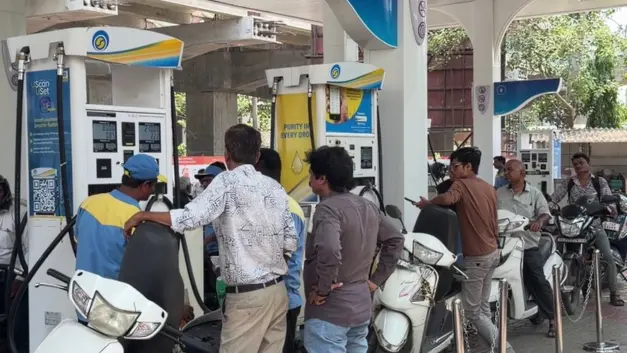
Why Petrol Pumps Are Facing Sudden Demand Spikes
The Government of India has officially dismissed widespread rumors of nationwide fuel rationing and shortages, clarifying that the unusually long queues observed at retail petrol pumps are primarily due to a massive price disparity that has driven bulk commercial consumers away from their regular wholesale distribution channels and directly into public fuel stations.
According to senior officials from the Ministry of Petroleum and Natural Gas, India’s national fuel production, refining capacity, and overall supply chain remain fully robust and operational. The visible bottlenecks are localized, last-mile logistical pressures caused by a sudden 20% to 30% surge in demand at retail outlets.
At the core of the sudden rush at public sector fuel bunks is a significant arbitrage opportunity. High-speed diesel intended for industrial, institutional, and commercial consumers such as state road transport corporations, manufacturing plants, and telecom tower operators is currently priced at approximately ₹134 to ₹149 per litre through wholesale supply depots. Meanwhile, the retail price of diesel at public sector petrol pumps stands significantly lower, hovering around ₹91 to ₹92 per litre.
This staggering price gap of ₹40-₹42 per litre has incentivised bulk transport companies, factories, and industrial buyers to divert their trucks and heavy machinery to ordinary retail fuel stations serving individual motorists and commuters.
Key Drivers Behind the Localized Pressures
- Wholesale vs. Retail Price Gap: Industrial consumers are saving up to ₹42 per litre by bypassing wholesale supply depots and filling up at public fuel stations.
- Peak Agricultural Season: The ongoing Kharif sowing and harvesting season has naturally escalated the structural demand for diesel among farming communities across rural regions.
- Migration from Private Fuel Outlets: Private fuel retailers (such as Nayara Energy and Shell) have increased their pump rates to match global crude volatility, driving ordinary consumers to swarm state-run outlets like Indian Oil, Bharat Petroleum, and HPCL.
+------------------------------------------+-----------------------+
| Fuel Consumer Category                   | Average Cost / Litre  |
+------------------------------------------+-----------------------+
| Bulk Industrial / Commercial Depot Rate  | ₹134 - ₹149           |
| Retail Public Petrol Pump Rate           | ₹91 - ₹92             |
+------------------------------------------+-----------------------+
*Note: This unique ₹40-42 price difference is the main cause of the migration.*
Government and Oil Marketing Companies Issue Strict Assurances
Speaking at an inter-ministerial briefing, stated that national supplies of crude oil, natural gas, petrol, diesel, and LPG are completely secure.
“To say that there is a structural shortfall of petrol and diesel at any place is completely incorrect. Our refineries are operating at optimum capacity to meet the entire nation’s demand. We appeal to citizens not to resort to panic buying and not to believe unverified rumors circulating on social media platforms.”
India’s top state-run Oil Marketing Companies (OMCs), including Indian Oil Corporation (IOCL), Bharat Petroleum (BPCL), and Hindustan Petroleum (HPCL), echoed the ministry’s remarks. The companies confirmed that while standard retail pumps carry roughly two to three days of inventory, a localized 30% demand spike can temporarily empty a pump’s underground tanks before the next scheduled fuel tanker arrives.
To combat this, OMCs have activated real-time digital monitoring cells, optimized regional depot delivery cycles, and augmented tanker movements to tier-2, tier-3, and highway locations where supply pressures are most acute.
Sufficient National Stock and Rising Geopolitical Safeguards
At the national level, India remains highly stable regarding energy security. The country processes and produces roughly 10 million tonnes of diesel every single month, comfortably outpacing the average domestic consumption of 8.5 million tonnes. Furthermore, despite ongoing maritime shipping anxieties linked to geopolitical tensions in West Asia, crude oil imports from key global trading partners like Russia have continued at stable, uninterrupted volumes.
To restore balance to the retail distribution network, several district and state administrations have begun issuing strict advisories to major fleet operators and industrial hubs, ordering them to return to their designated wholesale bulk supply points rather than overwhelming neighborhood fuel bunks. Officials have strongly urged daily commuters and vehicle owners to bypass the lines, refrain from precautionary over-filling, and purchase fuel solely based on immediate necessity.
Also read, Cockroach Janta Party Outpaces BJP on Instagram, Blocked on X
Watch Latest News Videos on KRH News: Click Here