


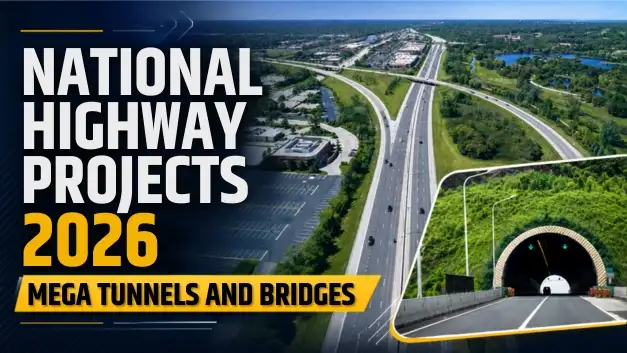
India is experiencing a golden era of civil engineering and infrastructure transformation. Backed by a historic capital expenditure (Capex) allocation of ₹11.21 lakh crore by the Ministry of Road Transport and Highways (MoRTH), the country is actively building complex transit systems at a global scale.
Mega Highway Projects in India: From the high-altitude peaks of the Himalayas to bustling coastal corridors, the National Highways Authority of India (NHAI) is deploying next-generation technology to rewrite logistics timelines. These mega tunnels, access-controlled highways, and record-breaking bridges are fundamentally altering the economic geography of the country.
Mega Tunnels: Conquering Difficult Terrains and Weather Bottlenecks
Building all-weather underground passages through fractured geological formations has become a hallmark of India’s infrastructural prowess.
1. The Mumbai-Pune Expressway “Missing Link” Tunnel
A monumental achievement in tunnel engineering is the recently inaugurated “Missing Link” project on the Mumbai-Pune Expressway. This structure features a tunnel measuring an astonishing 22.33 meters wide, officially breaking a Guinness World Record as the widest road tunnel on Earth. Engineered using the New Austrian Tunnelling Method (NATM), teams clocked over 9 million man-hours drilling through highly fractured basalt rock directly beneath an active lake, ensuring zero damage to the ecologically sensitive Western Ghats.
2. The Zojila Tunnel: Asia’s Longest Bi-Directional Marvel
Further north, construction is progressing rapidly on the Zojila Tunnel in Jammu & Kashmir. Spanning 14.2 kilometers, this mega project stands as Asia’s longest bi-directional tunnel. Located at an altitude of over 11,500 feet, the ₹6,809 crore engineering marvel will establish year-round, seamless all-weather connectivity between Srinagar and Ladakh a route previously cut off for six months every winter due to heavy snowfall. It serves as a vital strategic lifeline for military logistics and local trade.
High-Speed Roads: The Rise of Access-Controlled Expressways
India’s total National Highway network has expanded by over 61% in a single decade, growing past 1,46,500 kilometers. The crown jewel of this expansion is the fivefold increase in access-controlled High-Speed Corridors.
1. The Delhi-Mumbai Expressway
Spanning 1,386 kilometers, the Delhi-Mumbai Expressway is India’s longest and most advanced expressway project. Built with an investment exceeding ₹1.1 lakh crore, it features dedicated fiber-optic corridors, smart automated tolling systems, and wildlife overpasses to facilitate undisturbed animal migration. Once fully integrated, it will slash heavy commercial vehicle travel times from 24 hours down to just 12 hours.
2. The Ganga Expressway
Stretching 594 kilometers across Uttar Pradesh, the Ganga Expressway links Meerut directly to Prayagraj. This massive 6-lane greenfield project, expandable to 8 lanes, is designed to bring industrial growth directly to rural hinterlands, cutting down internal state travel times by half.
Mega Bridges: Engineering Masterpieces Over Swirling Rivers and Oceans
To cleanly bridge vast river networks and marine eco-zones, structural designers are building heavy-duty bridges capable of enduring severe seismic forces.
1. The Gandak River Mega Bridge
Approved via the Public Private Partnership Appraisal Committee (PPPAC), construction is moving swiftly on the 2-lane major bridge across the Gandak River. This engineering asset bridges Manuapul in Bettiah (Bihar) directly to Tiwaripatti in Uttar Pradesh. The bridge utilizes massive pre-stressed concrete girders to withstand immense seasonal water discharge, significantly reducing logistical friction between the two large states.
2. Mumbai Coastal Road Sea Tunnels and Bridges
Phase 1 of the Mumbai Coastal Road showcases India’s first underwater twin tunnels paired with expansive sea-bridge connectors. Costing roughly ₹14,000 crore, the project integrates reclaimed marine land designs with strict environmental safeguards to shave off up to 40% of standard commute times in downtown Mumbai.
Socio-Economic Impact: Reducing Logistics Costs for a Developed India
The underlying goal of this infrastructure push is economic efficiency. Currently, logistics costs in India hover around 13-14% of the national GDP, compared to 8% in advanced Western nations. The target under the comprehensive PM GatiShakti National Master Plan is to lower this cost to under 9%. By linking remote borders via projects like the 1,824 km Frontier Highway in Arunachal Pradesh to key economic centers, India is securing its borders while opening up fresh corridors for domestic trade, real estate development, and massive employment generation.
Also read, Surat Metro Update 2026: Trial Run, Routes, Map & Launch
Watch Latest News Videos on KRH News: Click Here