


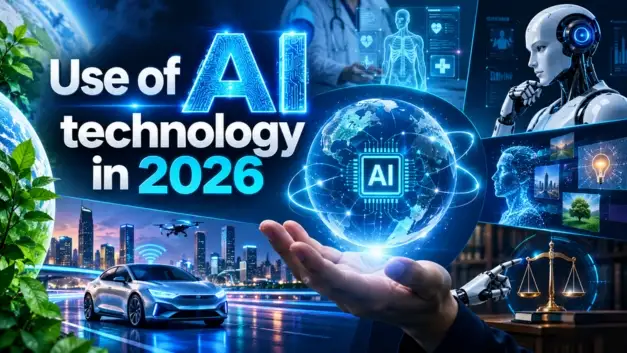
Artificial Intelligence, or AI Technology is no longer a technology we only see in science-fiction movies. In 2026, it is already part of our everyday lives.
We use AI to search for information, write emails, create images, translate languages, study, analyse data and even make business decisions. Behind the convenience, however, lies a much bigger global transformation and a race between countries to control the future of AI.
The story of AI is not just about machines becoming smarter. It is also about how humans are learning to live and work alongside them.
How Did Artificial Intelligence Begin?
The idea of intelligent machines is decades old. In 1950, British mathematician Alan Turing asked whether machines could think. In 1956, researchers at the Dartmouth conference formally introduced the term Artificial Intelligence.
For several decades, AI developed slowly. Computers were limited, data was scarce and processing power was expensive. The situation changed dramatically in the 2010s with the rise of machine learning, deep learning and powerful computing.
Then came a major turning point in 2022, when ChatGPT introduced generative AI to millions of ordinary users. Suddenly, people who had never written a line of code could have a conversation with an AI system.
AI in 2026: No Longer Just a Chatbot
Today’s AI can do much more than answer questions. It can generate text, images, audio and video, write computer code, analyse information, assist doctors, support students and automate business tasks.
The next major step is AI agents – systems designed not only to respond but to complete multiple tasks using software and digital tools. According to Stanford’s 2026 AI Index, global corporate AI investment reached $581.7 billion in 2025, showing how quickly businesses are moving toward AI adoption.
Which Countries Are Leading the AI Race?
The global AI competition is becoming one of the biggest technology stories of the decade.
United States
The US remains a dominant AI power, with companies such as OpenAI, Google, Microsoft, Meta and Anthropic investing heavily in AI models, chips and data centres.
China
China is the biggest strategic challenger to the US. Companies such as DeepSeek and Alibaba are rapidly developing competitive AI systems, while China is also investing heavily in chips, robotics and autonomous technologies.
Europe
Europe is taking a different approach, focusing strongly on AI regulation, safety and transparency through the EU AI Act.
India
India has enormous potential because of its technology workforce, huge digital population and diverse languages. The government’s IndiaAI Mission is focused on building India’s AI ecosystem, including computing infrastructure and indigenous AI models.
In 2026, India also hosted the India-AI Impact Summit, bringing global attention to India’s ambition to become an important AI player.
Why India’s AI Journey Matters
India’s AI story could be particularly important. Imagine an AI system that can understand not only English but Hindi, Gujarati, Tamil, Bengali, Marathi and other Indian languages. That could bring advanced digital services to millions of people who may currently struggle to access technology in English.
India is therefore trying to move from simply using AI created elsewhere to building AI for India and the world. But India also faces challenges, particularly access to advanced computing infrastructure, chips and large-scale AI investment.
The Positive Side of AI
AI has the potential to improve everyday life in many ways.
- Healthcare: AI can assist doctors in analysing medical images and medical data.
- Education: Students can use AI as a personalised learning assistant.
- Agriculture: AI can support farmers with weather, crop and irrigation information.
- Business: Small businesses can use AI for marketing, customer service, research and data analysis.
- Accessibility: Speech-to-text, translation and image recognition can make technology easier to use for people with disabilities.
- For a small business owner or a student working from a laptop, AI can provide capabilities that once required an entire team.
That is perhaps the most exciting part of the AI revolution – technology is becoming accessible to more people.
But AI Has a Dark Side
The same technology can also create serious problems.
Jobs
AI can automate repetitive tasks, creating concerns about job displacement. Some jobs may shrink, while completely new roles are likely to emerge.
Deepfakes
AI can create realistic fake images, voices and videos, making misinformation much easier to produce.
Cybersecurity
AI can help security teams defend networks, but criminals can also use AI to develop more sophisticated cyberattacks.
Privacy
AI systems can process enormous amounts of information, raising important questions about personal data and privacy.
Wrong Information
Generative AI can sometimes provide convincing but incorrect answers. Human verification remains essential, particularly for important decisions.
The AI War: US vs China
The phrase “AI war” increasingly describes the strategic competition between the United States and China.
The competition is not only about chatbots.
It involves:
- Advanced computer chips
- Data centres
- AI models
- Research talent
- Robotics
- Cybersecurity
- Defence technology
- Investment
- Global technology standards
Recent analysis shows that Chinese AI companies have been rapidly narrowing parts of the gap with US technology. This makes AI more than a business competition.
It is becoming a competition for economic and strategic influence.
What Will AI Look Like in the Future?
The next few years could bring even bigger changes. AI agents may manage complicated digital tasks. Robots could become more capable of working in factories, warehouses and homes. Healthcare AI may become a regular part of medical systems. Personal AI assistants could eventually understand our schedules, preferences and daily work much more deeply.
But one question will remain:
“How much should we allow machines to decide for us?” That question may become more important than how intelligent AI becomes.
Will AI Replace Humans?
AI will certainly replace some tasks. But it may not replace humans in the simple way many people fear.
A doctor may use AI rather than be replaced by it. A teacher may use AI to personalise learning. A journalist may use AI for research while still conducting interviews and making editorial decisions.
The future may increasingly be:
“Human + AI, rather than Human vs AI”. The people who learn how to use AI effectively may have an advantage over those who completely ignore it.
The Human Side of AI
Behind all the discussions about billions of dollars, powerful computers and global competition are ordinary people.
- A student wants help understanding a difficult subject.
- A small entrepreneur wants to compete with a bigger company.
- A farmer wants better information about crops.
For them, AI is not a geopolitical race. It is a tool that can potentially make life a little easier.
At the same time, another person may be wondering whether AI will take away their job. Both sides are real. That is why the future of AI should not only be about building smarter machines. It should also be about making sure people are prepared for the changes those machines bring.
Conclusion
From Alan Turing’s questions in the 1950s to generative AI in 2026, artificial intelligence has travelled an extraordinary distance. Today, countries are competing to lead the AI revolution, businesses are investing billions and India is building its own AI ecosystem. AI can improve healthcare, education, business and scientific research. But it can also create misinformation, privacy problems, cybersecurity threats and employment challenges.
The biggest question is therefore not “Will AI change the world?”
It already is.
The real question is:
Will humans use AI simply to make machines more powerful or to make human life better?
The answer will depend on the choices we make today.
Watch Latest News Videos on KRH News: Click Here